Will we see you there?
RSVP by email, at the event's Facebook page, or in a comment on the event page -- full names, please, so we know which Jane or Joe has responded, and how many people and dogs you are bringing. We need to know how many people are coming so we can thaw enough chickens! We need to know how many dogs so we can brag about it.
I'll have a schedule and maps up later this week, as well as a guide on local attractions, services, and eats. Hotel and campground information is already on the event page.
I've started a chipin to cover the costs of renting the park and community center, agility equipment, charcoal, supplies, beverages, etc. Anything collected above expenses will be split between National English Shepherd Rescue and the English Shepherd Club Health and Genetics committee.
The door prize will be a Brandywine Farm Basket o' Noms. The prize winner will determine the specific contents depending of individual preference and whether the items will be shipped, and how far. It may include a selection of eggs, cheese, home-canned goods, frozen chicken, rabbit, guinea fowl. We can even devise a basket for a vegan, if you like marinara and jam and salad dressing. You do not need to be present to win. You don't even have to come to the gathering.
You can buy door prize tickets at the event, too, but this way it's out of the way and you can just relax and enjoy the gathering -- and we've got the lettuce to pay for the hall and the supplies up-front.
Showing posts with label dog breeds. Show all posts
Showing posts with label dog breeds. Show all posts
Tuesday, May 17, 2011


Sunday, March 6, 2011
Just the basics: How to read a pedigree
I was trying to refer a puppy-seeker to some basic online information that explains how to read a pedigree chart, and was shocked to find that, while there are many sites out there that have complicated and pretty complete information on how to interpret the titles and abbreviations in a dog pedigree, there are none that do a clear job of the simplest principles. They all assume a knowledge base that most people who are not involved with animal breeding or genealogical research do not have.
One essential thing that many puppy-buyers don't understand is that a pedigree is not the same as registration papers. Every higher animal on the planet has a pedigree, whether or not it was ever written down or recorded -- it is just a chart that tells us who an animals' ancestors are. Registration papers may or may not come with a pedigree, and just show that an individual animal is recorded with a specific registry and (usually) that it is considered "purebred." Registration papers are often used as proof of ownership.
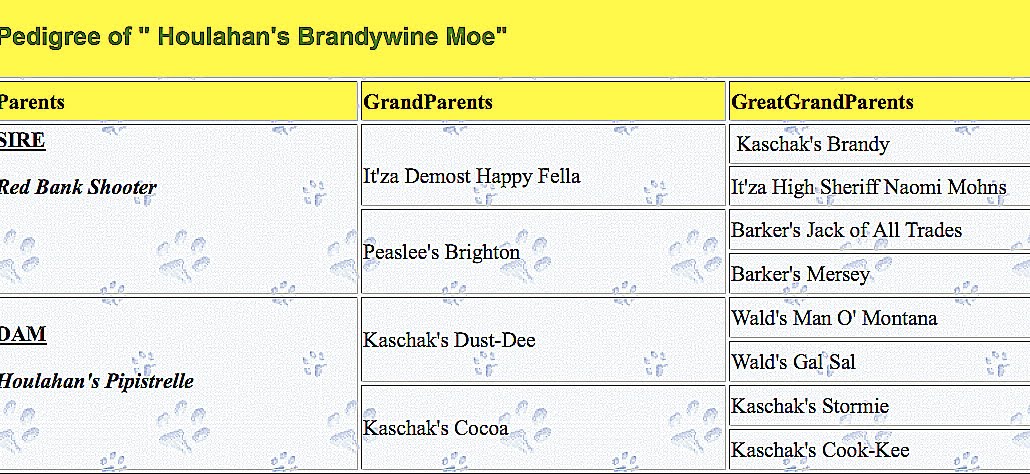
Let's start with a very simple pedigree chart:

Click to embiggen. Control-click (most browsers) to pop up a larger version in a new tab.
This is a copy of the three-generation pedigree for one of my own dogs, Moe. It is formatted by a free online dog breeders' website, but this does not matter. The pedigree is just information about the dog's ancestry, and a handwritten one on lined notebook paper would be laid out just the same and could have the same information on it. I entered the names into the form myself. The basic information that every pedigree must have (or it's not a pedigree) is the names of the animal's ancestors in a form that shows the relationships. (That counts for human animals, too.) Livestock animals might have a number rather than a name.
The pedigree reads from left to right. The name of the animal whose pedigree it is (let's call him Bubba) is either to the far left, or, as in this case, above the chart of ancestors. That saves horizontal space on the printed page. If this is a registered animal, this will usually be his or her registered name.
There will be two names in the far left column or the next column to the right if Bubba's name and info takes up the far left . The sire's (father's) name will be above, and the dam's (mother's) name will be below. The convention is always the male parent directly above the female parent. Moe's father is Shooter and his mother is Pipistrelle.
Then in the next column, you will see four names. The two above center line are the paternal grandparents -- Moe's father's father and mother. The two below center line are the maternal grandparents -- Moe's mother's father and mother.
Moe's paternal grandparents are "It'za Demost Happy Fella" and Brighton. His maternal grandparents are Dust-Dee and Cocoa.
This brings up a point that often confuses people looking at pedigrees. In many breeds the dog's registered name bears no resemblance to the name that people who know the dog will refer to him by. Often there is a kind of embedded "code" that is decipherable to insiders, including the breeder's kennel name and sly references to his ancestry. Strange spelling and punctuation is common. "It'za Demost Happy Fella" was called Chaz. I only know this because I've been told -- you can't derive it or guess it from the registered name. His owner followed the show-dog convention of using a very convoluted string of words to "name" her dog. Her kennel name was "It'za." As you can see, the owners of Moe's other ancestors followed the English shepherd owners' convention of fairly simple* registered names that are the same as, contain, or are similar to the dog's "call" name. Red Bank Shooter is called Shooter, and his owner's kennel and farm name is Red Bank. Houlahan's Pipistrelle is called Pip, and her owner is me, Heather Houlahan. My kennel and farm name is Brandywine. I didn't breed Pip, so she doesn't carry my kennel name.
In the third column, you will see eight names -- Moe's great-grandparents, all laid out so that you can see which grandparent each pair produced.
I've used a three-generation pedigree here so that it is easy to read and uncluttered.
The standard number of generations for a dog pedigree that is provided when you buy a puppy is generally five -- up to the great-great-great grandparents. That also happens to be the most extensive pedigree that can generally fit on a single sheet of paper (usually legal-sized) in readable type if you put Bubba's name above the "crane's foot"** of ancestors. Breeders who are researching their dogs' genetics will use spreadsheets or online databases to go back many more generations than can be fit on a sheet of paper. Some registries or services will sell up to an eight-generation pedigree printed on really big paper.
Now, let's get onto intermediate pedigree-reading. You can bail here if you found out what you need to know about reading a basic pedigree.
Here's a screen shot of the "top half" of Moe's five-generation pedigree as it is displayed by the English Shepherd Club Registry's database. When we talk about the "top half" of a pedigree, we mean the animal's sire's pedigree. Right now we are looking at Moe's father and his ancestors -- his mother and her ancestors are the "bottom half" of the pedigree. So we are really looking at Shooter's four-generation pedigree.
 This is the "bottom half" -- Pip's four-generation pedigree.

Together they make Moe's five-generation pedigree. There are a lot of bells and whistles on this pedigree chart. You can see registration numbers, birthdates, colors, health information, owners' and breeders' names. I could configure it differently and get photos, where available, of three generations of ancestors. You won't get that level of detail on most pedigree charts from other registries, or most handwritten or home-produced pedigrees from breeders. You'll see that as you go further back in the generations, there is less information provided for each dog. This is necessary in order to fit all the names on a page.
Having a lot of information right on the pedigree chart is very useful when you don't personally know the animals. What a person or registry chooses to put on a pedigree tells you something about their priorities. This ESCR pedigree includes hip-health information, because hip dysplasia is a genetic health problem in our breed. If an owner didn't check his dog's hips or won't publish the results, that raises suspicions. If the hip information was good or bad and the owner published it, that gives important information about that dog that can help someone make buying and breeding decisions down the road. The rest of the information is mostly to help people identify the dog precisely (registration numbers) or find out more (owner and breeder information).
An AKC pedigree will include any show championships that the dogs have won. Show-ring wins are important to the AKC. The English Shepherd Club does not think that show-ring results tell us anything about the quality of the dog, so those will not ever appear on an ESCR pedigree. If a breeder is generating her own pedigree charts by hand or computer, she may include more information than a list of names; what she chooses to include may tell you about her priorities.
In order to read you will have to click to embiggen. Control-click to open in a new tab (on most browsers). But you might want to print them out on two pages and follow along.
A five-generation pedigree includes slots for sixty-two ancestors -- two in generation one, four in generation two, eight in generation three, sixteen in generation four, thirty-two in generation five.
However, it would be highly unusual for a purebred or purpose-bred dog's five generation pedigree to have sixty-two unique names in it. There will be repeats.
If a dog's name is repeated on both top and bottom of the pedigree, then Bubba is inbred on that dog.
If you look only at Moe's three-generation pedigree, at top, you would conclude that Moe is not inbred at all. All of his grandparents and great-grandparents are unique individuals, with no names repeated. His parents and grandparents were not cousins.
But if you look closely at Moe's five-generation pedigree, you will see that Kaschak's Brandy is both his paternal great-grandfather and his maternal great-great grandfather. Moe is inbred on Brandy in generations three and four. This is not very inbred by purebred dog standards.
He is also inbred on Butcher's Sam Odie, who occurs twice (top and bottom) in generation five. Again, this is pretty far back. It statistically makes Sam Odie the equivalent of a great-great grandfather, or 1/16th of Moe's genome -- 6.25%. By contrast, Moe is (statistically) 18.75% Kaschak's Brandy. Knowing something about Brandy -- his health, appearance, and behavior -- is much more likely to tell us about Moe than will knowing the same things about Sam Odie.
If a dog occurs multiple times only on the "top" (father's pedigree) or only on the "bottom" (mother's pedigree) then Bubba is not inbred on that dog -- the parent whose pedigree includes that repeat may be, but Bubba is not.
Moe's paternal great-grandmother Naomi is very inbred on Mohn's Boodie -- he is both of her grandfathers -- in other words, her parents were half-siblings. But Naomi's son Chaz (the guy with the long unpronounceable name) is not inbred on Boodie (as far as we can see from this pedigree) because his father, Kaschak's Brandy, does not have Boodie as an ancestor. Moe is not inbred on Boodie (as far as we can see from this pedigree) because Boodie does not appear in his mother's pedigree.
I hope that has been helpful information about how to read a basic pedigree chart. I've used a dog's pedigree here because that is the species I know best. An animal's detailed pedigree can be like a Russian novel for someone who is an expert in the specific breed. It takes many years of living with and learning widely about a breed of dog, horse, cow, etc. for a printed pedigree to easily give up its information that way. But a beginner can at least look at a five generation pedigree and get a sense for whether the animal was very inbred (as was Naomi) and question why. You can try to find the owners of the animal's parents and grandparents and find out more about them, such as their health and what kind of temperaments they have or had.
A pedigree can be a full of mistakes or frank lies. This is true of an official-looking printed pedigree certificate with gold-filigree borders as much as it is of a hand-scrawled pedigree on a brown paper bag. A breeder may not know that his bitch was bred by a different dog than the one he listed in the pedigree -- maybe the sneaky neighbor dog got in, or the stud dog's owner was careless in the kennel or dishonest. A breeder may lie about paternity or even maternity. Puppymillers use registration papers fraudulently, so a registry pedigree on a puppymill purchase is likely to be complete fiction. Most dog registry organizations can't or don't check the DNA for most litters, and there are even ways to get around those for the devotedly dishonest. An old mistake or lie is impossible to check. And both individuals and registries can introduce clerical errors; I have one pedigree that was produced and sold by the United Kennel Club in which a dog is listed as his own father (same registration number and all). Most pedigrees are probably mostly accurate, but it is important to note that they are just information that is reported and recorded by fallible human beings. If you can't trust the honesty or the competence of the people who provided the information, then you can't trust the pedigree to give you information about your animal.
_______________________
*Sometimes too simple. When the dog's full registered name is simply "Max," there is a high probability that there are going to be more of them. The common practice of using the owner's surname and the dog's simple name is better, but there turns out to be a bunch of Smiths, Wilsons, Thomases, Johnsons, etc. Sometimes this creates a great deal of confusion.
** The English word "pedigree" derives from Old French "pied de gru" or "crane's foot." This refers to the way the chart branches, literally looking like the foot or footprint of a bird. Pretty cool!
One essential thing that many puppy-buyers don't understand is that a pedigree is not the same as registration papers. Every higher animal on the planet has a pedigree, whether or not it was ever written down or recorded -- it is just a chart that tells us who an animals' ancestors are. Registration papers may or may not come with a pedigree, and just show that an individual animal is recorded with a specific registry and (usually) that it is considered "purebred." Registration papers are often used as proof of ownership.
Let's start with a very simple pedigree chart:
Click to embiggen. Control-click (most browsers) to pop up a larger version in a new tab.
This is a copy of the three-generation pedigree for one of my own dogs, Moe. It is formatted by a free online dog breeders' website, but this does not matter. The pedigree is just information about the dog's ancestry, and a handwritten one on lined notebook paper would be laid out just the same and could have the same information on it. I entered the names into the form myself. The basic information that every pedigree must have (or it's not a pedigree) is the names of the animal's ancestors in a form that shows the relationships. (That counts for human animals, too.) Livestock animals might have a number rather than a name.
The pedigree reads from left to right. The name of the animal whose pedigree it is (let's call him Bubba) is either to the far left, or, as in this case, above the chart of ancestors. That saves horizontal space on the printed page. If this is a registered animal, this will usually be his or her registered name.
There will be two names in the far left column or the next column to the right if Bubba's name and info takes up the far left . The sire's (father's) name will be above, and the dam's (mother's) name will be below. The convention is always the male parent directly above the female parent. Moe's father is Shooter and his mother is Pipistrelle.
Then in the next column, you will see four names. The two above center line are the paternal grandparents -- Moe's father's father and mother. The two below center line are the maternal grandparents -- Moe's mother's father and mother.
Moe's paternal grandparents are "It'za Demost Happy Fella" and Brighton. His maternal grandparents are Dust-Dee and Cocoa.
This brings up a point that often confuses people looking at pedigrees. In many breeds the dog's registered name bears no resemblance to the name that people who know the dog will refer to him by. Often there is a kind of embedded "code" that is decipherable to insiders, including the breeder's kennel name and sly references to his ancestry. Strange spelling and punctuation is common. "It'za Demost Happy Fella" was called Chaz. I only know this because I've been told -- you can't derive it or guess it from the registered name. His owner followed the show-dog convention of using a very convoluted string of words to "name" her dog. Her kennel name was "It'za." As you can see, the owners of Moe's other ancestors followed the English shepherd owners' convention of fairly simple* registered names that are the same as, contain, or are similar to the dog's "call" name. Red Bank Shooter is called Shooter, and his owner's kennel and farm name is Red Bank. Houlahan's Pipistrelle is called Pip, and her owner is me, Heather Houlahan. My kennel and farm name is Brandywine. I didn't breed Pip, so she doesn't carry my kennel name.
In the third column, you will see eight names -- Moe's great-grandparents, all laid out so that you can see which grandparent each pair produced.
I've used a three-generation pedigree here so that it is easy to read and uncluttered.
The standard number of generations for a dog pedigree that is provided when you buy a puppy is generally five -- up to the great-great-great grandparents. That also happens to be the most extensive pedigree that can generally fit on a single sheet of paper (usually legal-sized) in readable type if you put Bubba's name above the "crane's foot"** of ancestors. Breeders who are researching their dogs' genetics will use spreadsheets or online databases to go back many more generations than can be fit on a sheet of paper. Some registries or services will sell up to an eight-generation pedigree printed on really big paper.
Now, let's get onto intermediate pedigree-reading. You can bail here if you found out what you need to know about reading a basic pedigree.
Here's a screen shot of the "top half" of Moe's five-generation pedigree as it is displayed by the English Shepherd Club Registry's database. When we talk about the "top half" of a pedigree, we mean the animal's sire's pedigree. Right now we are looking at Moe's father and his ancestors -- his mother and her ancestors are the "bottom half" of the pedigree. So we are really looking at Shooter's four-generation pedigree.
 This is the "bottom half" -- Pip's four-generation pedigree.
Together they make Moe's five-generation pedigree. There are a lot of bells and whistles on this pedigree chart. You can see registration numbers, birthdates, colors, health information, owners' and breeders' names. I could configure it differently and get photos, where available, of three generations of ancestors. You won't get that level of detail on most pedigree charts from other registries, or most handwritten or home-produced pedigrees from breeders. You'll see that as you go further back in the generations, there is less information provided for each dog. This is necessary in order to fit all the names on a page.
Having a lot of information right on the pedigree chart is very useful when you don't personally know the animals. What a person or registry chooses to put on a pedigree tells you something about their priorities. This ESCR pedigree includes hip-health information, because hip dysplasia is a genetic health problem in our breed. If an owner didn't check his dog's hips or won't publish the results, that raises suspicions. If the hip information was good or bad and the owner published it, that gives important information about that dog that can help someone make buying and breeding decisions down the road. The rest of the information is mostly to help people identify the dog precisely (registration numbers) or find out more (owner and breeder information).
An AKC pedigree will include any show championships that the dogs have won. Show-ring wins are important to the AKC. The English Shepherd Club does not think that show-ring results tell us anything about the quality of the dog, so those will not ever appear on an ESCR pedigree. If a breeder is generating her own pedigree charts by hand or computer, she may include more information than a list of names; what she chooses to include may tell you about her priorities.
In order to read you will have to click to embiggen. Control-click to open in a new tab (on most browsers). But you might want to print them out on two pages and follow along.
A five-generation pedigree includes slots for sixty-two ancestors -- two in generation one, four in generation two, eight in generation three, sixteen in generation four, thirty-two in generation five.
However, it would be highly unusual for a purebred or purpose-bred dog's five generation pedigree to have sixty-two unique names in it. There will be repeats.
If a dog's name is repeated on both top and bottom of the pedigree, then Bubba is inbred on that dog.
If you look only at Moe's three-generation pedigree, at top, you would conclude that Moe is not inbred at all. All of his grandparents and great-grandparents are unique individuals, with no names repeated. His parents and grandparents were not cousins.
But if you look closely at Moe's five-generation pedigree, you will see that Kaschak's Brandy is both his paternal great-grandfather and his maternal great-great grandfather. Moe is inbred on Brandy in generations three and four. This is not very inbred by purebred dog standards.
He is also inbred on Butcher's Sam Odie, who occurs twice (top and bottom) in generation five. Again, this is pretty far back. It statistically makes Sam Odie the equivalent of a great-great grandfather, or 1/16th of Moe's genome -- 6.25%. By contrast, Moe is (statistically) 18.75% Kaschak's Brandy. Knowing something about Brandy -- his health, appearance, and behavior -- is much more likely to tell us about Moe than will knowing the same things about Sam Odie.
If a dog occurs multiple times only on the "top" (father's pedigree) or only on the "bottom" (mother's pedigree) then Bubba is not inbred on that dog -- the parent whose pedigree includes that repeat may be, but Bubba is not.
Moe's paternal great-grandmother Naomi is very inbred on Mohn's Boodie -- he is both of her grandfathers -- in other words, her parents were half-siblings. But Naomi's son Chaz (the guy with the long unpronounceable name) is not inbred on Boodie (as far as we can see from this pedigree) because his father, Kaschak's Brandy, does not have Boodie as an ancestor. Moe is not inbred on Boodie (as far as we can see from this pedigree) because Boodie does not appear in his mother's pedigree.
I hope that has been helpful information about how to read a basic pedigree chart. I've used a dog's pedigree here because that is the species I know best. An animal's detailed pedigree can be like a Russian novel for someone who is an expert in the specific breed. It takes many years of living with and learning widely about a breed of dog, horse, cow, etc. for a printed pedigree to easily give up its information that way. But a beginner can at least look at a five generation pedigree and get a sense for whether the animal was very inbred (as was Naomi) and question why. You can try to find the owners of the animal's parents and grandparents and find out more about them, such as their health and what kind of temperaments they have or had.
A pedigree can be a full of mistakes or frank lies. This is true of an official-looking printed pedigree certificate with gold-filigree borders as much as it is of a hand-scrawled pedigree on a brown paper bag. A breeder may not know that his bitch was bred by a different dog than the one he listed in the pedigree -- maybe the sneaky neighbor dog got in, or the stud dog's owner was careless in the kennel or dishonest. A breeder may lie about paternity or even maternity. Puppymillers use registration papers fraudulently, so a registry pedigree on a puppymill purchase is likely to be complete fiction. Most dog registry organizations can't or don't check the DNA for most litters, and there are even ways to get around those for the devotedly dishonest. An old mistake or lie is impossible to check. And both individuals and registries can introduce clerical errors; I have one pedigree that was produced and sold by the United Kennel Club in which a dog is listed as his own father (same registration number and all). Most pedigrees are probably mostly accurate, but it is important to note that they are just information that is reported and recorded by fallible human beings. If you can't trust the honesty or the competence of the people who provided the information, then you can't trust the pedigree to give you information about your animal.
_______________________
*Sometimes too simple. When the dog's full registered name is simply "Max," there is a high probability that there are going to be more of them. The common practice of using the owner's surname and the dog's simple name is better, but there turns out to be a bunch of Smiths, Wilsons, Thomases, Johnsons, etc. Sometimes this creates a great deal of confusion.
** The English word "pedigree" derives from Old French "pied de gru" or "crane's foot." This refers to the way the chart branches, literally looking like the foot or footprint of a bird. Pretty cool!

Saturday, December 11, 2010
News from English Shepherd Land
English Shepherd Club
The 2011 English Shepherd calendar is available from the English Shepherd Club for $14 (ESC members) or $17 (non-members). Order here. Volume discounts available.
This gorgeous calendar features ES from around the world, including many of our beloved rescue ES. It is a major fundraiser for the ESC, a 501(c)3 non-profit incorporated for the conservation of the English shepherd dog as a heritage agricultural resource.
While you're there, now is the time to renew your membership for 2011, or apply for membership if you are not already one. (Join now and get the member price on your calendars.)
NESR
The National English Shepherd Rescue 2010 cookbook is also on sale. Shepherds in the Kitchen: 483 Recipes to the Rescue is available for $20 here.

Yep, almost five hundred recipes for $20 -- about four cents a recipe. Hell, it costs me that much to print one out. And it's the only way you are going to get my chili recipe, or my famous marinara.
While you are on the order page, check out the other items that benefit NESR's work rescuing and rehoming English shepherds in need -- jewelry, decals, and the great martingale collars with side-release clips (hard-to-find item!) made by the vendor who supplied them for the ONB dogs. And visit the NESR Cafe Press shop.
Mark Your New ESC 2011 Calendar

June 11-12, 2011 will be the first Brandywine Farm English Shepherd Gathering in Harmony, PA (16037).
What's a Gathering?
Two days of education, fun, food, networking, socializing, and celebration of (and with) the dogs we love.
I've been to Gatherings in Ohio, North Carolina, Ontario, Montana and California. Each one was different, each had activities tailored to the venue. The larger gatherings attracted ES and their humans from all over North America.
At Brandywine Farm, we are fortunate to be able to rent the township park and community center that abuts our hayfield -- giving us the entire farm, plus the community center's historic schoolhouse (with kitchen and bathrooms), picnic pavilion, baseball field, playground, and parking.
Activities planned include CGC testing, a SAR demonstration, agility, a silent auction to benefit NESR, lectures on breed history and conservation, obedience fun drills, and, if we have the fencing and stock squared away by then, a stockwork clinic. (I've already ordered new ducks for the occasion; we're working on the sheep.)
There will be two days of potluck picnicking, and a barbeque of Brandywine Farm pastured Freedom Ranger chicken. As those who are wise enough to order the NESR cookbook will soon discern, English shepherd people take their cooking seriously. I generally waddle away from Gathering potlucks with a smile on my face.
You can come for one or both days.
There are a variety of camping and dog-friendly motel accommodations nearby.
You do not need to own an English shepherd to come. The ES community is a friendly crowd, and we welcome friends of the breed, the curious, and all who have an interest in conserving heritage breeds. No one will check your dog's pedigree at the door, and all well-behaved dogs are welcomed.
If you have a Facebook account, you can RSVP or keep up on developments at the Brandywine Farm Gathering's FB page. I'll be adding a page to this blog with schedule and particulars as they develop.
The 2011 English Shepherd calendar is available from the English Shepherd Club for $14 (ESC members) or $17 (non-members). Order here. Volume discounts available.
This gorgeous calendar features ES from around the world, including many of our beloved rescue ES. It is a major fundraiser for the ESC, a 501(c)3 non-profit incorporated for the conservation of the English shepherd dog as a heritage agricultural resource.
While you're there, now is the time to renew your membership for 2011, or apply for membership if you are not already one. (Join now and get the member price on your calendars.)
NESR
The National English Shepherd Rescue 2010 cookbook is also on sale. Shepherds in the Kitchen: 483 Recipes to the Rescue is available for $20 here.

Yep, almost five hundred recipes for $20 -- about four cents a recipe. Hell, it costs me that much to print one out. And it's the only way you are going to get my chili recipe, or my famous marinara.
While you are on the order page, check out the other items that benefit NESR's work rescuing and rehoming English shepherds in need -- jewelry, decals, and the great martingale collars with side-release clips (hard-to-find item!) made by the vendor who supplied them for the ONB dogs. And visit the NESR Cafe Press shop.
Mark Your New ESC 2011 Calendar

Please come!
June 11-12, 2011 will be the first Brandywine Farm English Shepherd Gathering in Harmony, PA (16037).
What's a Gathering?
Two days of education, fun, food, networking, socializing, and celebration of (and with) the dogs we love.
I've been to Gatherings in Ohio, North Carolina, Ontario, Montana and California. Each one was different, each had activities tailored to the venue. The larger gatherings attracted ES and their humans from all over North America.
At Brandywine Farm, we are fortunate to be able to rent the township park and community center that abuts our hayfield -- giving us the entire farm, plus the community center's historic schoolhouse (with kitchen and bathrooms), picnic pavilion, baseball field, playground, and parking.
Activities planned include CGC testing, a SAR demonstration, agility, a silent auction to benefit NESR, lectures on breed history and conservation, obedience fun drills, and, if we have the fencing and stock squared away by then, a stockwork clinic. (I've already ordered new ducks for the occasion; we're working on the sheep.)
There will be two days of potluck picnicking, and a barbeque of Brandywine Farm pastured Freedom Ranger chicken. As those who are wise enough to order the NESR cookbook will soon discern, English shepherd people take their cooking seriously. I generally waddle away from Gathering potlucks with a smile on my face.
You can come for one or both days.
There are a variety of camping and dog-friendly motel accommodations nearby.
You do not need to own an English shepherd to come. The ES community is a friendly crowd, and we welcome friends of the breed, the curious, and all who have an interest in conserving heritage breeds. No one will check your dog's pedigree at the door, and all well-behaved dogs are welcomed.
If you have a Facebook account, you can RSVP or keep up on developments at the Brandywine Farm Gathering's FB page. I'll be adding a page to this blog with schedule and particulars as they develop.
Sunday, October 17, 2010
Gestalt
A conversation is not the sum of its syllables.
Rottweiler owners are fond of telling those who (they presume) don't know the breed that Rotties like to "talk."
He's not growling, he's just talking.
Thing is, many Rottweilers (and some other dogs) do have a growly vocalization that is not meant to be agonistic. It is rather charming.
People who are primed to skid their knickers in the mere presence of Satan's draught dogs are difficult to convince. Even most dog lovers and, in my experience, many dogs, can misinterpret these chest-rumbling soliloquies as a statement of most sincere ill-intention.
It gives me a little start every time a dog first does it around me, just like I do a double-take when one offers me a toothy greeting grin.
The submissive or happy grinning dog is quickly distinguishable from the angry snarler.
The "talking" dog is not always so clear.
Trouble is, another thing about Rottweilers is that they also growl. Sometimes a lot. Sometimes at their owners and their owners' friends and family. The growl frequently means something such as "You want the La-Z-Boy? Try me," or "Nail trim. Yeah, I don't think so."
Rottweilers are one of the very few breeds in which a large proportion of individuals can fairly be characterized as highly dominant animals*, dogs who actually want to take over the household and run it, sometimes even when the owner is quite competent.
Most dogs are happiest -- and know they are happiest -- if a credible human handles all the important decisions. "Dominance" challenges are either garden-variety adolescent experimentation or a desperate gambit to take the empty controls of a plane that the dog perceives as plummeting into the side of Mount Doom.
But there are exceptions, and a lot of those exceptions are Rottweilers. The breed supplies a disproportionate number of those truly dominant-aggressive dogs, as well as territorial-aggressive dogs, resource-guarders, and standoffish animals with a well-developed sense of personal space.
The fact that the dog has not bitten anyone yet is not prima facie evidence that he is not growling. When a Rottweiler -- or any dog -- is making a low rumbly sound in its chest, one has to look at the entire gestalt before determining, even provisionally, that the dog is either "talking" or "growling."
First, the circumstances -- the dog who rumbles like a gravel truck when told to get off the couch may be talking, but what he's saying is unprintable, and sooner or later he's highly likely to back up the threats. The dog who makes the same sound while writhing on his back in the grass getting his chest scratched is saying something else entirely -- possibly also unprintable, but only because this is a puritanical culture that frowns on pleasure.
But far more important, the whole picture of the dog's communication -- eyes, ears, eyebrows, lips. Butt and tail**. Muscle tension in neck, legs, and torso. Breathing. Looseness v. tightness. Skin tension and hackling. Not one little pieces-part, and not an imaginary sum of the pieces-parts -- the whole damned dog. How it all hangs together. It's nice to be able to name the parts and their positions, but no more practical than diagramming a diplomat's sentences to discern whether his country is about to declare war.
Those in the thrall of the Dunning-Kruger Effect focus on one thing, some body-language shibboleth that they imagine is the secret decoder ring for what a dog says or means.
We all know the classic, man on the street with some suprise body-perforations who claims, "But he looked friendly! His tail was wagging!"
Worse are those whose cynological expertise would move them to mock that poor civilian who thought the "cute" Akita's slowly-waving vertical tail was a friendly wag. They volunteer at the shelter. They've studied a chart. And doG help us, they've gone to a workshop (or better yet, watched a video of a workshop) in which a presenter attempts to teach them to "see" a dog's communications.
Even the best instructor can only do so much. Most of the students will walk away with a half-understanding of two or three canine field marks; if they retain one for more than a week, it is noteworthy. The rest will latch onto one or two insider buzzwords that become increasingly all-purpose and divorced from anything a dog is actually saying. Because the inexpert student is looking for a one-to-one babelfish dog-English translation, he refuses to consider that a dog, like any sentient creature, may experience ambivalence, threaten and not deliver, change his mind, hide his intentions, use misdirection, or speak gibberish. But he's proud of his insider knowledge, and takes it to the streets.
A few weeks ago, my teammate Rebecca was the recipient of much helpful advice about her young, enormous, steady, good-natured dog's temperament and behavior, from students who had just finished one such seminar. We now know that Cinders is "reactive" (he looked at another dog when it was disorderly) and that he is "trying to be the boss." (Still pulls on the leash a bit when he's not on a training collar and is very excited about working.)
 Dominant Cinders reacting.
As Rebecca -- I love her, she's so diplomatic -- said, after I regaled the room† with my impression of Cinders trying to be the boss, "Everyone here is so friendly! And they all want to share what they know, whether or not it's right."
Combine such shallow "expertise" with a pig-headed commitment to interpret a dog's behavior as a "special" -- generally a breed-specific "specialness" -- and the sum can be a spectacular failure of common sense.
Consider two Rottweilers that, according to their owners, "purr," another term that rottie owners will apply to their dogs' actual or imagined "talking."
No cheating now. View each clip first with your speakers muted.
First this one:
And then this one:
Edit: Sorry folks. The person who posted video #2 has designated it "private." I don't think it was my readers, who are far too classy to harass a stranger on YouTube; it has been zipping around Facebook for a little while now, and I am guessing that some of the attention it was getting was not what the poster had in mind. It's also certainly possible that there was, shall we say, an "outcome" involving this dog that makes this video seem like not such a good idea in retrospect.
Disclaimer: I don't know either of these dogs, or the women shown with them. I don't know their histories, or what either of them might or might not have done since the videos were recorded and posted.
Questions:
Are both dogs happy? Are both dogs enjoying the hugging and handling? Is either woman in any danger of being bitten, either immediately or at some future time? What do you see as the differences, if any, in what the dogs are communicating?
Now watch the clips with the sound on. Does it change your opinion?
Is either dog's non-vocal gestalt at odds with his vocalization? Or does the vocalization mean something different depending on the silent communication that accompanies it?
What would it take for you to believe a stranger when he tells you that his dog is "just talking" or "purring?"
_________________
* I am well aware that the latest fad among the Clinique Calls That Burning set is to declare that (mix 'n' match):
There is no such thing as a canine dominance hierarchy because dogs aren't cooperative hunters / dogs aren't even predators / packs are families, and everyone knows that non-pack predators / families don't have vertical development in their social structures / don't have social structures at all, and that therefore there is no such thing as a dominant dog, and also, dominance is not a temperament / character / personality trait so ipso facto no animal can have more or less of a predisposition towards social climbing, it's all the same, like minnows in a giant school, or slime molds. And also, anyone who says otherwise is a dog abuser. He kicked that dog! There, in the slow motion replay, see that, didn't you see it, that was a kick!
I don't care.
** Yeah, this is more difficult to assess when you have cut off the dog's fucking tail.
† The audience consisted of Rebecca and three dogs, mind you, but it was the crowd most qualified to appreciate the irony.
Rottweiler owners are fond of telling those who (they presume) don't know the breed that Rotties like to "talk."
He's not growling, he's just talking.
Thing is, many Rottweilers (and some other dogs) do have a growly vocalization that is not meant to be agonistic. It is rather charming.
People who are primed to skid their knickers in the mere presence of Satan's draught dogs are difficult to convince. Even most dog lovers and, in my experience, many dogs, can misinterpret these chest-rumbling soliloquies as a statement of most sincere ill-intention.

It gives me a little start every time a dog first does it around me, just like I do a double-take when one offers me a toothy greeting grin.
The submissive or happy grinning dog is quickly distinguishable from the angry snarler.
The "talking" dog is not always so clear.
Trouble is, another thing about Rottweilers is that they also growl. Sometimes a lot. Sometimes at their owners and their owners' friends and family. The growl frequently means something such as "You want the La-Z-Boy? Try me," or "Nail trim. Yeah, I don't think so."
Rottweilers are one of the very few breeds in which a large proportion of individuals can fairly be characterized as highly dominant animals*, dogs who actually want to take over the household and run it, sometimes even when the owner is quite competent.
Most dogs are happiest -- and know they are happiest -- if a credible human handles all the important decisions. "Dominance" challenges are either garden-variety adolescent experimentation or a desperate gambit to take the empty controls of a plane that the dog perceives as plummeting into the side of Mount Doom.
But there are exceptions, and a lot of those exceptions are Rottweilers. The breed supplies a disproportionate number of those truly dominant-aggressive dogs, as well as territorial-aggressive dogs, resource-guarders, and standoffish animals with a well-developed sense of personal space.
The fact that the dog has not bitten anyone yet is not prima facie evidence that he is not growling. When a Rottweiler -- or any dog -- is making a low rumbly sound in its chest, one has to look at the entire gestalt before determining, even provisionally, that the dog is either "talking" or "growling."
First, the circumstances -- the dog who rumbles like a gravel truck when told to get off the couch may be talking, but what he's saying is unprintable, and sooner or later he's highly likely to back up the threats. The dog who makes the same sound while writhing on his back in the grass getting his chest scratched is saying something else entirely -- possibly also unprintable, but only because this is a puritanical culture that frowns on pleasure.
But far more important, the whole picture of the dog's communication -- eyes, ears, eyebrows, lips. Butt and tail**. Muscle tension in neck, legs, and torso. Breathing. Looseness v. tightness. Skin tension and hackling. Not one little pieces-part, and not an imaginary sum of the pieces-parts -- the whole damned dog. How it all hangs together. It's nice to be able to name the parts and their positions, but no more practical than diagramming a diplomat's sentences to discern whether his country is about to declare war.
Those in the thrall of the Dunning-Kruger Effect focus on one thing, some body-language shibboleth that they imagine is the secret decoder ring for what a dog says or means.
We all know the classic, man on the street with some suprise body-perforations who claims, "But he looked friendly! His tail was wagging!"
Worse are those whose cynological expertise would move them to mock that poor civilian who thought the "cute" Akita's slowly-waving vertical tail was a friendly wag. They volunteer at the shelter. They've studied a chart. And doG help us, they've gone to a workshop (or better yet, watched a video of a workshop) in which a presenter attempts to teach them to "see" a dog's communications.
Even the best instructor can only do so much. Most of the students will walk away with a half-understanding of two or three canine field marks; if they retain one for more than a week, it is noteworthy. The rest will latch onto one or two insider buzzwords that become increasingly all-purpose and divorced from anything a dog is actually saying. Because the inexpert student is looking for a one-to-one babelfish dog-English translation, he refuses to consider that a dog, like any sentient creature, may experience ambivalence, threaten and not deliver, change his mind, hide his intentions, use misdirection, or speak gibberish. But he's proud of his insider knowledge, and takes it to the streets.
A few weeks ago, my teammate Rebecca was the recipient of much helpful advice about her young, enormous, steady, good-natured dog's temperament and behavior, from students who had just finished one such seminar. We now know that Cinders is "reactive" (he looked at another dog when it was disorderly) and that he is "trying to be the boss." (Still pulls on the leash a bit when he's not on a training collar and is very excited about working.)
 Dominant Cinders reacting.
As Rebecca -- I love her, she's so diplomatic -- said, after I regaled the room† with my impression of Cinders trying to be the boss, "Everyone here is so friendly! And they all want to share what they know, whether or not it's right."
Combine such shallow "expertise" with a pig-headed commitment to interpret a dog's behavior as a "special" -- generally a breed-specific "specialness" -- and the sum can be a spectacular failure of common sense.
Consider two Rottweilers that, according to their owners, "purr," another term that rottie owners will apply to their dogs' actual or imagined "talking."
No cheating now. View each clip first with your speakers muted.
First this one:
And then this one:
Edit: Sorry folks. The person who posted video #2 has designated it "private." I don't think it was my readers, who are far too classy to harass a stranger on YouTube; it has been zipping around Facebook for a little while now, and I am guessing that some of the attention it was getting was not what the poster had in mind. It's also certainly possible that there was, shall we say, an "outcome" involving this dog that makes this video seem like not such a good idea in retrospect.
Disclaimer: I don't know either of these dogs, or the women shown with them. I don't know their histories, or what either of them might or might not have done since the videos were recorded and posted.
Questions:
Are both dogs happy? Are both dogs enjoying the hugging and handling? Is either woman in any danger of being bitten, either immediately or at some future time? What do you see as the differences, if any, in what the dogs are communicating?
Now watch the clips with the sound on. Does it change your opinion?
Is either dog's non-vocal gestalt at odds with his vocalization? Or does the vocalization mean something different depending on the silent communication that accompanies it?
What would it take for you to believe a stranger when he tells you that his dog is "just talking" or "purring?"
_________________
* I am well aware that the latest fad among the Clinique Calls That Burning set is to declare that (mix 'n' match):
There is no such thing as a canine dominance hierarchy because dogs aren't cooperative hunters / dogs aren't even predators / packs are families, and everyone knows that non-pack predators / families don't have vertical development in their social structures / don't have social structures at all, and that therefore there is no such thing as a dominant dog, and also, dominance is not a temperament / character / personality trait so ipso facto no animal can have more or less of a predisposition towards social climbing, it's all the same, like minnows in a giant school, or slime molds. And also, anyone who says otherwise is a dog abuser. He kicked that dog! There, in the slow motion replay, see that, didn't you see it, that was a kick!
I don't care.
** Yeah, this is more difficult to assess when you have cut off the dog's fucking tail.
† The audience consisted of Rebecca and three dogs, mind you, but it was the crowd most qualified to appreciate the irony.
Tuesday, March 23, 2010
Oh, does that matter?
From the Toronto City News:
It's usually the perfect combination - a loving youngster and a gentle dog.
But something went horribly wrong at an Oshawa home Tuesday and now a three-year-old girl is facing the possibility of having plastic surgery.
Police say the youngster was being cared for by neighbours at 506 Lanlark Drive just after 1pm, and was petting a normally friendly pit bull.
Cops aren't sure what provoked the animal, but it suddenly turned on the child, mauling the tot from her eye to her cheek.
The toddler was rushed to Lakeridge Health Centre, where plastic surgeons began examining the damage. It's believed her eyesight will be O.K. but she may require surgical repairs to her cheek.
The same people looking after the child were also looking after the dog for the day.
"They were petting the dog," relates Richard Ovila, the babysitter's husband. "I don't know if they were patting together or what, when all of a sudden the dog turned around and took her on the left cheek."
The dog has been seized by animal control and those who know the creature are baffled. Pit bulls are generally among the most gentle of dogs and are usually excellent with children.
"It was a very serious dog bite," confirms Dave Selby of Durham Regional Police.
The youngster was surprised by what happened and reportedly continually asked the doctors who were treating her why the dog bit her. But like police, they didn't have those answers, either.
"It's just a very unfortunate incident and obviously our thoughts and prayers are with that young girl right now to make sure she can get through this situation and hopefully not have too many damages as she grows older," Selby concludes.
It's not clear what will become of the canine, but the owner is the neighbour's son and he has no idea about what's happened to his beloved pet. He's currently away on vacation down south for March Break.
Authorities hope this tragic event will provide a lesson for others.
"The best thing to do is keep your children away from unknown dogs or strange dogs that you don't know their personality or behaviour," suggests Tre Smith of the Toronto Humane Society.
The little girl has been taken to the Hospital for Sick Children in Toronto for further assessment. She'll be staying there until at least Wednesday.
Something is off, you say?
Why, how could the gentle pet who "turned on" the toddler be a pit bull, when Ontario has criminalized them?
Where are the cries for the dog's death, the smug Itoldyasos, the obligatory accounts of locking jaws?
Why isn't anyone being investigated for dogfighting? Cited for harboring a vicious and dangerous animal?
Oh, sorry. My bad.
My computer must have a virus that searches text and autoreplaces. "Pit bull" for "golden retriever."
Feel better now? No?
This toddler will grow up with a scar on her cheek, and maybe her psyche, but secure in the knowledge that the Ontario government has wisely protected her from all possible harm.
Tuesday, March 9, 2010
The Emperor's Striptease
Until about 2006, the American Kennel Club published its registration statistics every year -- how many dogs of each breed registered, the comparable number from the previous year, each breed's relative position in popularity rankings, and the overall number of individual dogs registered.
Once the interwebz had evolved, those statistics were easy to find, handy to access on the AKC's site -- and announced with fanfare and fatuous press releases every January -- "Labrador Retriever is America's Top Dog Fourth Year in a Row -- Yorkshire Terrier Closing In."
But starting in 1992, the statistics tell a more interesting story than the timeless drama of poodles vs. Rottweilers.
From what is itself an outlying peak of over 1.5 million registrations in 1992, the numbers went into an immediate tailspin -- not a slow, steady decline, not an accelerating curve, but an impressive nosedive. By 2002, AKC registered fewer than a million new dogs -- over a one-third reduction in registrations over the course of a decade.
One institutional response to this extraordinary development was to circle the wagons and stop putting those registration statistics out where people like me could see them. That will fix it!
According to the AVMA, in 2001 Americans owned 61,572,000 dogs. 36% of American households included one or more dogs. By 2007, 37% of US households owned 72,114,000 dogs. And the average number of dogs per dog-owning household increased from 1.6 to 1.7.
Dog ownership rates increased slightly over that six year period, the human population increased, the number of households increased, and the total number of owned dogs jumped by over ten million animals! During the same period, AKC annual purebred registrations dropped -- as I've just learned, by 300,000.
No wonder they've circled the wagons.
But, you say, wouldn't a well-run business try to find out why they were losing market share, and then do what they needed to do to change that?
Of course it would. We'll get back to that.
I was surprised to find that the AKC recently allowed a gross account of its registration statistics to be published here.
No surprise, the tailspin has not abated.

(And yes, I tried to embed these figures here -- fair use -- and they won't go. I found a workaround to display the gif images. I get the distinct impression of an organization that is still desperately trying to control the message.)
In 2008, the AKC registered the same number of dogs it did in 1965 -- the year I was born. Even more dramatic, when the data controls for the size of human population -- number of dogs registered with AKC / human population -- the potential revenue loss shitstorm from 1992 to 2008 is more on the order of 62%.

Now, the article from the ag-industry astroturf organization NAIA would have us believe that the reasons the AKC's registrations are dropping are:
• New laws and regulations that target breeders
• Imports of purebred puppies*
• 30 years of bad publicity about breeders
Reality: none of the above.
AKC isn't drowning. It's in quicksand. It jumped in by itself. All of its witless struggles just send it deeper. And as it screams abuse and curses at its former subjects, fewer and fewer of them are feeling inclined to throw it a rope and get pulled in themselves.
The real reasons for the drop in registrations have something to do with general cultural trends and consumer behavior, and quite a lot to do with the behavior of the AKC itself, past and present. These factors interact with one another, form feedback loops, weave into a full picture and become effectively impossible to parse out into separate threads. Nevertheless, I'll give it the old college try.
10. Televised Dog Shows
Does watching the Miss USA pageant on television make you want to run right out and buy a JonBenet Ramsay Junior Pageant Whore-Baby kit for your daughter?
Really?
Yeah, I didn't think so.
Westminster and other televised dog shows do nothing to encourage regular dog owners to become "dog fanciers." While they are moderately popular with viewers -- so are reality TV shows featuring freaks, misfits, drama queens and assorted object lessons.
As your teacher tried to tell you, They aren't laughing with you, they are laughing at you.
The viewers -- mostly dog lovers -- who watch for the weird dog haircuts, unfortunate handler fashion decisions, strange misshapen breeds, and tiny dogs with absurd names that weigh more than they do, are not gaining a higher opinion of the ACK, dog shows, and dog fanciers. The whole exercise in artificial glamor and hype for the cameras makes that world seem even more remote and bizarre.
9. Shelter Adoption
The last two decades have seen a revolution in attitudes towards dogs in animal shelters. Dogs that were formerly killed are now adopted as pets.
None of those dogs are producing purebred offspring to be registered. All of them are occupying a growing, but still finite number of slots in family homes.
There's a special place in my own black little heart for breeders who bitch about rescue because rescue adoptions deprive them of puppy sales. (Yes, really, I've had breeders complain to me about this, as if they would find a sympathetic ear.)
A registry that pisses and moans about essentially the same thing is no better.
8. Puppymills
Consumers began to become aware of the puppymill/pet store connection in the 1970's; awareness continued to grow through the eighties and nineties. The pet stores went on the defensive, with marketing spin that all their puppies came from USDA-registered breeders. (Read: puppymills.) "We buy our puppies from local breeders, not puppymills." Etc. The puppymill marketers and consumer consciousness have been in a sort of arms race of spin versus cognition for over 30 years, but in general, ordinary dog owners and would-be dog owners are aware that puppymills are bad and cruel and to be avoided.
Sadly, many dog buyers discover the provenance of their dog after the fact, when they are standing in a vet's office with a sick or psycho puppy and folder containing the receipt from Petland, a useless warranty, and the puppy's possibly fraudulent AKC "papers."
The postwar marketing scam that had duped American consumers into believing that "AKC-registered" was synonymous with "quality dog" was unraveling.
The AKC was not only willing to register pups that had passed from massive mill to wholesaler to retailer to unwitting pet buyer, it actively courted those revenues. Even when the little sales units weren't individually registered by their ultimate buyers, the AKC took a cut every time the beastie changed hands -- much more lucrative than a hobby or show breeder who sold a puppy just once to a pet buyer. Without the massive revenues of the puppymill industry to subsidize the swank Madison Avenue HQ and glittery dog shows, ACK would have been forced to scale back or require its vassal fanciers to bear the actual cost of their hobby.
Related post: At Least, Don't Buy This
7. Puppymill Registries
Ironically, the biggest hit on AKC registrations came as a direct result of ACK's single arguably good deed.
If the central function of an animal registry is to keep an accurate account of the pedigrees of the animals registered, the AKC was failing because of its long-standing policy of rubberstamping whatever the puppymills reported. It was an open secret that the sale of "papers" for breeding stock and the sale of the animals themselves were two independent and unrelated transactions in puppymill land. If aproduction unit breeder dog died, its papers were still a lucrative property. This was not limited to simple fraud about identity. Especially in the case of expensive and delicate small breeds, it becomes convenient to cross the breeds, with a small sire caged with some bigger-breed bitches in order to maximize litter size and survivability. No one knows how many Petland "Maltese" are the offspring of a bichon mother and a Maltese father, but by the time the switcheroo becomes apparent, they are in little danger of being returned to the store -- if the owners ever figure it out at all.
The AKC's core constituency -- dog fanciers whose hobby is competing in dog pageants -- was understandably miffed about the open secret that their core values of pedigree accuracy and breed "purity" were overwhelmingly compromised.
In response, the AKC instituted their frequently used sires program, requiring that males that engendered more than a certain number of litters (it is now six, or three in one year, though I believe the initial thresholds were higher) be DNA typed.
The puppymill industry's reaction was to vote with their feet, and create their own papermills with cheaper fees and no questions asked. Not only do the ACA, APRI, CKC, et. al. issue bogus pedigrees for their core constituency, but they are happy to keep on doing so for the mill-puppy buyers turned backyard breeders whose classified ads are the last thing keeping dead-tree newspapers out of bankruptcy.
So now, most puppies bought at pet stores are not AKC-registered, and fewer and fewer of the pups sold by casual breeders and local direct-to-consumer puppymills are. Yesterday's Pittsburgh Post-Gazette pet classifieds included 58 ads for pups registered with AKC, as against 37 that mentioned no registry, 23 for cross-breds (almost all deliberate "designer dog" crosses) and 18 that mentioned "other" registries -- puppymill industry registries. However, most of the ads for deliberate crossbreds and many of the ones for ACA, WWKC, and other papermill-registered pups bore the field marks of direct-to-consumer mills -- websites, takes Visa, multiple litters listed in one ad -- so the number of pups sold per ad in that category is indubitably higher than the single litters listed.
No question, the Frequently Used Sire Program and concurrent crackdown on records violators -- steps the AKC took to assure its delegates and core customers that it was doing job they pay it to do -- severely cut into the profits. And there is probably no way for them to take it back without digging the hole deeper. Not that they aren't capable.
6. The Return to Normalcy
The practice of sending money to a stranger and accepting in return a sheet of paper that repeats the information you sent along with the money is a curious one, and it only goes back a little over a hundred years in this country. It was initially an indulgence of wealthy fanciers, and remained exclusively so for decades.
The wealthy fanciers also set the habit of paying someone to tell them what they could and could not do with their dogs -- the Government of Dogs proclaimed that there would be no race-mixing, that thus and such color or shape or fur texture was anathema, that ears must be amputated for this dog, but never for that one -- and their subjects jostled one another aside to be the first to obey. (Still cheaper than hiring a dominatrix or Frank Lloyd Wright, and the welts and structural defects are on the dog, not you.)
It wasn't until after the Second World War that very many ordinary middle-class people were convinced that they needed a "pedigree dog." (And there were never more than six AKC registered dogs per year per one thousand Americans, even at the outlying peak of registrations.)
The practice of registering dogs with, and paying obeisance to, an organization that is designed to indulge the hobby of a tiny proportion of dog owners, is a historical blip in the culture. Choosing not to register, not to follow "the rules," is more in keeping with the way that Americans -- humans -- have always kept pet and working dogs.
Rather than ask why Americans no longer register their pets with the AKC, we might seriously ask how it is that they were persuaded to do so, for no apparent benefit to themselves or their animals, for nearly fifty years.
5. Michael Lemonick and Mark Derr
In the March 1990 issue, The Atlantic published the first mainstream media critique of the institution of fancy breeding of dogs. Mark Derr laid out the harm to animal welfare and human needs that follows from selection for physical uniformity, closed studbooks, and exaggerated type in "The Politics of Dogs." (Not available online without paying $$ to The Atlantic.)
More than a decade later, Time's Michael Lemonick laid it all out again in the cover story "A Terrible Beauty."
While most mainstream media coverage of doggy matters remains firmly in the realm of fluff and fatuousity, the horse has left the barn. Even the shallowest treatment of show dogs and "The Fancy" now typically includes some mention of the evils of rewarding only for beauty, inbreeding, ignoring health and temperament. Sure the journalettes have no idea what they are talking about, and get it mostly wrong, but there is some obligatory embedded backlash nevertheless. The reading public is reminded that AKC papers "are best used to housebreak the puppy" at regular intervals.
The popular perception that purebred dogs are inbred (largely true) and that mixed breed dogs are healthier (also on average true) has fueled the market for gormlessly crossbred "designer dogs." While consumers misunderstand the precise nature of the problem, and have definitely fallen for a marketing scam with the "solution," they are to some extent on the right track.
4. Gen X, Y and Z
We don't need your stinkin' certificate to tell us we got a dog, dude!
Oddly enough it was Boomers -- yeah, you're all revolutionaries, sure you are -- who obediently sent in the check for their pets' papers in unprecedented numbers.
That swan dive starting in '92? Right around the time my generation started settling down and getting their own dogs. (Yes, I am 44 years old. That is Generation X. Seriously. Few tats, no piercings. Lotta Gulf War veterans. Look it up.)
3. People Like Me, You, and This Here Lamppost
I used to encourage my clients to send in their dogs' registrations, just in case they might want to go into the obedience ring one day.
I haven't done that in years.
Now, when a client asks, I discourage them from sending in the money. The boys on Madison Avenue don't need your fifteen dollars. Spend it on a nice leash. If they want to know about the pedigree, their breeder should have already provided it. If the breeder won't give a pedigree, that's about all we need to know about that breeder.
I talk about the shortcomings of the ACK -- including a lot of the ones listed here -- to all sorts of people, not just dog hobbyists who seek out a blog like this.
It boils down to advancing the idea that the AKC offers no value for money spent, and is actually bad for dogs.
Viruses spread. Most of you regular readers have spread this one.
2. The Dog Wars
Once upon a time, the gentlemen of independent means from the Westminster KC who actually call the shots at Madison Avenue HQ had some pretty strict criteria for "recognizing" a breed.
A club of fanciers had to come hat-in-hand to the back door, present a studbook that established the unassailable "purity" of their breed, and sing a cool island song to melt their hot hearts, or whatever, in the hopes of being granted permission to send money to the AKC in exchange for a piece of paper that tells them what they already know -- and especially, being included in the honor of having someone who knows nothing about their dogs tell them which ones are wonderful and which are shite.
There were even a fair number of disappointed office seekers. My own breed was dismissed from the servant's entrance for being inadequately pure and insufficiently "standard," some time in the 1950's.
Whew! That was close!
This changed in the early 1990's. 1992, I think it was, when AKC announced that it would "recognize" the Australian shepherd.
Except, the Aussie owners' club had no interest in being so honored. It was doing just fine by itself, with a registry, pageant shows (there was their mistake -- a topic for another day), and open-to-all obedience and working trials.
But AKC was in an acquisitive mood. It cobbled together a little group of Aussie owners who wanted to enter the big pageants, declared them the official club, and to Hell with the studbook -- they'd just take your word for it on the pedigree.
Most of the Aussie people I knew at the time took a fatalistic view -- they didn't like it, but basically rolled over and peed themselves. "I guess I have to double-register, or else lose puppy sales. They're going to close the studbook." (Edit: I do not mean to imply that all Aussie owners went this way; I was just shocked and disappointed about the ones I knew at the time, who all did.)
And they were off.
Next in the sights was the border collie.
Their owners did not roll over and pee themselves.
They "lost," in that they could not prevent the ACK from appropriating the name "border collie" for their transvestite show dogs, nor from capturing the registrations of dogs from working breeding whose owners were addicted to the rush of kicking ass at agility and obedience trials.
But the thing about a little guy who gets beaten by a bully -- all he really has to do is give the thug a bloody nose, and he's won. Better yet if a whole crowd of people watches the fight. It not only clearly reveals the bully for what he is, it plants the seeds of resistance in all of the spectators' minds.
The ABCA continues to register over 20,000 border collies a year -- more than ten times as many as the AKC. Most of those latter are "captured" agility and obedience dogs, and many of those are dual-registered.
The AKC's "standard" version of the "border collie" is widely referred to as the "Barbie collie," and recognized for the pale imitation that it is.
Nowadays, when the AKC announces that it is fixing to "recognize" a working breed, it is universally (and accurately) assumed that this is a hostile acquisitive action fronted by a tiny hollow shell group of wannabes who do not work their dogs.
The involuntary quality of recent annexation is even true of companion breeds, such as the Coton de Tulear, Cavalier King Charles spaniel, and Leonberger.
The boards of "rare breed" clubs no longer present themselves at the service entrance and tug their forelocks while handing over the sacred studbook for scrutiny. Yet AKC keeps trying to make up for lost registration revenues from the Labrador and fox terrier columns by grabbing up rare breeds and declaring them "recognized."
It leaves a foul taste in the mouths of even the most die-hard pageant fanciers. Some object only to the untrustworthy pedigrees and opportunities for fraud. But most see how shabbily their Overlord treats those who don't get with its program.
1. Institutional Arrogance
The AKC cannot make up its mind whether it is a Most Anciente and Exclusive Order that has charged itself with governing a small, fanatical, and timorously obedient cadre of social-climbing dog-pageant addicts, or the divinely-ordained Government of Dogs in all of America.
One identity is primarily insular and snobbish. The other is primarily totalitarian and expansionist. They commingle gracelessly into something resembling a Stalinist Switzerland.
Virtually every disastrous decision the organization has made traces back to one of these two identities, or to the grating disharmony between them. But both identities are grounded in over a century that fanciers spent cultivating institutional arrogance -- starting in the dark-wood-and-leather smoking rooms (No Girlz Alowd!) where men who needn't work for a living decided How It Was Going to Be over cigars and sherry.
Arrogance underlies the presumption that "just a registry" has the right to tell the owners of dogs of every breed which dogs are worthy and which impermissible, whom they may breed to, from where they may import an animal.
It defines the conceit that what is important, exciting, and worthy about a dog of any breed is what can be seen in a few seconds by a man in a penguin suit or a matron in sequins who has never owned a dog of that breed, never worked one, never seen one work.
It is indispensable in maintaining the unsupportable faith that purebred dogs are exempt from the principles of genetics that apply to all living beings, and that the answer to the disaster of the closed-registry systematic inbreeding "experiment" is more of the same purge-and-purify insanity.
It drives the see-want-take impulse behind almost twenty years of hostile takeovers of breeds and the imperious treatment of the unconsenting human beings who own the actual dogs and the ephemeral creature that is "the breed."
It governs the institution's imperious dealings with its core constituents as embodied in its own delegates -- and even the previous presumption that their puppymiller gravy train would roll over and keep sending the munneyz when the paper-peddlers no longer winked at the wholesale fraud and unconscionable animal abuse that has paid for so many silver cups and Landseers.
It underlies the transparently grabby attempt to take credit for the achievements of working dogs. ("To qualify, the purebred dog must be AKC registered or an AKC recognized breed ...")
If the AKC wasn't fueled, steered, and simultaneously blinded by its own stupefying arrogance, not only would it avoid the consequences of its own oblivious decisions, it would be much less susceptible to the loss of respect and revenue that has been driven by cultural evolution.
_________
* Total about 70,000 young pups in 2006. No hard figures given for prior years. So no way of knowing a baseline (say, 1992) figure for puppy imports. Some of these pups -- I think a lot -- are English and French bulldogs bred in Russia or other Eastern European countries. That's a new phenomenon; most of these pups aren't going to be AKC registered. Some will be German shepherds and other working-breed dogs born in Germany and imported by private American buyers or pretty much legitimate brokers. Many of those will be registered with the AKC -- probably many more than are native-born GSDs for the neighborhood pet market. That import market has been around for a long time. Some are dogs bred by fanciers or working breeders in Canada and Mexico, sold to private pet and show and working buyers in the US -- again, a well-established practice along those porous borders. Just as likely to be AKC registered as a comparable native-born pup. Some are like this guy. Definitely registered.
I don't think there's any damned way that 70,000 imported pups, many of which ultimately are registered with the AKC (which presumably knows the exact number), and which may or may not represent an increase in imports, account for much of the > half a million fewer dogs registered in 2008 v. 1992.
Once the interwebz had evolved, those statistics were easy to find, handy to access on the AKC's site -- and announced with fanfare and fatuous press releases every January -- "Labrador Retriever is America's Top Dog Fourth Year in a Row -- Yorkshire Terrier Closing In."
But starting in 1992, the statistics tell a more interesting story than the timeless drama of poodles vs. Rottweilers.
From what is itself an outlying peak of over 1.5 million registrations in 1992, the numbers went into an immediate tailspin -- not a slow, steady decline, not an accelerating curve, but an impressive nosedive. By 2002, AKC registered fewer than a million new dogs -- over a one-third reduction in registrations over the course of a decade.
One institutional response to this extraordinary development was to circle the wagons and stop putting those registration statistics out where people like me could see them. That will fix it!
According to the AVMA, in 2001 Americans owned 61,572,000 dogs. 36% of American households included one or more dogs. By 2007, 37% of US households owned 72,114,000 dogs. And the average number of dogs per dog-owning household increased from 1.6 to 1.7.
Dog ownership rates increased slightly over that six year period, the human population increased, the number of households increased, and the total number of owned dogs jumped by over ten million animals! During the same period, AKC annual purebred registrations dropped -- as I've just learned, by 300,000.
No wonder they've circled the wagons.
But, you say, wouldn't a well-run business try to find out why they were losing market share, and then do what they needed to do to change that?
Of course it would. We'll get back to that.
I was surprised to find that the AKC recently allowed a gross account of its registration statistics to be published here.
No surprise, the tailspin has not abated.

(
In 2008, the AKC registered the same number of dogs it did in 1965 -- the year I was born. Even more dramatic, when the data controls for the size of human population -- number of dogs registered with AKC / human population -- the potential revenue loss shitstorm from 1992 to 2008 is more on the order of 62%.

Now, the article from the ag-industry astroturf organization NAIA would have us believe that the reasons the AKC's registrations are dropping are:
• New laws and regulations that target breeders
• Imports of purebred puppies*
• 30 years of bad publicity about breeders
Reality: none of the above.
AKC isn't drowning. It's in quicksand. It jumped in by itself. All of its witless struggles just send it deeper. And as it screams abuse and curses at its former subjects, fewer and fewer of them are feeling inclined to throw it a rope and get pulled in themselves.
The real reasons for the drop in registrations have something to do with general cultural trends and consumer behavior, and quite a lot to do with the behavior of the AKC itself, past and present. These factors interact with one another, form feedback loops, weave into a full picture and become effectively impossible to parse out into separate threads. Nevertheless, I'll give it the old college try.
Top Ten Reasons the AKC's Registration Revenues are Down the Shitter
10. Televised Dog Shows
Does watching the Miss USA pageant on television make you want to run right out and buy a JonBenet Ramsay Junior Pageant Whore-Baby kit for your daughter?
Really?
Yeah, I didn't think so.
Westminster and other televised dog shows do nothing to encourage regular dog owners to become "dog fanciers." While they are moderately popular with viewers -- so are reality TV shows featuring freaks, misfits, drama queens and assorted object lessons.
As your teacher tried to tell you, They aren't laughing with you, they are laughing at you.
The viewers -- mostly dog lovers -- who watch for the weird dog haircuts, unfortunate handler fashion decisions, strange misshapen breeds, and tiny dogs with absurd names that weigh more than they do, are not gaining a higher opinion of the ACK, dog shows, and dog fanciers. The whole exercise in artificial glamor and hype for the cameras makes that world seem even more remote and bizarre.
9. Shelter Adoption
The last two decades have seen a revolution in attitudes towards dogs in animal shelters. Dogs that were formerly killed are now adopted as pets.
None of those dogs are producing purebred offspring to be registered. All of them are occupying a growing, but still finite number of slots in family homes.
There's a special place in my own black little heart for breeders who bitch about rescue because rescue adoptions deprive them of puppy sales. (Yes, really, I've had breeders complain to me about this, as if they would find a sympathetic ear.)
A registry that pisses and moans about essentially the same thing is no better.
8. Puppymills
Consumers began to become aware of the puppymill/pet store connection in the 1970's; awareness continued to grow through the eighties and nineties. The pet stores went on the defensive, with marketing spin that all their puppies came from USDA-registered breeders. (Read: puppymills.) "We buy our puppies from local breeders, not puppymills." Etc. The puppymill marketers and consumer consciousness have been in a sort of arms race of spin versus cognition for over 30 years, but in general, ordinary dog owners and would-be dog owners are aware that puppymills are bad and cruel and to be avoided.
Sadly, many dog buyers discover the provenance of their dog after the fact, when they are standing in a vet's office with a sick or psycho puppy and folder containing the receipt from Petland, a useless warranty, and the puppy's possibly fraudulent AKC "papers."
The postwar marketing scam that had duped American consumers into believing that "AKC-registered" was synonymous with "quality dog" was unraveling.
The AKC was not only willing to register pups that had passed from massive mill to wholesaler to retailer to unwitting pet buyer, it actively courted those revenues. Even when the little sales units weren't individually registered by their ultimate buyers, the AKC took a cut every time the beastie changed hands -- much more lucrative than a hobby or show breeder who sold a puppy just once to a pet buyer. Without the massive revenues of the puppymill industry to subsidize the swank Madison Avenue HQ and glittery dog shows, ACK would have been forced to scale back or require its vassal fanciers to bear the actual cost of their hobby.
Related post: At Least, Don't Buy This
7. Puppymill Registries
Ironically, the biggest hit on AKC registrations came as a direct result of ACK's single arguably good deed.
If the central function of an animal registry is to keep an accurate account of the pedigrees of the animals registered, the AKC was failing because of its long-standing policy of rubberstamping whatever the puppymills reported. It was an open secret that the sale of "papers" for breeding stock and the sale of the animals themselves were two independent and unrelated transactions in puppymill land. If a
The AKC's core constituency -- dog fanciers whose hobby is competing in dog pageants -- was understandably miffed about the open secret that their core values of pedigree accuracy and breed "purity" were overwhelmingly compromised.
In response, the AKC instituted their frequently used sires program, requiring that males that engendered more than a certain number of litters (it is now six, or three in one year, though I believe the initial thresholds were higher) be DNA typed.
The puppymill industry's reaction was to vote with their feet, and create their own papermills with cheaper fees and no questions asked. Not only do the ACA, APRI, CKC, et. al. issue bogus pedigrees for their core constituency, but they are happy to keep on doing so for the mill-puppy buyers turned backyard breeders whose classified ads are the last thing keeping dead-tree newspapers out of bankruptcy.
So now, most puppies bought at pet stores are not AKC-registered, and fewer and fewer of the pups sold by casual breeders and local direct-to-consumer puppymills are. Yesterday's Pittsburgh Post-Gazette pet classifieds included 58 ads for pups registered with AKC, as against 37 that mentioned no registry, 23 for cross-breds (almost all deliberate "designer dog" crosses) and 18 that mentioned "other" registries -- puppymill industry registries. However, most of the ads for deliberate crossbreds and many of the ones for ACA, WWKC, and other papermill-registered pups bore the field marks of direct-to-consumer mills -- websites, takes Visa, multiple litters listed in one ad -- so the number of pups sold per ad in that category is indubitably higher than the single litters listed.
No question, the Frequently Used Sire Program and concurrent crackdown on records violators -- steps the AKC took to assure its delegates and core customers that it was doing job they pay it to do -- severely cut into the profits. And there is probably no way for them to take it back without digging the hole deeper. Not that they aren't capable.
6. The Return to Normalcy
The practice of sending money to a stranger and accepting in return a sheet of paper that repeats the information you sent along with the money is a curious one, and it only goes back a little over a hundred years in this country. It was initially an indulgence of wealthy fanciers, and remained exclusively so for decades.
The wealthy fanciers also set the habit of paying someone to tell them what they could and could not do with their dogs -- the Government of Dogs proclaimed that there would be no race-mixing, that thus and such color or shape or fur texture was anathema, that ears must be amputated for this dog, but never for that one -- and their subjects jostled one another aside to be the first to obey. (Still cheaper than hiring a dominatrix or Frank Lloyd Wright, and the welts and structural defects are on the dog, not you.)
It wasn't until after the Second World War that very many ordinary middle-class people were convinced that they needed a "pedigree dog." (And there were never more than six AKC registered dogs per year per one thousand Americans, even at the outlying peak of registrations.)
The practice of registering dogs with, and paying obeisance to, an organization that is designed to indulge the hobby of a tiny proportion of dog owners, is a historical blip in the culture. Choosing not to register, not to follow "the rules," is more in keeping with the way that Americans -- humans -- have always kept pet and working dogs.
Rather than ask why Americans no longer register their pets with the AKC, we might seriously ask how it is that they were persuaded to do so, for no apparent benefit to themselves or their animals, for nearly fifty years.
5. Michael Lemonick and Mark Derr
In the March 1990 issue, The Atlantic published the first mainstream media critique of the institution of fancy breeding of dogs. Mark Derr laid out the harm to animal welfare and human needs that follows from selection for physical uniformity, closed studbooks, and exaggerated type in "The Politics of Dogs." (Not available online without paying $$ to The Atlantic.)
More than a decade later, Time's Michael Lemonick laid it all out again in the cover story "A Terrible Beauty."
While most mainstream media coverage of doggy matters remains firmly in the realm of fluff and fatuousity, the horse has left the barn. Even the shallowest treatment of show dogs and "The Fancy" now typically includes some mention of the evils of rewarding only for beauty, inbreeding, ignoring health and temperament. Sure the journalettes have no idea what they are talking about, and get it mostly wrong, but there is some obligatory embedded backlash nevertheless. The reading public is reminded that AKC papers "are best used to housebreak the puppy" at regular intervals.
The popular perception that purebred dogs are inbred (largely true) and that mixed breed dogs are healthier (also on average true) has fueled the market for gormlessly crossbred "designer dogs." While consumers misunderstand the precise nature of the problem, and have definitely fallen for a marketing scam with the "solution," they are to some extent on the right track.
4. Gen X, Y and Z
We don't need your stinkin' certificate to tell us we got a dog, dude!
Oddly enough it was Boomers -- yeah, you're all revolutionaries, sure you are -- who obediently sent in the check for their pets' papers in unprecedented numbers.
That swan dive starting in '92? Right around the time my generation started settling down and getting their own dogs. (Yes, I am 44 years old. That is Generation X. Seriously. Few tats, no piercings. Lotta Gulf War veterans. Look it up.)
3. People Like Me, You, and This Here Lamppost
I used to encourage my clients to send in their dogs' registrations, just in case they might want to go into the obedience ring one day.
I haven't done that in years.
Now, when a client asks, I discourage them from sending in the money. The boys on Madison Avenue don't need your fifteen dollars. Spend it on a nice leash. If they want to know about the pedigree, their breeder should have already provided it. If the breeder won't give a pedigree, that's about all we need to know about that breeder.
I talk about the shortcomings of the ACK -- including a lot of the ones listed here -- to all sorts of people, not just dog hobbyists who seek out a blog like this.
It boils down to advancing the idea that the AKC offers no value for money spent, and is actually bad for dogs.
Viruses spread. Most of you regular readers have spread this one.
2. The Dog Wars
Once upon a time, the gentlemen of independent means from the Westminster KC who actually call the shots at Madison Avenue HQ had some pretty strict criteria for "recognizing" a breed.
A club of fanciers had to come hat-in-hand to the back door, present a studbook that established the unassailable "purity" of their breed, and sing a cool island song to melt their hot hearts, or whatever, in the hopes of being granted permission to send money to the AKC in exchange for a piece of paper that tells them what they already know -- and especially, being included in the honor of having someone who knows nothing about their dogs tell them which ones are wonderful and which are shite.
There were even a fair number of disappointed office seekers. My own breed was dismissed from the servant's entrance for being inadequately pure and insufficiently "standard," some time in the 1950's.
Whew! That was close!
This changed in the early 1990's. 1992, I think it was, when AKC announced that it would "recognize" the Australian shepherd.
Except, the Aussie owners' club had no interest in being so honored. It was doing just fine by itself, with a registry, pageant shows (there was their mistake -- a topic for another day), and open-to-all obedience and working trials.
But AKC was in an acquisitive mood. It cobbled together a little group of Aussie owners who wanted to enter the big pageants, declared them the official club, and to Hell with the studbook -- they'd just take your word for it on the pedigree.
Most of the Aussie people I knew at the time took a fatalistic view -- they didn't like it, but basically rolled over and peed themselves. "I guess I have to double-register, or else lose puppy sales. They're going to close the studbook." (Edit: I do not mean to imply that all Aussie owners went this way; I was just shocked and disappointed about the ones I knew at the time, who all did.)
And they were off.
Next in the sights was the border collie.
Their owners did not roll over and pee themselves.
They "lost," in that they could not prevent the ACK from appropriating the name "border collie" for their transvestite show dogs, nor from capturing the registrations of dogs from working breeding whose owners were addicted to the rush of kicking ass at agility and obedience trials.
But the thing about a little guy who gets beaten by a bully -- all he really has to do is give the thug a bloody nose, and he's won. Better yet if a whole crowd of people watches the fight. It not only clearly reveals the bully for what he is, it plants the seeds of resistance in all of the spectators' minds.
The ABCA continues to register over 20,000 border collies a year -- more than ten times as many as the AKC. Most of those latter are "captured" agility and obedience dogs, and many of those are dual-registered.
The AKC's "standard" version of the "border collie" is widely referred to as the "Barbie collie," and recognized for the pale imitation that it is.
Nowadays, when the AKC announces that it is fixing to "recognize" a working breed, it is universally (and accurately) assumed that this is a hostile acquisitive action fronted by a tiny hollow shell group of wannabes who do not work their dogs.
The involuntary quality of recent annexation is even true of companion breeds, such as the Coton de Tulear, Cavalier King Charles spaniel, and Leonberger.
The boards of "rare breed" clubs no longer present themselves at the service entrance and tug their forelocks while handing over the sacred studbook for scrutiny. Yet AKC keeps trying to make up for lost registration revenues from the Labrador and fox terrier columns by grabbing up rare breeds and declaring them "recognized."
It leaves a foul taste in the mouths of even the most die-hard pageant fanciers. Some object only to the untrustworthy pedigrees and opportunities for fraud. But most see how shabbily their Overlord treats those who don't get with its program.
1. Institutional Arrogance
The AKC cannot make up its mind whether it is a Most Anciente and Exclusive Order that has charged itself with governing a small, fanatical, and timorously obedient cadre of social-climbing dog-pageant addicts, or the divinely-ordained Government of Dogs in all of America.
One identity is primarily insular and snobbish. The other is primarily totalitarian and expansionist. They commingle gracelessly into something resembling a Stalinist Switzerland.
Virtually every disastrous decision the organization has made traces back to one of these two identities, or to the grating disharmony between them. But both identities are grounded in over a century that fanciers spent cultivating institutional arrogance -- starting in the dark-wood-and-leather smoking rooms (No Girlz Alowd!) where men who needn't work for a living decided How It Was Going to Be over cigars and sherry.
Arrogance underlies the presumption that "just a registry" has the right to tell the owners of dogs of every breed which dogs are worthy and which impermissible, whom they may breed to, from where they may import an animal.
It defines the conceit that what is important, exciting, and worthy about a dog of any breed is what can be seen in a few seconds by a man in a penguin suit or a matron in sequins who has never owned a dog of that breed, never worked one, never seen one work.
It is indispensable in maintaining the unsupportable faith that purebred dogs are exempt from the principles of genetics that apply to all living beings, and that the answer to the disaster of the closed-registry systematic inbreeding "experiment" is more of the same purge-and-purify insanity.
It drives the see-want-take impulse behind almost twenty years of hostile takeovers of breeds and the imperious treatment of the unconsenting human beings who own the actual dogs and the ephemeral creature that is "the breed."
It governs the institution's imperious dealings with its core constituents as embodied in its own delegates -- and even the previous presumption that their puppymiller gravy train would roll over and keep sending the munneyz when the paper-peddlers no longer winked at the wholesale fraud and unconscionable animal abuse that has paid for so many silver cups and Landseers.
It underlies the transparently grabby attempt to take credit for the achievements of working dogs. ("To qualify, the purebred dog must be AKC registered or an AKC recognized breed ...")
If the AKC wasn't fueled, steered, and simultaneously blinded by its own stupefying arrogance, not only would it avoid the consequences of its own oblivious decisions, it would be much less susceptible to the loss of respect and revenue that has been driven by cultural evolution.
_________
* Total about 70,000 young pups in 2006. No hard figures given for prior years. So no way of knowing a baseline (say, 1992) figure for puppy imports. Some of these pups -- I think a lot -- are English and French bulldogs bred in Russia or other Eastern European countries. That's a new phenomenon; most of these pups aren't going to be AKC registered. Some will be German shepherds and other working-breed dogs born in Germany and imported by private American buyers or pretty much legitimate brokers. Many of those will be registered with the AKC -- probably many more than are native-born GSDs for the neighborhood pet market. That import market has been around for a long time. Some are dogs bred by fanciers or working breeders in Canada and Mexico, sold to private pet and show and working buyers in the US -- again, a well-established practice along those porous borders. Just as likely to be AKC registered as a comparable native-born pup. Some are like this guy. Definitely registered.
I don't think there's any damned way that 70,000 imported pups, many of which ultimately are registered with the AKC (which presumably knows the exact number), and which may or may not represent an increase in imports, account for much of the > half a million fewer dogs registered in 2008 v. 1992.
Monday, March 1, 2010
Dispatches from the Before Time

I recently jumped at an opportunity to acquire a well-worn, slightly water damaged, mildly smelly time capsule that has, however, miraculously retained all of its plates for 163 years.
The Dog, by William Youatt.
Mine is the 1847 American edition, edited and with additions by E.J. Lewis, M.D.
You don't have to save your pennies for an antiquarian keepsake to read it; it's available as a modern reprint, and online for free.
Mr. Youatt was a British veterinarian of wide renown who published on many species, but had a particular interest in, and love for, dogs.
He wrote this opus more than a decade before the first British dog show.
The overview of British dog breeds includes no reference to any "standards" or litany of "important" show winners and sires of show winners.
Yet there they were -- sheepdogs, cur dogs, lapdogs, esquimaux dogs, Newfoundlands and beagles, poodles and The Alpine Spaniel or Bernardine Dog.
Somehow human beings managed to develop and maintain distinct breeds without the authoritative oversight of a kennel club. No overlord to petition for, grant, or withhold permission!
Now one of the things that is explained to me from time to time is that all objections anyone has to anything on animal welfare grounds are a plot hatched last Tuesday by PeTA.
So I periodically learn, for example, that Ingrid Newkirk invented both the word puppymill and its imaginary business model some time in the 1990's. Nevermind that I can remember first encountering the term and the reality in a dog fancier magazine some years before I first encountered pubes.
One of the most adamant recurring lessons goes like this:
If I can't cut off my dog's ears and tail to suit my whimsy, then I don't really own him. They'll be coming to take him away any minute.
It is mandated in the Breed Standard because that is what is correct for the breed.
Having its roots in the Historic Vital Function Of The Breed and in The Inerrant Authority Of The Dead Breed Founders.
Only a whiny little dog-ignorant sentimental Bambi-loving vegan twinkie raises an objection to this practice, which is not cruel or painful at all.
Real Dogmen know that The Standard represents not only Knowledge Moste Anciente and Wyse, but the unanimous consensus of all the Founding Breedfathers and the Leading Men of The Day.
Men like Youatt, natch:
Ever see an ear-cropped pug?
Cropping of the Ears. -- I had some doubt, whether I ought not to omit the mention of this cruel practice. Mr. Blaine very properly says, that "it is one that does not honour the inventor, for nature gives nothing in vain ... That must, therefore, be a false taste, that has taught us to prefer a curtailed organ to a perfect one, without gaining any convenience by the operation." He adds, and it is my only excuse for saying one word about the matter, that "custom being now fixed, directions are proper for its performance."
The owner of the dog commences with maiming him while a puppy. He finds fault with the ears that nature has given him, and they are rounded or cut into various shapes, according to his whim or caprice. It is a cruel operation. A great deal of pain is inflicted by it, and it is often a long time before the edge of the wound will heal: a fortnight or three weeks at least will elapse ere the animal is free from pain.
...
Mr. Blaine very naturally observes that, "it is not a little surprising that this cruel custom is so frequently, or almost invariably, practiced on pug dogs, whose ears, if left alone to nature, are particularly handsome and hang very gracefully. It is hardly to be conceived how the pug's head -- which is not naturally beautiful except in the eyes of a perverted taste -- is improved by suffering his ears to remain."
Me neither. Add that to the list of things for which I am deeply thankful.
Guess that particular arm of custom was not entirely fixed. I don't know whether pinna amputation never made it into the sacred texts, or was later removed.
Lucky pugs. Left without a functioning respiratory system by mandate of their "standard" and those who serve it, they have at least been permitted to retain their ears.
Dobermans, schnauzers, pit bulldogs, boxers, Boston terriers, Danes, miniature pinschers -- not so lucky.
A practice that would likely have faded away on its own accord in all but a few cases (fighting pit bulldogs, some LGDs) was codified, regularized, and made either mandatory or effectively so because kennel clubs and the dog fanciers' breed clubs were looking out for the "purity" and cosmetic uniformity of the gene pools they captured from the original landraces.
163 years after Youatt, is it too much to ask that fanciers of show dogs who do no work acknowledge the butt obvious truth that the leading dog vets of the mid-19th century could spot and name gratuitous cruelty grounded in idle vanity very well, thank you?
Or does Peter Singer have a secret time machine?
Sunday, February 14, 2010
It Has Never Been About the Dogs
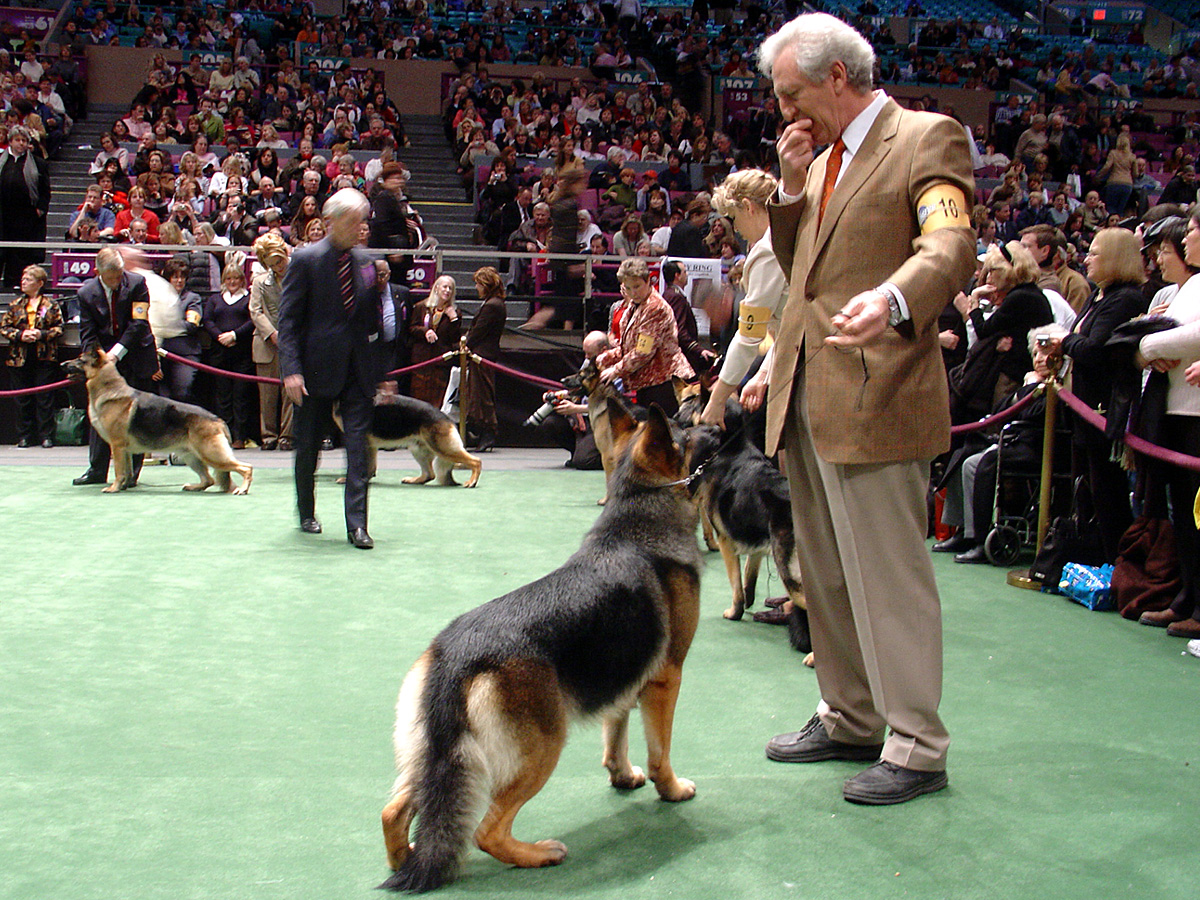
The Grey Lady writes about the M-word in dog pageants.
Karma points for the scare quotes around the word "pets."
US Today gives Frei his podium for the party line that dogs who live in crates with professional handlers are "just like your pet at home." Just like JonBenet Ramsay was just a regular little girl playing dress-up.
Srsly, could this dog want to be where he is any less? (Video -- I did not embed because of obnoxious continuous stream ads.) Hey Frei, slap his head back towards you and the newstwinkie again, show us how much you love him. Yeah, he runs wild on a ranch in Texas. Or lives in Missouri, with another "owner." Or in Illinois. Or at Frei's apartment in NYC. Depends on which member of his "ownership team" or handler or PR shill is holding forth on how he's just like your pet at home.
Three more recently working breeds get a stake through their hearts this year. The AP acts as the ACK's press agent on this one.
I will not be watching, unless Perfesser Chaos decides that it is time to get a flat-screen teevee; he knows he can count on my foot going through the tube of the old one when the GSDs and border collies take the stage. Or the obese Labs. Or the lumbering goldens. Or any other visually apparent atrocity against dogdom.
Sunday, January 24, 2010
She's Baaaack!
Hooray!
Working Dog Diary is back!
Check it out.
She doesn't have a feed to update in a blogroll, so you just have to check it for yourself.
Working Dog Diary is back!
Check it out.
She doesn't have a feed to update in a blogroll, so you just have to check it for yourself.
Friday, January 22, 2010
Now We See The Violence Inherent In the System
In a move that reveals recently unprecedented clarity of self-interest and public relations goals, the American Kennel Club has just announced that it will now permit the impure-of-blood to pay their fees and compete against those anointed by the right paperwork, in contests of obedience and agility.
Most AKC critics are applauding this decision as actually virtuous and good for dogs and their owners. Here's why I'm not joining them.
A couple years ago, ACK started sending up weather balloons about the feasibility of permitting filthy mongrels to compete in performance events.
AKC has always controlled virtually all the venues for formal obedience competition and titling in the US. Only properly-documented ACK-registered "purebreds" were eligible to compete in this red-headed stepchild of "The Sport of Purebred Dogs."
When I took my golden retriever -- an obviously purebred, field-line bitch -- to community obedience classes in the mid-70's, she could not prepare for any formal competitions because she came from the pound. No "papers." The instructor was kind but matter-of-fact in explaining this inflexible reality to the skinny kid who rode her bike* to class, dog galloping beside. Shannon's more accomplished son, who looked purebred, was not, and was also ineligible.
So there we were, alone at the fairgrounds and park, practicing retrieving over jumps and scent discrimination, just because.
In the 80's, they instituted a scheme called the "indefinite listing privilege," (renamed "Purebred Alternative Listing" two years ago) in which the owners of undocumented dogs that looked like a particular AKC-registered breed might pay a fee and send in some photos and proof that their putative purebred was surgically sterilized, and be permitted to slip in alongside the pedigreed elite in the pursuit of obedience and tracking titles.
Many a mongrel became a "Labrador" or "poodle" by virtue of a clever camera angle or strategic haircut, and once the Government of Dogs (G.O.D.) had so declared it, who was to say it was not so? And on the ground, who the hell cared? Obedience competitors are practical sorts, for the most part. The only complaint about an ILP I've ever heard seemed to have to do with someone winning too much, and with the pageant matrons of the breed club getting wind of it. That one provoked a special rule.
Meanwhile, an organization called the American Mixed-Breed Obedience Registry got going in the early 80's. They worked out a deal whereby mongrels could enter local "fun"** matches, the handler and judge could treat the run as if it were a trial and be scored accordingly, and AMBOR would issue titles.
Yeah, second-class citizenship -- but citizenship of a sort, even if not granted by the G.O.D.. Later AMBOR and the privately-owned commercial registry called the United Kennel Club worked out a deal that allowed mixed dogs into UKC obedience trials on an equal footing with UCK-registered -- with one caveat. The mixed-breed dogs had to be sterilized.
Keep watching that last clause, because it becomes important.
One big disadvantage of hitching up with the UKC was that there aren't a lot of UKC trials in most parts of the country. The owner of an AKC-registered dog or an AKC-anointed "ILP" dog could trial every weekend with moderate travel in most parts of the US. Nowhere was that true for those with dogs whose only venues were UKC shows. The advantage was that everyone in the class was really competing, so it was harder for snobs to denigrate the curs' achievements as just affirmative action grade-inflation.
Meanwhile, through the 90's, new, innovative dog sports not under the aegis of the G.O.D. were catching on -- flyball, agility, freestyle and rally obedience -- and venerable working tests/sports -- stockdog trials, schutzhund, earthdog trials -- were becoming more prominent. These events were, for the most part, sponsored and controlled by entities that did not limit entrants or prizes based on breed or registration or "purity." In the new sports, mixed-breed dogs were common and unremarked. In some cases, competitors started to deliberately cross-breed in order to develop competitive animals. Interest in entering dog beauty pageants was waning (even as more and more were televised and glamorized), and consumers started getting wise to the bad deal that "champion bloodlines" meant when they went looking for a pet. ACK registrations were in a clearly unrecoverable tailspin, due in part to the rise of the new puppymill registries, and in part to the indifference of pet owners who quite rightly could not be bothered to send AKC money in exchange for worthless paper. In a panicked attempt to keep the registrations rolling in, the AKC was grabbing "new" breeds right and left, against the increasingly righteous and organized resistance of their breed stewards.
Is it any wonder that the AKC also cast its lidless red eye on these new, and newly prominent, sports -- sports that had developed and flourished under a system of fair, equitable, open-to-all competition? Earthdog, agility, rally obedience, "herding" and lure coursing were soon appropriated, with varying degrees of success. In the wake of public interest in SAR dogs after the Oklahoma City bombing, a new variable-surface tracking title was, before the screaming from the public safety community, witlessly promoted as a search and rescue certification! ("The level of physical difficulty should be such that it will permit all AKC breeds and handlers of any age to participate.")
In the case of, for example, agility trials, clubs and venues that had previously hosted open-to-all, level-playing-field trials sanctioned by USDAA or NADAC in conjunction with their large dog shows and obedience trials now found themselves forbidden to do so.
In 1993, my SAR unit was asked to provide demos and a booth for an AKC dog show in Massachusetts. We'd done the same at an even bigger "cluster" of shows for some years -- a cluster that included an ARBA pageant and open-to-all agility. Good PR and education, sometimes a recruiting success, and a moderate fund-raiser.
But the hosting AKC club of this other show had one stipulation. Only search and rescue dogs that were AKC purebreds were invited to demonstrate or attend. The pit bull (gasp!) and the mixed breeds and their low-life handlers were not wanted. Not Our Sort, you know.
I was the unit's contact person for setting up this demonstration. My regular readers can probably fill in the wording and tone of my response for themselves.
The following year, AKC-sanctioned agility trials -- for registered purebreds only -- replaced those held by the USDAA or NADAC at AKC show and obedience-trial venues.
That's the mindset we are dealing with here, folks. It may have learned to keep its David Duke opinions about canine race under wraps a little better in the past decade and a half, but believe me, inside the country club, when the help is out of earshot, nothing has changed.
So fast-forward to around 2007, when the AKC started floating those weather balloons about the mutts. Eventually it belched out a survey directed at the members of the "Purebred Fancy" and the owners of impure performance dogs, asking under what conditions each group would find it acceptable for mixed dogs to compete in agility, obedience, rally, and tracking trials.
What they came up with, in an attempt to have/eat cake, was separate water fountains.
Mixed dogs could not earn the same exalted titles as the pure. They could never compete head-to-head for placements with the pure. They could not advance to AKC invitationals or the Nationals. They could not be entered into trials where a beauty pageant was being conducted at the same venue, else they might infect the Aryan dogs in much the same way that a rusty heap can profane a new Beemer just by parking next to it. And of course, they had to be sterilized.
Reaction from the owners of mixed-breed performance dogs -- particularly those that are tearing up the USDAA and NADAC agility courses around the country -- apparently sounded like this.
It appears that the reaction from the clubs that actually run the trials and shows from which ACK takes a cut for its "sanction" was also less than enthusiastic.
Prompting thisnew development frantic backpeddle:
As long as the mongrels are sterilized!
The "Canine Partners" program is also open to "purebred" dogs of non-AKC breeds.
As long as the infidel dogs are sterilized!
Ruh roh, Raggy.
Of great note, the AKC's new-ish method of breed-takeover-by-attrition, the "Foundation Stock Service," comes into play here. Because if you own a dog of an FSS-listed breed, you can't access performance events through the "Canine Partners" scheme. You have to register it through the FSS -- the dog, and it's sweet, juicy pedigree.
Make no mistake that the AKC's latest policy move has nothing to do with what is good for dogs, what is good for dog breeds, or what is good for dog owners.
It is good forGeneral Motors the AKC, period.
One aim is to destroy the largest of the level-playing-field, open-to-all competitive venues entirely. USDAA and NADAC compete with ACK for entry fees, publicity, and credibility, and they have to die. Same for APDT rally trials. What started when their trials (and the mutts that entered them) were banned from the same grounds as the dog shows is now meant to finish with the appropriation of all the entrants.
Another aim is to short-stop deliberate cross-breeding for performance and the development of new breeds for new roles. The G.O.D. that howls in protest whenever a mandatory sterilization law threatens to impact their revenues institutes the exact same policy against a subset of their "customers."
A third aim, largely dependent on the destruction of the independent sporting organizations, is to appropriate non-AKC breeds into the FSS, and thence on to full "recognition" as proper show dogs. So they can be improved, natch. And to keep those registration dollahs coming in.
There is no way for the owner of a non-AKC purebred dog to compete with him in AKC events unless the dog is sterilized. With the swamping of alternative venues, the ACK can increase the pressure on independent breed clubs to fold and be assimilated into the FSS, in order to maintain some access to events that can serve as thresholds for soundness and ability, and an engaging hobby for the owners of dogs who don't have real work to do.
The AKC spent nearly a century imagining itself to be the G.O.D. in the United States, and having that presumption continually reinforced by its toadies in The Fancy. Those it considers its rightful subjects have overwhelmingly been sniggering at its nudity or ignoring its existence and getting on with their lives with dogs without benefit of its rule for decades.
Since bringing down the hammer of "purity" backfired last time -- causing the puppymills to take their registration money and go home -- the putative G.O.D. is pursuing another favorite tactic of the failing tyrant -- expansionist warfare.
Fourth, the money from the individual enrollees could be significant. The fee for enrolling a mudblood dog or non-AKC breed as a "Canine Partner" is $15 more than standard registration. An extra ten-spot if you want to give him a particularly long and fancy name. Interesting differential, given that the AKC (we're just a registry, we keep the pedigree records) is not charged with the task of recording the pedigrees of these animals, nor will those pedigrees continue into the future.
More confusion. Although wolf hybrids of any percentage are strictly verboten from enrollment in the "Canine Partners" scheme, by the curious and physics-challenged requirement that the animal be "... not a wolf or the immediate progeny of a wolf-dog crossbreeding, in the past or in the future" the FSS happily enrolls these wolf-dogs as a "breed."
What it all adds up to is a grab for more power over American dogs and their owners, and especially the breeding of dogs and the development of breeds, presented in PR-friendly way. It's especially targeted at getting control of working dogs -- those breeds and types whose owners and breeders are most likely to seek outside validation of their dogs' trainability and athleticism. ACK has been trying for decades to take credit for working dogs, and accelerated their efforts after 9-11 in the smarmiest way.
What better way to associate oneself with the achievements of others than by killing off any alternative sources of external validation?
___________________________
*Purple. Hi-rise handlebars. Flowered banana seat. Plastic basket on the front. Yes, those are bell-bottoms caught in the chain. But no sissy-bar. Not a Stingray, either, what, were we the friggin' Rockefellers?
** Those not "sanctioned" by the AKC, and meant for people to practice before entering a sanctioned match or trial. Often hosted by obedience clubs, sometimes by training centers.
Most AKC critics are applauding this decision as actually virtuous and good for dogs and their owners. Here's why I'm not joining them.
A couple years ago, ACK started sending up weather balloons about the feasibility of permitting filthy mongrels to compete in performance events.
AKC has always controlled virtually all the venues for formal obedience competition and titling in the US. Only properly-documented ACK-registered "purebreds" were eligible to compete in this red-headed stepchild of "The Sport of Purebred Dogs."
When I took my golden retriever -- an obviously purebred, field-line bitch -- to community obedience classes in the mid-70's, she could not prepare for any formal competitions because she came from the pound. No "papers." The instructor was kind but matter-of-fact in explaining this inflexible reality to the skinny kid who rode her bike* to class, dog galloping beside. Shannon's more accomplished son, who looked purebred, was not, and was also ineligible.
So there we were, alone at the fairgrounds and park, practicing retrieving over jumps and scent discrimination, just because.
In the 80's, they instituted a scheme called the "indefinite listing privilege," (renamed "Purebred Alternative Listing" two years ago) in which the owners of undocumented dogs that looked like a particular AKC-registered breed might pay a fee and send in some photos and proof that their putative purebred was surgically sterilized, and be permitted to slip in alongside the pedigreed elite in the pursuit of obedience and tracking titles.
Many a mongrel became a "Labrador" or "poodle" by virtue of a clever camera angle or strategic haircut, and once the Government of Dogs (G.O.D.) had so declared it, who was to say it was not so? And on the ground, who the hell cared? Obedience competitors are practical sorts, for the most part. The only complaint about an ILP I've ever heard seemed to have to do with someone winning too much, and with the pageant matrons of the breed club getting wind of it. That one provoked a special rule.
Meanwhile, an organization called the American Mixed-Breed Obedience Registry got going in the early 80's. They worked out a deal whereby mongrels could enter local "fun"** matches, the handler and judge could treat the run as if it were a trial and be scored accordingly, and AMBOR would issue titles.
Yeah, second-class citizenship -- but citizenship of a sort, even if not granted by the G.O.D.. Later AMBOR and the privately-owned commercial registry called the United Kennel Club worked out a deal that allowed mixed dogs into UKC obedience trials on an equal footing with UCK-registered -- with one caveat. The mixed-breed dogs had to be sterilized.
Keep watching that last clause, because it becomes important.
One big disadvantage of hitching up with the UKC was that there aren't a lot of UKC trials in most parts of the country. The owner of an AKC-registered dog or an AKC-anointed "ILP" dog could trial every weekend with moderate travel in most parts of the US. Nowhere was that true for those with dogs whose only venues were UKC shows. The advantage was that everyone in the class was really competing, so it was harder for snobs to denigrate the curs' achievements as just affirmative action grade-inflation.
Meanwhile, through the 90's, new, innovative dog sports not under the aegis of the G.O.D. were catching on -- flyball, agility, freestyle and rally obedience -- and venerable working tests/sports -- stockdog trials, schutzhund, earthdog trials -- were becoming more prominent. These events were, for the most part, sponsored and controlled by entities that did not limit entrants or prizes based on breed or registration or "purity." In the new sports, mixed-breed dogs were common and unremarked. In some cases, competitors started to deliberately cross-breed in order to develop competitive animals. Interest in entering dog beauty pageants was waning (even as more and more were televised and glamorized), and consumers started getting wise to the bad deal that "champion bloodlines" meant when they went looking for a pet. ACK registrations were in a clearly unrecoverable tailspin, due in part to the rise of the new puppymill registries, and in part to the indifference of pet owners who quite rightly could not be bothered to send AKC money in exchange for worthless paper. In a panicked attempt to keep the registrations rolling in, the AKC was grabbing "new" breeds right and left, against the increasingly righteous and organized resistance of their breed stewards.
Is it any wonder that the AKC also cast its lidless red eye on these new, and newly prominent, sports -- sports that had developed and flourished under a system of fair, equitable, open-to-all competition? Earthdog, agility, rally obedience, "herding" and lure coursing were soon appropriated, with varying degrees of success. In the wake of public interest in SAR dogs after the Oklahoma City bombing, a new variable-surface tracking title was, before the screaming from the public safety community, witlessly promoted as a search and rescue certification! ("The level of physical difficulty should be such that it will permit all AKC breeds and handlers of any age to participate.")
In the case of, for example, agility trials, clubs and venues that had previously hosted open-to-all, level-playing-field trials sanctioned by USDAA or NADAC in conjunction with their large dog shows and obedience trials now found themselves forbidden to do so.
In 1993, my SAR unit was asked to provide demos and a booth for an AKC dog show in Massachusetts. We'd done the same at an even bigger "cluster" of shows for some years -- a cluster that included an ARBA pageant and open-to-all agility. Good PR and education, sometimes a recruiting success, and a moderate fund-raiser.
But the hosting AKC club of this other show had one stipulation. Only search and rescue dogs that were AKC purebreds were invited to demonstrate or attend. The pit bull (gasp!) and the mixed breeds and their low-life handlers were not wanted. Not Our Sort, you know.
I was the unit's contact person for setting up this demonstration. My regular readers can probably fill in the wording and tone of my response for themselves.
The following year, AKC-sanctioned agility trials -- for registered purebreds only -- replaced those held by the USDAA or NADAC at AKC show and obedience-trial venues.
That's the mindset we are dealing with here, folks. It may have learned to keep its David Duke opinions about canine race under wraps a little better in the past decade and a half, but believe me, inside the country club, when the help is out of earshot, nothing has changed.
So fast-forward to around 2007, when the AKC started floating those weather balloons about the mutts. Eventually it belched out a survey directed at the members of the "Purebred Fancy" and the owners of impure performance dogs, asking under what conditions each group would find it acceptable for mixed dogs to compete in agility, obedience, rally, and tracking trials.
What they came up with, in an attempt to have/eat cake, was separate water fountains.
Mixed dogs could not earn the same exalted titles as the pure. They could never compete head-to-head for placements with the pure. They could not advance to AKC invitationals or the Nationals. They could not be entered into trials where a beauty pageant was being conducted at the same venue, else they might infect the Aryan dogs in much the same way that a rusty heap can profane a new Beemer just by parking next to it. And of course, they had to be sterilized.
Reaction from the owners of mixed-breed performance dogs -- particularly those that are tearing up the USDAA and NADAC agility courses around the country -- apparently sounded like this.
It appears that the reaction from the clubs that actually run the trials and shows from which ACK takes a cut for its "sanction" was also less than enthusiastic.
Prompting this
While each club's participation in the AKC Canine Partners program will remain voluntary, clubs may now choose to allow mixed breed participation at any AKC Agility, Obedience or Rally event. Mixed breeds will compete in the same classes and earn the same titles as their purebred counterparts.So, individual clubs may now ban the impure, but the G.O.D. is no longer mandating apartheid.
As long as the mongrels are sterilized!
The "Canine Partners" program is also open to "purebred" dogs of non-AKC breeds.
As long as the infidel dogs are sterilized!
Ruh roh, Raggy.
Of great note, the AKC's new-ish method of breed-takeover-by-attrition, the "Foundation Stock Service," comes into play here. Because if you own a dog of an FSS-listed breed, you can't access performance events through the "Canine Partners" scheme. You have to register it through the FSS -- the dog, and it's sweet, juicy pedigree.
Make no mistake that the AKC's latest policy move has nothing to do with what is good for dogs, what is good for dog breeds, or what is good for dog owners.
It is good for
One aim is to destroy the largest of the level-playing-field, open-to-all competitive venues entirely. USDAA and NADAC compete with ACK for entry fees, publicity, and credibility, and they have to die. Same for APDT rally trials. What started when their trials (and the mutts that entered them) were banned from the same grounds as the dog shows is now meant to finish with the appropriation of all the entrants.
Another aim is to short-stop deliberate cross-breeding for performance and the development of new breeds for new roles. The G.O.D. that howls in protest whenever a mandatory sterilization law threatens to impact their revenues institutes the exact same policy against a subset of their "customers."
A third aim, largely dependent on the destruction of the independent sporting organizations, is to appropriate non-AKC breeds into the FSS, and thence on to full "recognition" as proper show dogs. So they can be improved, natch. And to keep those registration dollahs coming in.
There is no way for the owner of a non-AKC purebred dog to compete with him in AKC events unless the dog is sterilized. With the swamping of alternative venues, the ACK can increase the pressure on independent breed clubs to fold and be assimilated into the FSS, in order to maintain some access to events that can serve as thresholds for soundness and ability, and an engaging hobby for the owners of dogs who don't have real work to do.
The AKC spent nearly a century imagining itself to be the G.O.D. in the United States, and having that presumption continually reinforced by its toadies in The Fancy. Those it considers its rightful subjects have overwhelmingly been sniggering at its nudity or ignoring its existence and getting on with their lives with dogs without benefit of its rule for decades.
Since bringing down the hammer of "purity" backfired last time -- causing the puppymills to take their registration money and go home -- the putative G.O.D. is pursuing another favorite tactic of the failing tyrant -- expansionist warfare.
Fourth, the money from the individual enrollees could be significant. The fee for enrolling a mudblood dog or non-AKC breed as a "Canine Partner" is $15 more than standard registration. An extra ten-spot if you want to give him a particularly long and fancy name. Interesting differential, given that the AKC (we're just a registry, we keep the pedigree records) is not charged with the task of recording the pedigrees of these animals, nor will those pedigrees continue into the future.
More confusion. Although wolf hybrids of any percentage are strictly verboten from enrollment in the "Canine Partners" scheme, by the curious and physics-challenged requirement that the animal be "... not a wolf or the immediate progeny of a wolf-dog crossbreeding, in the past or in the future" the FSS happily enrolls these wolf-dogs as a "breed."
What it all adds up to is a grab for more power over American dogs and their owners, and especially the breeding of dogs and the development of breeds, presented in PR-friendly way. It's especially targeted at getting control of working dogs -- those breeds and types whose owners and breeders are most likely to seek outside validation of their dogs' trainability and athleticism. ACK has been trying for decades to take credit for working dogs, and accelerated their efforts after 9-11 in the smarmiest way.
What better way to associate oneself with the achievements of others than by killing off any alternative sources of external validation?
___________________________
*Purple. Hi-rise handlebars. Flowered banana seat. Plastic basket on the front. Yes, those are bell-bottoms caught in the chain. But no sissy-bar. Not a Stingray, either, what, were we the friggin' Rockefellers?
** Those not "sanctioned" by the AKC, and meant for people to practice before entering a sanctioned match or trial. Often hosted by obedience clubs, sometimes by training centers.
Friday, January 1, 2010
Double-Suspension of Disbelief
The six of us drove from the Bay Area to the only motel near a Central Valley town where there are more coursing hounds than anywhere else on the continent. Hell, there may be more hounds than humans, amid the glass-flat, engineer-squared, desert cotton fields forced green by water wrung from the Sierras.
View Larger Map
Three humans and three search and rescue dogs rolled out of bed at o-dark-thirty and met our long-time correspondent,* Dr. John Burchard, and his colleagues George Bell and Vicky Clarke at the blinking stoplight in "town," before driving out to the unplanted -- therefore unwatered -- fields near the irrigation ditch.
With them were an assortment of the fastest quadruped predators on the continent outside of the cheetah pen at the zoo.
It was already summer, and for the sake of both hounds and hares, all coursing needed to be done before the sun could begin its relentless scorching.
The SAR dogs presented a conundrum. It was too dangerous to leave them in the car. Would it work to bring them along? Vicky briefly fretted about our GSD partner, Mel. Her hounds had never met another dog who was not a sighthound. Would they make Mel to be a coyote and try to hunt her down?
Not to worry. Mel and the two English shepherds, Pip and Rikki, had one thing in common with the salukis -- courtly dog manners.

Vicky asked for this picture, as proof that Joey and Mojo had met a pointy-ear and not served her as a giant 'yote. The SAR dogs walked as part of the human "gallery" when we slip-coursed with George's greyhounds; when the salukis were released to free-course, the SAR dogs moved out a bit more. Rikki even flushed a hare and futilely chased it until the salukis took over.
In slip-coursing, the humans walk a line through the grass and light brush, hold hounds by the most ingeniously-constructed leash-collar contraption. When someone spots a hare, he shrieks RABBBIIIITT, the hounds surge forward, the handlers let go of the T-handle of the lead, and the wrist loop engages the deadman release -- it all takes less than a second, and the chase is on.
George handed me the lead of a massive greyhound named Lionheart. I felt as if a total stranger had just trustingly handed me the keys to a Bugatti with his baby inside.**
As we walked and scanned for hares, I asked him about the breeding of these real coursing greyhounds -- what characterized the bloodlines of dogs who still hunt the way their ancestors did before the invention of the alphabet?
We cross track-bred dogs with AKC greyhounds.
Coulda knocked me over with a saluki's ear feather.
Why do you do that?
Because it works.
My brain raced with more questions, but I dropped them, because George had just given the final answer to any sensible inquiry about why an expert might do something a certain way. And because someone screamed RABBBIIITTT, and the chase was on.
It was over in less than a minute. The hare escaped through a fence that was so far away I had failed to perceive it. The hounds were colored dots in the distance.
When they returned at a more reasonable lope, they were done. The first order of business was to thoroughly cool them.

George took the greys home, and it was time to free-course the salukis. Contrary to the armchair fancier folklore I'd been fed, they hunted by scent like any other dog until they (or Rikki) flushed a hare.
When Joey and Dark Lady were in pursuit, Mojo was most ingenious as he tried to get a look at its trajectory.

The salukis were not as fast, and did not run as far (edit: as far away -- they ran for longer over a more crazed course), as the greyhounds, but they turned and strategized and provided an exciting chase at least twice. My blood surged with adrenaline shared by hunters in wide desert places since the Bronze Age.
I would not have been in better company if I'd been invited to hunt from the Pharaoh's chariot.
No jackrabbits were harmed in the making of this morning of hunting.
We did do considerable damage to some chorizo and huevos at an excellent Mexican greasy spoon.
Then to George's house, to spend the late morning studying astonishing videos and high-speed photographs of sighthounds running, turning, spinning -- hyperextending their joints in ways that humans never imagined before Muybridge.
It was John who had, years before, presented such definitive evidence for the functional necessity of front dewclaws that I was compelled to discard every bit of lore I had been fed for decades about the practice of amputating them. (And just in time for our first litter of puppies to keep their God-given thumbs.)
As we viewed another amazing image, one of our hosts mentioned that the double suspension gallop was unique, among dogs, to the sighthounds.
All galloping animals have a moment in the collected phase of the gait when the beast is airborne.

A dog or cheetah capable of double-suspension is also airborne at full extension.
And apparently, everyone knows that only sighthounds can do this. Ken and Laura and I were conversing with two of the world's experts on animal locomotion, and they were quite clear on this point.
Except ... I fired up my laptop and starting looking for this:

Pip had just spent the morning being emphatically not a sighthound in the company of both of them. She is not structured anything like a sighthound, doesn't do a sighthound's job, and isn't remotely as fast as a sighthound.
There is undeniably air under each of her feet in this photograph.
QED. Sighthounds do not have a monopoly on the canine double-suspension gallop.
What was striking was how delighted both men were to see the photo. How happy they were to surrender what they knew in favor of the new information. A lovely demonstration of the scientific worldview, and beyond that the generosity and confidence of temperament that prefers a novel and messy truth to a tidy and coherent conviction.
----------------------------------------------
Pupdate. I'm putting together a photo gallery of non-sighthounds airborne at full extension, here.
Reviewing the excellent photos people have been sending me, I need to specify that what we need is sequential photos of the animal airborne at both collection and extension.
Like this fabulous coyote.
Otherwise, there's no way to know that the dog wasn't leaping out of a different gait.
You can send submissions to the surname of this blog's author spelled correctly AT zoominternet DOT net
----------------------------------------------
* I don't think the dogs had been writing to him, though he'd be one to read and answer graciously if they did.
** Begging the question, who puts a car seat into a Bugatti?
View Larger Map
Three humans and three search and rescue dogs rolled out of bed at o-dark-thirty and met our long-time correspondent,* Dr. John Burchard, and his colleagues George Bell and Vicky Clarke at the blinking stoplight in "town," before driving out to the unplanted -- therefore unwatered -- fields near the irrigation ditch.
With them were an assortment of the fastest quadruped predators on the continent outside of the cheetah pen at the zoo.
It was already summer, and for the sake of both hounds and hares, all coursing needed to be done before the sun could begin its relentless scorching.
The SAR dogs presented a conundrum. It was too dangerous to leave them in the car. Would it work to bring them along? Vicky briefly fretted about our GSD partner, Mel. Her hounds had never met another dog who was not a sighthound. Would they make Mel to be a coyote and try to hunt her down?
Not to worry. Mel and the two English shepherds, Pip and Rikki, had one thing in common with the salukis -- courtly dog manners.

Vicky asked for this picture, as proof that Joey and Mojo had met a pointy-ear and not served her as a giant 'yote. The SAR dogs walked as part of the human "gallery" when we slip-coursed with George's greyhounds; when the salukis were released to free-course, the SAR dogs moved out a bit more. Rikki even flushed a hare and futilely chased it until the salukis took over.
In slip-coursing, the humans walk a line through the grass and light brush, hold hounds by the most ingeniously-constructed leash-collar contraption. When someone spots a hare, he shrieks RABBBIIIITT, the hounds surge forward, the handlers let go of the T-handle of the lead, and the wrist loop engages the deadman release -- it all takes less than a second, and the chase is on.
George handed me the lead of a massive greyhound named Lionheart. I felt as if a total stranger had just trustingly handed me the keys to a Bugatti with his baby inside.**
As we walked and scanned for hares, I asked him about the breeding of these real coursing greyhounds -- what characterized the bloodlines of dogs who still hunt the way their ancestors did before the invention of the alphabet?
We cross track-bred dogs with AKC greyhounds.
Coulda knocked me over with a saluki's ear feather.
Why do you do that?
Because it works.
My brain raced with more questions, but I dropped them, because George had just given the final answer to any sensible inquiry about why an expert might do something a certain way. And because someone screamed RABBBIIITTT, and the chase was on.
It was over in less than a minute. The hare escaped through a fence that was so far away I had failed to perceive it. The hounds were colored dots in the distance.
When they returned at a more reasonable lope, they were done. The first order of business was to thoroughly cool them.

George took the greys home, and it was time to free-course the salukis. Contrary to the armchair fancier folklore I'd been fed, they hunted by scent like any other dog until they (or Rikki) flushed a hare.
When Joey and Dark Lady were in pursuit, Mojo was most ingenious as he tried to get a look at its trajectory.

The salukis were not as fast, and did not run as far (edit: as far away -- they ran for longer over a more crazed course), as the greyhounds, but they turned and strategized and provided an exciting chase at least twice. My blood surged with adrenaline shared by hunters in wide desert places since the Bronze Age.
I would not have been in better company if I'd been invited to hunt from the Pharaoh's chariot.
No jackrabbits were harmed in the making of this morning of hunting.
We did do considerable damage to some chorizo and huevos at an excellent Mexican greasy spoon.
Then to George's house, to spend the late morning studying astonishing videos and high-speed photographs of sighthounds running, turning, spinning -- hyperextending their joints in ways that humans never imagined before Muybridge.
It was John who had, years before, presented such definitive evidence for the functional necessity of front dewclaws that I was compelled to discard every bit of lore I had been fed for decades about the practice of amputating them. (And just in time for our first litter of puppies to keep their God-given thumbs.)
As we viewed another amazing image, one of our hosts mentioned that the double suspension gallop was unique, among dogs, to the sighthounds.
All galloping animals have a moment in the collected phase of the gait when the beast is airborne.

A dog or cheetah capable of double-suspension is also airborne at full extension.
And apparently, everyone knows that only sighthounds can do this. Ken and Laura and I were conversing with two of the world's experts on animal locomotion, and they were quite clear on this point.
Except ... I fired up my laptop and starting looking for this:

Pip had just spent the morning being emphatically not a sighthound in the company of both of them. She is not structured anything like a sighthound, doesn't do a sighthound's job, and isn't remotely as fast as a sighthound.
There is undeniably air under each of her feet in this photograph.
QED. Sighthounds do not have a monopoly on the canine double-suspension gallop.
What was striking was how delighted both men were to see the photo. How happy they were to surrender what they knew in favor of the new information. A lovely demonstration of the scientific worldview, and beyond that the generosity and confidence of temperament that prefers a novel and messy truth to a tidy and coherent conviction.
----------------------------------------------
Pupdate. I'm putting together a photo gallery of non-sighthounds airborne at full extension, here.
Reviewing the excellent photos people have been sending me, I need to specify that what we need is sequential photos of the animal airborne at both collection and extension.
Like this fabulous coyote.
Otherwise, there's no way to know that the dog wasn't leaping out of a different gait.
You can send submissions to the surname of this blog's author spelled correctly AT zoominternet DOT net
----------------------------------------------
* I don't think the dogs had been writing to him, though he'd be one to read and answer graciously if they did.
** Begging the question, who puts a car seat into a Bugatti?
Subscribe to:
Posts (Atom)