Dogs. Dawgs. Other critters. Life as Oliver Wendell Douglas. Live heirlooms, both flora and fauna. Self-sufficiency. Suffering not a fool to live. Land stewardship. Turnip trucks, and those who have not fallen therefrom. Training things. Growing things. Search and rescue. What is this bug and what is it doing under my desk light?
Embracing the reality that Nature Bats Last.
The very least of the rolling disaster that was our spring and summer, 2023, was the escape of Sneaky Fucker from the designated Pasture of Testicles, his breach of several layers of both woven wire and electrically-charged security, and the subsequent impregnation of the Wrong Goats at the Wrong Time by the Wrong Guy.
But here we are, trying to keep 2# kids alive in the middle of winter. And here the Nigerian does are, doing their goat kegels to keep those tailhead ligaments nice and tight every day until I have checked them and walked away, at which point they skulk off and look for a nice ice crevasse or maybe a lava pit where they can give birth and then immediately forget what they were doing and go out for sushi with their friends.
On Tuesday it was We Broke the Planet warm, dry, sunny. Nobody was birthin’ no babies, they swore. The lambs were romping, the ewes and does were sunbathing.
At hay time and last pasture check, the black clouds were starting to roll in.
And this absolute ding-dong comes shuffling down from the rise in the big pasture with a tiny strawberry blond babby alongside.
Mug shot vibe? So be it.
Huh.
Picked up the little buckling and reached for his normally — well, compliant is not a word generally applied to goats, but at least tame — mother.
She decided to play wyld gôte, Absolutely not, she was not going to cooperate in the project of going into a safe warm dry stall with a heat plate for her child, with all the hay and alfalfa pellets and grain she could nom.
So we played greased pig for 25 minutes with her kid stuffed into my shirt, and boy those clouds were ominous and wind was picking up.
Another 15 to get a stall freed up and the two of them installed, and now the rain was starting and the temperature was dropping.
I did a circuit of the 8 acre pasture and decided everyone was accounted for,
Then I decided I had better be sure and that rain was coming nasty now.
Went into the house to get a raincoat and an expert.
Sammie looked outside and told me to go to Hell Kemosabi.
“Sam, I need your help.”
Oh, if you put it that way.
She levitated and started chortling, because I’m your dog, so what is it we are doing in this now sideways rain and fuck is this hail?
She’d seen and smelled the doe, Cait, and the wee buckling, when I brought them out.
She is all about context.
As I started on the perimeter of the pasture fence near where I had first seen the two, she started casting into the wind, then shot straight and started examining the ground about 20 meters away.
I caught up with her, and there was the placenta. A favorite dog treat here, but she had no interest in eating it; it was more data for the mysterious logic engine under her skull.
What the placenta told her was that not everyone was accounted for. It smelled of Cait, and of the buckling, and also someone else. But I didn’t understand that yet. Just that she was insistent that we keep going.
Don’t bring in an expert and then disregard what they tell you.
It was getting pretty dark.
She started casting really aggressively now. I walked the perimeter to get all the way downwind and then we turned to work into it. The hail was driving into the elderly rain jacket I had grabbed. Was that lightning? Is the middle of a hilltop field next to a long high-tensile fence the ideal place to be?
I still didn’t really believe in another kid. I expected to perhaps find another spot in the pasture with birth slime.
Sam looked so pretty, searching into that squall, that I pulled my phone out to record her pattern of low casting, get some video of how she worked in unreasonable conditions, and just as I looked up:
I’m not crying you’re crying.
For our troubles, we got accusatory huffing from The Ding-Dong. How very dare we maliciously snatch her darling daughter from her? If that’s not what happened, then how is that we had her? What were we implying about her famously excellent maternal qualities? She knew exactly where she had put the child!
I wasn’t about to leave that stall until I saw Baby Girl get a nice drink of fresh bewb juice, and Cait was still indignant and pissy. Maybe she would just dance and kick a little when the prodigal tried to nurse?
Maybe I have no compunction about cold-cocking a goat?
It's time to get the old blogging gang back together.
Like, well, practically everyone, I have fallen for the tempting grift of "less friction."
Going into blogger, writing and editing a worthwhile post, formatting it, monitoring and moderating comments (because oh my Dog, the spam, the spam, and also the weirdos, the weirdos), visiting other blogs of interest, maybe needing yet another account to comment there if I am so moved, signing in, remembering passwords -- all of them are points of friction and annoyance. Yahoo Groups took over the listserv game a couple decades ago, got everyone in one place, and then, a few years back, just POOFED away years and years of conversations and files and whole online communities. Just gone.
And The Zuck made it ever eeeeasier to interact. Schedule events. Conduct business. Sell your shit.
Until Zuckworld had sucked all the air out of the rest of God's internet while, you know, also sucking the tit of Putin's fascist trolls, that sweet sweet Kremlin troll money.
It's all great until you find that your now-predominant means of communication and commerce is capriciously cut off by a bloody-minded literalist imbecile algorithm that cannot detect irony or hyperbolic metaphor, and flags a pleasant conversation among consenting friends about interesting science, or a real pretty vintage kitchen set, as "inciting violence."
That literally confuses a straightforward statement that hunting Mike Pence with a noose is a, you know, bad thing, with advocating Pence-hunting.
Meanwhile, same day, classic Holocaust denial on a news story public comment thread -- eh, it's fine. Didn't hit any of the secret no-no words.
The automation is about as competent at grokking the hoo-mans as the Zuck itself.
Story time.
It's junior high speech class. The teacher is Mr. Stanton. Mr. Stanton is kinda a dick, but by no means the worst asshole teaching at Roehm Junior High, mainly only because of the stiff competition. The thing to know is that in 1979, the dicks and assholes babysitting the hormonal adolescents at Roehm Junior High school were empowered to beat the students who annoyed them. Literally take them into the hallway and hit them in the ass with a wooden paddle. "Swats." Some liked to brandish their beating paddles as threats, and the legendary ones had paddles with holes drilled into them for, allegedly, extra pain. The good teachers did not employ beatings or threats of beatings .But any of them were allowed to. Good times! The students who regularly received beatings for being little shits considered it a badge of honor, so the deterrence power of beatings was pretty openly understood to be zilch.
So we kids learning public speaking had to choose a topic, some political or social issue, take a side, and research, prepare, and deliver a "speech to convince." Nobody could take the same side of the same topic as anyone else, but we could take different sides. Mr. Stanton polled us alphabetically for our topics, with students lower in the alphabet getting dibs.
I announced my topic and position. Topic doesn't matter, I'm not entirely sure I remember what it was.
A few students later, one of the boys calls dibs on the opposing side of the issue.
I remember who it was, but won't embarrass him here. A popular kid who wasn't particularly my buddy, but definitely not one of the legions of junior high shithead bullies.
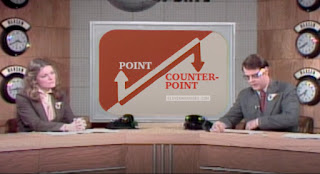
When he called dibs for a speech opposing my position, the kids started invoking a favorite Saturday Night Live sketch. We gonna have a Point/Counterpoint!
My classmate snapped out in a fair Dan Akroyd twang Heather, you ignorant slut. And we all roared.
You know, the way people do, when bantering, and invoking in-group memes, references that show that we all get the joke.
Stanton, that dick, did not get the joke.
We tried to explain the joke.
He did not want to get the joke.
I especially was anxious that he understand that this was a good joke that did not offend me and that my classmate was not bullying me. Plenty of nasty little shits doing that and never, ever being punished for it, but this was not that. And I particularly did not want my classmate to sustain a beating in the hallway because of me.
Nope.
Random hallway beating it was.
Seriously, fuck that guy.
Aaaanyway.
That's Zuckerworld, and also The House That Jack Built.
Hallway assault? Didn't see it. Vile, obscene provocation from the back row? Better not respond, you're gonna be the one that gets it. The useless little shits don't fear the random punishment, because they aren't doing anything worthwhile in the space, the beating just raised their status among the other useless little shits, and punishment isn't linked to conduct or its harm anyway, so they can just watch the kid who made an innocent SNL reference get whaled on for giggles.
So I am diversifying my communication channels. More blog entries, either here on blogger or possibly moved to a different platform at some point. Back to a stand-alone website for the training and farm businesses.
And I encourage everyone else who has got sumthin' to say to do the same. Unzuck yourself, despite the friction and some expense.
The love being your goon and enforcing your rules -- whether or not you have asked them to do so -- and they love inventing rules of their own and then making it so.
While border collies move and control stock out of an obsession with geometry in four dimensions, ES dogs crack kneecaps in the service of How Things Are To Be.
You have to be very careful that your ES doesn't go all "Who will rid me of this turbulent priest?" on you. There are certain things we do with livestock that we don't let the dogs see, or perhaps don't let immature dogs see, and others that we are careful to introduce in a very deliberate and controlled manner, so that nobody gets the wrong idea or promotes herself to a job above her paygrade.
As every stockdog and livestock guardian trainer knows, adolescence is fraught with peril even when a pup comes from genetics that are totally appropriate to the job she is doing. Pure stockdog trainers would never leave a teen pup unsupervised or only lightly supervised around stock or poultry the way we have done with six of our own dogs and dozens of young fosters.
But ES are not pure stockdogs by nature; they have a strong guardian impulse as well, deriving from the notion that the animals are ours* rather than the true LGD's conviction that he is theirs. Raising an ES puppy on a diversified farm involves some of the same risks that raising a guardian pup does; the pup will have some unsupervised time with the stock in the ordinary course of things, and teenagers can make bad decisions about fun. Once bad decisions yield satisfying results, they can escalate and become habit. There's a fine balance between too much and too little management of a developing pup.
Sammie has decided that the chickens belong in the coop.
I'm not sure where she got this idea; it has been a mild winter with very little snow, so the chooks have been free-ranging almost every day of her life. But there it is, she is much happier if they stay in the coop; barring that ideal state of stasis, they should definitely not range far away from the safety of the barnyard.
That's not how any of this works.
Frustrating her impulse for World Poultry Domination, the barnyard is partly bordered by cattle panel fences that chickens can easily slip through, but puppies over five months of age cannot.
She generally lets them be except when Perfesser Chaos or I are working in the barn or barnyard, or when she is with me as I return from the south pasture, where I have been doing a lot of maintenance work this year.
When we tested the litter for raw, incipient stock sense at the tender age of seven weeks, using tiny, ridiculous, dog-broke ducks, some of the pups already showed real power and balance. The Peanut's sister Bess was gobsmackingly precocious -- not exactly conscious of her power, but displaying it anyway. She turned the very flocky ducks by just turning her head at the proper moment. Whut did I just see?!?
My little nut wanted to play with the duckies. Sproing sproing pounce. She was a silly puppy being silly. Duckies are fun!
No worries. I've raised both precocious pups and slow-maturing ones from her family line. I was sure that it would come.
And it has.
When we approach the barnyard from the pasture and her boxy little mind decides poultry must be safe in the box, she begins to work them, showing balance and intelligence. When hens pile up in a corner, she stays off of them, gives them space to escape, but only towards the pop-door of safety. Gradually they flow in there; she has them pretty well trained that this is the best course of action.
This is what it looks like when everybody goes along quiet-like and I don't stop her on her quest for World Poultry Containment:
I have good roosters and territorial dim-bulb guinea cocks who are always the last outside. The roos take their hen-protecting jobs very seriously. That leaves them exposed as single, non-compliant chickens instead of a flock that can be managed with 4-D geometry, so they get chased. I am pretty sure that they run and squawk to distract the puppy from the hens as well, as I have seen a couple of them do once when the fox came shopping in the poultry yard. (Difference is, they then turned around and beat the fox like an old rug. This is why I have a few more roosters than I had been planning to keep. That kind of heroics earns a sinecure.)
Not chased with any intent to catch, but chased out of balance, with excessive excitement on both ends.
And that's where her big sister Verity comes in.
Verity is not at all sure about this new rule. She does not remember Momma announcing such a rule. Daddy opens the pop door every morning and lets the chickens out, so that carries the strong implication that there is no such rule.And there is definitely a rule about getting too excited chasing poultry; she and her brother Finch got their adolescent asses kicked one time on the matter of squishing a dumb turkey and pulling out feathers, and that was all it took for both of them to remember.
So Verity enforces the rule about sparking poultry. Very subtly when she can, with precisely-calibrated shoulder blocks, distraction, redirection.
More forcefully when she must -- in the form of wrestling play, but escalating to serious discipline as necessary.
It's not yet clear to me to what extent this is entirely about Respect the Rules and to what extent it may contain elements of Respect Mah Authoritah. V. is a soft, sensitive dog who feels pressure very acutely and does not attempt to social-climb; she is also a young adult English shepherd bitch looking at her more brash up-and-coming younger sister and thinking about her future.
Momma Chuck seems to be taking a very deliberate paws-off approach to this whole thing. Same with Grandma Rosie and, mostly, Uncle Cole. But if you watch the personified negative space that is Chuck, you may perceive the neutral calm that she radiates. That is itself an opinion and an influence.
I'm being a little bit more involved day-to-day. I generally tell Sammie that'll do when I see her starting to haze the birds towards the coop; the videos are to show what happens if I am not there to provide guidance. She needs to learn that they are actually allowed to play outside, and that only a few places are off-limits to them. Cooping them when there's a predator threat is obviously right on. But I also appreciate that she is practicing self-control and learning balance of the literally flightiest of livestock, and that's a useful thing for her to be developing. So I don't squash it reflexively every time. She calls off well even when things get very exciting, and that's a very good skill to work on during her adolescence, one that generalizes to so many situation where safety is at stake.
And I'm so pleased with V.'s sense of the meta-rules, and her willingness to educate her sister, that I will gently encourage her when she's unsure whether she's supposed to take action, especially when she literally looks to me for guidance. V. takes a very light touch, something that can be hard to provide amidst a family of harder characters.
I shot this as we returned from checking the south pasture growth (me) and trying to flush bunnies from the brush piles there (them), so energies were high. The hen drama as they are rousted from the lilac bush by the house has more to do with the thumping V. is giving Peanut than any overkill by Peanut. Cole participates here.
Notice that the birds have the option of just slipping through the cattle panels and stock fence to avoid the puppy prefect, but they just resign themselves and head for the pop door.
If you have trouble telling very similar-looking dogs apart here, these are their field marks:
Chuck: Two completely white front legs, minimal white collar.
Verity: Two completely white front legs, lots of full white collar, legs up to here, rather pointy
Sam Peanut: One white front leg, one mostly black, a small white neck splash, no collar Cole: Exact same markings as Sammie. Go figure. Stumpy little shit.
-----------------------------
* "We" are the humans, the pack dogs, and sometimes other privileged animals, such as our farm cats. "Ours" is the stock that belongs -- "we" care for it and protect it, but also push it around and control it. "Them" is a range of beings ranging from the mail carrier who we welcome and the hummingbirds that the humans feed all the way up to threats that are neutralized, the human miscreant at the window and the fox running off with a mouthful of feathers, the raccoons that Cole habitually murders, even the mice in the house -- not "prey" exactly, the neutral way that a cottontail is, but "intruder" to be removed or repelled.
New livestock and new dog fosters have a brief period during which the humans have to establish that they are "ours" and not "them," especially with the young dogs who don't know the drill. I'm currently teaching peanut that the new piglets are ours. She's unfamiliar with the species, but is starting to grok them after an initial bad reaction to a surprise pig-scream from an unseen monster in a barrel at the breeder's farm.
Motivated bold puppy is motivated and bold. Handler shit-eating grin is genuine. Chicken hat is awesome. Nobody slags on the chicken hat. Photo credit Michelle Silka-Eaton.
For nearly three decades, I have given every wannabe SAR handler who starts with a pup, and every puppy-owning client, the same explicit, unambiguous warning that I got when I was training Lilly.
Your bold, friendly, people-loving puppy who has no environmental sensitivities will one day lose her damned mind.
At one or more points during adolescence she will go through a developmental stage called the secondary fear imprint period. This is natural. It is normal. All puppies* experience this. For some puppies, it's a week of woofing at balloons and lawn gnomes and done. For others it's full-on panic at seeing a stranger on the street, and it may pulse in and out of her consciousness for over a month.
For SAR puppies, it almost always plays out this way:
Puppy who is advancing well in her work, ranging out independently and finding boldly, starting to do longer big-dog training tasks, and trusting herself and her marvelous nose will happen to approach a search subject (or possibly an incidental person in her search area) in such a way that she sees the person when she cannot smell the person. The person may be sitting very still, in camouflage, in shadow, or just appear from an unusual angle. The important thing is, puppy believes in her nose, and her nose is saying that there is no person there. Q.E.D. it is a monster.
Cogitate on the truth that in a dog's cognitive world, a thing that looks like a thing but does not smell like that thing is a monster.
Puppy barks, hackles, cowers, runs back to Momma. She may machine-gun bark. She's not gonna go anywhere near that enchanted stump, that vaguely human-shaped smell-less illusion.
And the handler who has been told about this exact scenario, nine times out of ten, loses her shit and forgets what to do, forgets that she was even told that this would happen, fixates on what the puppy is doing and not on what the puppy is experiencing. Oh wailie wailie my puppy is vicious and schizy and unstable!
Sigh.
That's when we hope that there's an experienced handler on the task to run the intervention, which is very simple.
Stop it!
Act like a damned grownup!
Show some leadership to your puppy! Not forcefulness. Not anger. Not cooing. Leadership.
Get the puppy downwind of the monster so that her nose can tell her what the reality is.
That's why I was stoked when I happened to get the first footage I've ever captured of a pup doing that thing they all do.
The setup of this task is simple. I wanted to use the wide-open agricultural field for young Sammie to practice ranging. There's a swale that gives enough cover for a person, and I'd sent Perfesser Chaos to hide in it somewhere. I thought I might catch some nice footage of her hitting the scent cone and working it. The wind had been shifty all day, even more erratic than usual for our part of the world.
I am walking west towards the swale while Peanut ranges. Initially the wind is coming from the north-northwest. You can see her hit the scent at about 0:32 and move directly into it, not casting across a scent cone. The topography is making the scent move directly towards her rather than disperse into a cone. At about 0:45 the wind shifts to north-northeast. At 0:49 she runs up a little bit, entirely out of the scent, and simultaneously sees PC at the bottom of the swale -- hatted, camouflaged, with a lumpy pack next to him, outline distorted by sharp shadows. (We don't do bright sun and sharp shadows in Pittsburgh. Has Sam ever seen one of us in sunglasses, even?)
A moment ago I smelled my Daddy and now there is a monster! Monster musta eated Daddy!
The background on Sam-Peanut-Horrible-Brandywine --
She's in training to be a fourth-generation search and rescue dog. Her genetic selection has been for boldness, friendliness, resilience, and a balance between cooperation and independent action, and she has displayed all of these from the time she could toddle. Her upbringing has supported those genetics. She is just turning seven months old at the time of the video.
The owner of her sire gave all the owners of the litter this heads-up -- bold, friendly, calm, chill, self-possessed Sid had experienced an acute, short-lived, and absolutely hellacious secondary fear imprint period when he was about six months old, from which he recovered fully without any lingering aftereffects or rebound episodes. So we were all watching for these transient emotional changes and prepared to understand and respond to them.
This is the kind of intel that one gets when one's dog comes from a community of breeders who pay attention, understand what they are seeing, care, and communicate. Don't expect that insight from onlinedoodlesdotcom or the retail rescue that ships wormy pitahoulas to a highway rest stop near you twice a month.
So Sammie is standing at the top of a rise in a standoff with a monster.
She considers running back to Momma, but Sammie is a brave puppy. She's a scared puppy, but constitutionally brave, and learning from her dog family about guarding the farm and livestock from raccoons and chupacabra. It would be perfectly okay for her to run back to Momma. Most puppies in this scenario -- yes, even your Rottweiler pup -- do exactly that. But she can see that I am coming, and chooses to hold off the the threat from her high vantage point. She's a bit of a Momma's girl, but that heavy attachment has more to do with FOMO than with insecurity, and she showed that to me in the moment.
It would not be okay for Sammy to flee back to the refuge of the van (across a country road from this field) or just hightail it for the hills in a panic, and this is one of a hundred reasons why dogs with weak nerves, those who are fearful as a baseline, are not suitable candidates for search and rescue training. There is no training patch that can cover that kind of temperament and make the dog safe and effective at work in a complex world where wind shifts are the least of the challenges. If the puppy enters her secondary fear imprint period with fear and flight already her baseline, any untoward events are going to be orders of magnitude more traumatic, possibly permanently scarring, however mild the trigger appears to be. The shy puppy's brain is already primed to uniformly process new as bad, and to hold on to any lesson that supports that view of the world. A pup with a weak attachment to her handler, or a handler who she fears, or a handler who is weak and fearful himself, might also flee, because the handler has not been a reliable source of authoritative safety in the past.✚
So Sam holds off the scary monster from her high position while her handler approaches, and then the wind shifts again, and just like that it's Daddy! It is a human and it is my human Daddy down there in the swale! I am so embarrassed! I am so relieved! I have found Daddy and saved him from monsters! Woo hoo!
I have observed wannabe handlers remain distressed and upset over their puppy's "aggressive" episode during what should be a collective burst of joy and relief. It's important to model good humor and happiness for the puppy. She's feeling sheepish about her mistake and has a lot of explosive emotional energy to dispel, and it should be dispelled in lap-rolling and love and play and laughter.
What to do if the wind hadn't shifted?
Ideally, if the puppy has some of her wits about her, the handler invites the puppy to walk with her and circles downwind of the monster without coming in any closer. When the puppy hits the human scent, she recovers exactly as Sam has done on her own here.
If the pup has become so overwrought that a faceful of human scent does not overcome her fear-fire-foe-flood mindset, or if some obstacle prevents the team from getting downwind, the handler should ask the subject to call the puppy in a calm, happy voice. Just talk to her.
Dogs believe their noses first, their ears second, their eyes last of everything.
If you are the monster, don't suddenly stand up and fordogssake do not move towards the puppy, but sometimes slowly removing a hat or the hood of a camo jacket or straightening up can change the picture for the tyke.✝
This may be a good time to reflect on the importance of using intelligent, fully-briefed, fully-committed helpers to hide for our SAR dogs, people who need not be experts, but who enjoy dogs and are capable of following instructions, even instructions shouted at 50' over the sound of a barking puppy.
What do handlers who have never been briefed and don't understand developmental periods and canine sensory processing do?
I've watched them attempt to force a puppy to march straight at the scentless monster.
This does not go well.
Don't do that.
Similarly, attempting to "lure" a puppy who is in a state of terror towards the terrifying thing is a disastrous shitshow. It's a good way to convince a puppy that you are a born idiot and inherently untrustworthy. The thing has to first stop being terrifying and resolve into something familiar and comprehensible, and then, if the puppy has decent resilience, you won't need any damned bribe.Nothing beyond the monster-turned-human's friendly invitation to contact and fun, all is forgiven, it was just a mistake, aren't we all silly, let's be silly here together as befits a puppy and a human.
I'm not a pollyanna, but I also tend to the point of view that Nature conserves most traits for a functional reason, and if we can understand that function we can work with it instead of at odds with Nature.
The secondary fear imprint period in canine cognitive development is there because throughout evolution, pups who go through this experience at this time were more likely to survive. It's a potential brake on the coming heedlessness of social adolescence. A few scary experiences fueled by endogenous emotions teach appropriate skepticism; recovery from the well-managed scary experiences and a resolution of the conflict that the puppy feels becomes an emotional skill, a resource for managing risk and her own emotions later in life. The apparent crisis really is an opportunity for emotional growth.
Peanut has processed her experience, and next time she sees and does not smell, she will have knowledge that is deeper and more unshakable because of the emotional charge that gaining it required of her.
___________________
* Except Mel. Mel is always the exception to every rule. She didn't have a primary fear imprint period, or a secondary fear imprint period, because she didn't know what fear was. She wasn't courageous, except morally courageous, she was fearless, confident in not only her own invulnerability, but in the power of her aegis to spread over everyone in her orbit.
It's funny how much you can learn about the mold from the one who shattered it when she was born.
✚ If you have acquired an adolescent or just pre-adolescent puppy for SAR, no matter the pup's genetic temperament and upbringing, work for several months on building up a strong attachment and relationship with the handler in safe circumstances where the chance of untoward surprises is as minimal as possible. Nobody wants to spend the next two weeks setting live traps for a teenage puppy with gazelle-speed who has gone feral because away from here felt safer than with that guy.
✝ Do not have your subject use a ghillie suit when hiding for puppies or adolescents. Those things make ya look like Swamp Thing to everyone. That's the point. Expect even well-seasoned adult dogs to react strongly the first time they encounter a subject or anyone else who is wearing a ghillie suit, even if they can smell them perfectly well. Don't spring the ghillie-suited subject on a team the first time without briefing the handler. Seriously, that is a dick move.
It's fun to mess with Our Friend Nancy. She's Minnesota Nice, a retired middle school teacher, and in the eighth grade I would have been the end of her. Douglas and I nearly were in Billings in 2009, because the only thing worse than Douglas and me unsupervised is attempting to supervise Douglas and me.
One of the things that vexes Nancy is when we call our quite feminine Brandywine Charlotte by her preferred name.
Why the hell shouldn't a girl dog answer to Chuck?
Anyway, Nancy probably shouldn't have let on that this bugs her. I mean, she has a decade of experience with me.
Chuck Chuck Chuck Chuck Chuck Chuckeeeeee.
Forget the rules, Olds. It's a new day. The gender binary is being relegated to something more like a fuzzy suggestion. A kind Millennial explained to me why it's polite for an obvious cis human to declare preferred pronouns in certain social and professional contexts and oh, that makes sense, got it. Cis is a vocabulary word. Absolutely no one is hurt by any of this change, and many people are helped a great deal. Even our understanding of biological sex is getting all shook up, that is, biologists are sharing the things they've long known with the lay world . I've personally watched a mature hen stop laying, grow spurs and hackle feathers, and start crowing. No one in the flock batted an ... well, chickens do not have eyelashes, but still. Turkeys can reproduce parthenogenically and it was not someone taking the piss out of me.
So you can see where we had to go when Chuck partnered with the similarly name-neutral Sydney to make a pile of seven little creatures who will be empowered to self-define.
But I'm still a GenXer, demography's middle child, so my cultural reference for people squirming over someone else's ambiguity in both gender and biological sex is a recurring SNL skit from 1990*, when I was young and impressionable.
Here are the It's Pat babies, in all their unique individual glory.
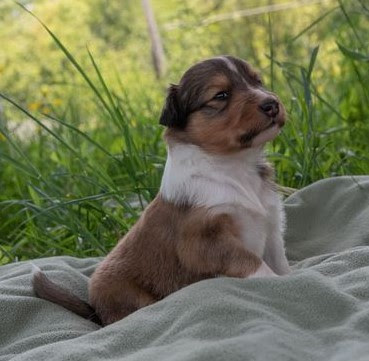
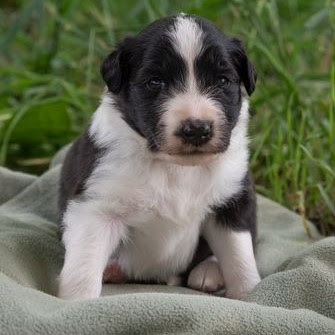
Sam is the tiniest Pat, half the size of the largest puppies. Smol but fierce. Also known as Peanut. The only Pat with a face blaze. Additional ambiguity: seal or black? Can't quite tell yet.
Robin is a big, vigorous, adventurous dark sable who will be the image of Daddy Sidney.. Robin so closely resembles Kim that I have to flip puppies over to tell them apart. Their white chest markings are slightly different.
Is Riley black and tan with minor white, or tricolor? The ambiguity in what should be a clear binary is killing me, let me tell ya.
Kim looks like Robin, Robin looks like Kim, you got that, right? It's like that with siblings sometimes.
Billy is seal and was the first Pat to make a big deal out of finding the newspapers to wee. Remember, everypuppy squats.
Jamie is the firstborn, and can be distinguished among the seal puppies by a white nose smutch. The firstborn thing doesn't matter because inheritance laws have changed.
Val is seal. You can tell Val from Billy by the shape of their chest markings, but it's otherwise hard. Val is short for Vaaaaaal.
----------------------------------------------
* Also a feature-length film that garnered a coveted 0% on Rotten Tomatoes, of which we will not speak. Pat portraits are by Mary Cvetan. If you would like to schedule a photo shoot for your animal(s) in the Greater Pittsburgh, PA area, contact her directly.