I partner with English shepherds in my work. I breed and raise them to be as intelligent as possible -- no prudent stops on cognition, designed to make the beasts easier to live with. You want to live with an English shepherd, it's your job to make it easy by co-opting that brain, not suppressing it.
So I am not easily impressed.
This video left me gobsmacked.
It's a cute two-minute clip of a goofy dog playing with the hose, right?
This canine engineer is the prophetically-named Sagan.
You may know him as Garrett, son of Rosie.
He went home to live with Eric and Braveheart in Connecticut. A third (genetic) or fifth (cultural) generation dog trainer's assistant.
And he knows how to position a hose so that the water makes the arc he wants. In fact, without resorting to opposable thumbs, he does better at it, with fewer errors, than I typically do when I'm trying to water something in the garden and want to put the hose down for a spell.
Most "experts" will tell us that dogs are not cognitively capable of the kind of calculation that Sagan performs here.
And consider -- he is a teenage dog, very recently introduced to the joys of hose-play, and is in an excited and slightly frustrated frame of mind. Not a recipe for successful rocket surgery.
No one screwed around with a clicker and treats to manipulate Sagan into picking up the end of the hose. Nobody manipulated successive approximations towards an arc of flowing water. Eric just gave his puppy the latitude to find what he enjoys and experiment with it.
A dog who is selected to be intelligent, and then empowered to be intelligent will always exceed the expectations of those who have dismissed them as "lemon brains."
Sometimes he will even leave his proud grandma with her jaw hanging slack.
Update:
The video is starting to go viral, with over 5400 pageviews in the last 16 hours.
And has been picked up by MSN. Where they employ someone who understands English shepherds astonishingly well.
Showing posts with label dog behavior. Show all posts
Showing posts with label dog behavior. Show all posts
Saturday, July 14, 2012


Wednesday, September 7, 2011
Base Seven
One of the gospels of dog breeders who make a good-faith effort to do right by their puppies is the popular "Rule of Sevens."
Not a bad floor. If someone pays enough attention to a litter to meet this criteria, it's likely that the pups will go to their homes well-socialized and fairly resilient, ready to be well-adjusted pets or show dogs.
But if one is aiming to develop the most confident, flexible, intelligent, unflappable working companion allowed by each pups' genetics, one should be aiming higher and thinking more about process than checklists.
When I learned to do bodywork on animals, my witch doctor friend Maryna taught us a low-velocity, deep-penetrating pulse in-hold-pulse out pattern. One's fingers "intrude" on the muscles, ligaments, and tendons, remain at the point of deepest intrusion until they detect the desired change (a release of tension, or of some of it) and then gradually retreat, allowing the animal's mind and body to register the change and assimilate it into the whole.
This principle of pressure and release works in behavioral rehab, too -- you push your student/patient/subject to the point of discomfort, hold that degree of pressure while the mind copes with the challenge and achieves some incremental change, and then gradually take the pressure off, allowing a period of rest while the change assimilates into the whole animal.
Without pressure -- challenge -- there is no forward momentum. Without pausing and holding the pressure, there is no change. And without retreat and rest, there is no processing of what just happened, no long-term application.
The Roseannadannas don't need rehab. They are clean and shiny and new; they are perfect, and so is their world. But their world will expand, and they will expand to meet it, through the same process of pressure, hold, release.
Much of the "pressure" comes from inside the puppies. They are bursting to grow. They push their own comfort levels in order to satisfy their intense curiosity. This is the pressure to expand that is natural to every intelligent creature, and all we need to do is support it.
Monday they were enjoying their free-range time. Now, whenever I can, I close the gates and open the doors so that they have access to the puppy-proofed kitchen and living room, the deck, and the whole outdoors via the front door (which opens from the kitchen). They are lightly supervised as we go about our business. The big dogs can mingle with them, or go in the back door to the parts of the house that are gated off -- pups can't get there yet. There's nothing between pups and poultry other than the poultry's good judgement and speed.
In general, they move in groups -- this is their time to learn about dog society with one another. They spend a lot of time playing and contending, and a lot of time sleeping. They play with Cole or Ernie or mob their mother. They play with any humans who are among them. The social world takes precedence.
But some of the time, they are pulsing out -- pushing the physical boundaries of their world. On
Sunday, the theme was to climb the landscaping boulders in the front yard, push leads into their crevices, and generally work in three dimensions. Monday we were all about getting into the mint patch for a little aromatic puppy caving. (Few photo ops in that endeavor.)
Generally, when I walk a hundred feet from the front door, the pups fall back. But not always. On Sunday, Garrett followed me all the way to the barnyard for night chores, then found his way back without drama. This meant negotiating some stone steps, down and then up. Monday, tiny Gilda followed me to the pole barn, hung out while I assembled tools, and then followed me back. These are long treks for little puppies, precursors of the pack walks that will start in a few days.
As they develop, we also provide some pressure -- not often to push them further outwards, but to direct their expanding psyches.
Chevy roo-roos and wants to be picked up. I love his drive to engage a person, but he's a bit pushy and full of swagger. I pick him up and cradle him, and he becomes slightly stiff -- he did not want to be cradled on his back, he wanted to come into my lap and nibble my chin and generally have me enable his agenda. I keep him cradled and he pitches a minor tantrum. Alas, it does not succeed in granting him his wish. When the tantrum abates, not before, I set him upright in my lap for stroking and kissies. Pressure ... hold ... hold ... hold ... hold ... releeeease. We will repeat this many times.
Gilda is playing with a bit of cotton rope. I take the end and apply gentle traction. We play "tug" while I stroke her whole body with long, firm, calming strokes, the way I've seen the best schutzhund trainers work with a young puppy. Nothing exciting, no thrashing around, no proving I'm stronger than a five-pound furball. Her grip stays firm. I let the rope slide out of my hand (gradual release). We will teach her to release a toy in a few weeks. To my delight, when she finds she has full possession of the rope, she cheerfully brings it back to me and asks me to re-engage. Playing with someone is more fun than having something. A lesson she will learn many times, in many contexts, until one day she is teaching it to some pup in the dog park or some toddler who is learning about grabbiness.
The pups have the routine and the familiar, and they have challenges to the routine and familiar. I put a new obstacle onto the deck -- it is a challenge and a diversion. Can I climb on it? Under it? Does it move if I hit it? Is it shreddable? This is exciting! But other things stay the same. If I get too stimulated, I can always go sleep on my same pillow with my same brother. Mother changes -- now she says no to me, and sometimes she plays with me -- but she is also the same -- she smells the same and the milk still tastes so good and she still cleans me like she did the minute I was born. With every pulse of pressure to grow and change, there's a corresponding path back to the familiar, a physical or emotional space to rest and contemplate that becomes the springboard to dive back into the unfamiliar. Each pulse-hold-release strengthens the whole pattern, until the familiar becomes the puppy's own sense of herself, and to the degree that her genetics permit, nothing can faze her.
Wednesday, August 10, 2011
Bye Bye Baby(hood)
With the appearance of all their tiny peepers over the weekend, the Roseannadannas are officially no longer neonates.
They've now entered the week of their life that has long been relegated to, in essence, "miscellaneous" or "other" or puppy limbo -- what behavioral researchers call the "transitional" period, prior to the explosion of learning and brain pruning between the ages of three to twelve weeks.
As neonates, they experienced three different puppy dens and a Moses-sized wicker basket. A couple days after the first Moving Day, Rosie decided that she didn't want to give up the company of the rest of the family in order to care for her puppies. So, until they start eating solid food, they all get loaded into their Moses basket at night and come upstairs to bunk in my bedroom closet. Most mornings they get breakfast in bed -- a chance to imprint on human scent, snuggle, bump into Uncle Moe, and occasionally plop off the edge of the bed, lemming-fashion, and promptly fall asleep on the rug. Then, downstairs to the day den.
Their eyes opened precociously. They are sometimes getting their feet underneath themselves. I'm hearing proto-barks and liquid little growlettes among the squeaking, crying and puppy whale song. They recognize the existence of people and toddle closer, even climb into laps. They are great climbers; whenever I didn't provide lumps and bumps and texture changes in the puppy den, Rosie would heap the bedding into an infant monkeybars structure.
They are rather relaxed about handling. I'm still looking for that orienting reflex that allegedly "forces" a young puppy to right himself when he finds himself saluting the sky. Their reflex on being picked up and put in nearly any position is to go slack and fall asleep. They especially love being cradled.
If altricial infants can be said to "imprint," they have been imprinted on the scent and touch of human beings and the rest of their dog family, a great springboard for multi-species socialization.
They've now entered the week of their life that has long been relegated to, in essence, "miscellaneous" or "other" or puppy limbo -- what behavioral researchers call the "transitional" period, prior to the explosion of learning and brain pruning between the ages of three to twelve weeks.
(Select little speech balloon to view captions)
As neonates, they experienced three different puppy dens and a Moses-sized wicker basket. A couple days after the first Moving Day, Rosie decided that she didn't want to give up the company of the rest of the family in order to care for her puppies. So, until they start eating solid food, they all get loaded into their Moses basket at night and come upstairs to bunk in my bedroom closet. Most mornings they get breakfast in bed -- a chance to imprint on human scent, snuggle, bump into Uncle Moe, and occasionally plop off the edge of the bed, lemming-fashion, and promptly fall asleep on the rug. Then, downstairs to the day den.
Their eyes opened precociously. They are sometimes getting their feet underneath themselves. I'm hearing proto-barks and liquid little growlettes among the squeaking, crying and puppy whale song. They recognize the existence of people and toddle closer, even climb into laps. They are great climbers; whenever I didn't provide lumps and bumps and texture changes in the puppy den, Rosie would heap the bedding into an infant monkeybars structure.
They are rather relaxed about handling. I'm still looking for that orienting reflex that allegedly "forces" a young puppy to right himself when he finds himself saluting the sky. Their reflex on being picked up and put in nearly any position is to go slack and fall asleep. They especially love being cradled.
If altricial infants can be said to "imprint," they have been imprinted on the scent and touch of human beings and the rest of their dog family, a great springboard for multi-species socialization.
Tuesday, August 2, 2011
Brain Breakfast
Old wive's white-coats' tale -- you can't teach a puppy anything before his eyes open.
I know, I know -- paint drying. But it is fast-drying paint.
Some important points. No puppy is in any given position for more than five seconds. And you only do this once a day. (We couldn't do a second take yesterday for this video.)
One isn't evaluating puppies during this exercise. Whether puppy sleeps or squirms is of no consequence. This is neurological stimulation -- a little bit of challenge that the puppy would not normally get.
Two things I've noted over the course of five days:
• The puppies are responding much more vigorously to the head-down position, and are squirmier in general.
• The puppies are dramatically relaxing in the belly-up position, a little more each day. I don't know whether that can be attributed to the short stimulation sessions, or if it is due to all the snuggle time they spend in this position, in a lap or tucked under someone's chin. Their epic six days of experience on the part of the planet that is not the inside of their mother is already overriding their programmed reflex to right themselves when tits-up, at least when the touch and smell of a human being is part of the equation. This will stand them in good stead in their lives with people, no matter what jobs they hold.
_______________
* "Early in our observations of newborn puppies, we noticed that they did not seem to learn by experience. A puppy would fall to the edge of the scale platform, fall off, and begin to yelp in distress. When placed in the middle of the platform, it would do the same thing over again ... Some recent experiments (Stanley et al 1963) indicate that the puppy is capable of some degree of slow learning with regard to sucking. A puppy which is given milk after sucking a rubber nipple will eventually begin to suck more often than a puppy which is not so rewarded, and one that is given quinine instead of milk will eventually refuse to suck the nipple at all."
Genetics and the Social Behavior of the Dog, 1965, pp. 87-88.
** Before he went all woo-woo.
No less a pair of authorities than Scott and Fuller proclaimed it, more or less.* After all, neonatal pups are blind, hear poorly, and don't get around all that well. Terrible at mazes. Nevermind that their little noses can lead them to the biggest nipple in their dark, warm world. Humans are a bunch of sight snobs. Worse than our hangup about thumbs.
Michael Fox** discovered that neonates could be conditioned to localize the scent of anise, but essentially concluded that this was as far as it goes.
Jebus Christmas -- they are living, growing beings. They don't just wake up from a coma at three weeks of age. Shit is happening.
Differential equations and whistle commands -- save it.
Neurological connections, resilience, trust, persistence, scent-imprinting -- now we're talking.
While the neonates' nervous systems are pruning and strengthening connections, their immune systems are also beginning to develop under the protection of mother's magic colostrum.
Interestingly enough, the same kinds of mild challenges can strengthen both body systems, just as massive insults to one can throw the other out of whack. (The immune system/nervous system nexus is huge and unappreciated. The New Agers basically ate the white-coats' lunch on this one, and it will be a while before those who apply the scientific method sheepishly catch up and distinguish the valid information from the moonbeams.)
Our "program" for imprinting and stimulating neonatal puppies is mostly the terrible chore of picking up little grunting sausages for snuggle time every day. I know! What we breeders sacrifice. Zrrrbting pink bellies, nibbling tiny toes, smooching little schnozzes -- oh the humanity.
But we do some extra stuff, too. We get a head start on the "Rule of Sevens" and make sure that the pups experience different surfaces in the whelping box. (With this litter, Rosie is intent on making sure they experience four or five different dens in the first two weeks -- still fighting that battle.) We create little moraines under their blankets, so that puppies must climb obstacles to reach the milk bar. (Or Rosie bunches the bedding into Mount Pupali and really gives them a workout.) As soon as Momma allows, pups are touched and cared for by their relatives -- Gramma Pip and Uncle Moe are already cleaning pups. And we do "Superdog" early neurological stimulation -- a little first taste of challenge for the puppies' developing brains and nervous systems.
The neonatal exercises arose from the DoD's "biosensor" program -- an attempt to breed and develop a better military working dog -- in the 1970's. The "Superdog" breeding, developmental, conditioning and training protocols were mostly cloaked in obscurity -- possibly secrecy -- but a few consultants, including the late lamented Cap Haggerty, brought results and protocols out into the light. While the program itself was not a success -- whether due to errors in breeding selection, failure to follow up with appropriate socialization, training shortfalls, or the interaction of all three -- there was a general consensus that the neonatal conditioning, once initiated, improved the results within the program.
It takes only a few minutes a day. Used as directed it does no harm, and may do considerable good.
I've never seen photographs or video of the process, so here you go. Apologies for the poor video quality -- lighting is poor in our living room, and my video camera batteries were all dead, so we used my regular camera. Cutting off the puppies' heads is a YouTube issue -- they were properly framed in the original. My assistant didn't feel confident panning and zooming, so we put the camera on a tripod. And I wasn't sure that it was properly recording audio, so I didn't narrate what I was doing.
Our "program" for imprinting and stimulating neonatal puppies is mostly the terrible chore of picking up little grunting sausages for snuggle time every day. I know! What we breeders sacrifice. Zrrrbting pink bellies, nibbling tiny toes, smooching little schnozzes -- oh the humanity.
But we do some extra stuff, too. We get a head start on the "Rule of Sevens" and make sure that the pups experience different surfaces in the whelping box. (With this litter, Rosie is intent on making sure they experience four or five different dens in the first two weeks -- still fighting that battle.) We create little moraines under their blankets, so that puppies must climb obstacles to reach the milk bar. (Or Rosie bunches the bedding into Mount Pupali and really gives them a workout.) As soon as Momma allows, pups are touched and cared for by their relatives -- Gramma Pip and Uncle Moe are already cleaning pups. And we do "Superdog" early neurological stimulation -- a little first taste of challenge for the puppies' developing brains and nervous systems.
The neonatal exercises arose from the DoD's "biosensor" program -- an attempt to breed and develop a better military working dog -- in the 1970's. The "Superdog" breeding, developmental, conditioning and training protocols were mostly cloaked in obscurity -- possibly secrecy -- but a few consultants, including the late lamented Cap Haggerty, brought results and protocols out into the light. While the program itself was not a success -- whether due to errors in breeding selection, failure to follow up with appropriate socialization, training shortfalls, or the interaction of all three -- there was a general consensus that the neonatal conditioning, once initiated, improved the results within the program.
It takes only a few minutes a day. Used as directed it does no harm, and may do considerable good.
I've never seen photographs or video of the process, so here you go. Apologies for the poor video quality -- lighting is poor in our living room, and my video camera batteries were all dead, so we used my regular camera. Cutting off the puppies' heads is a YouTube issue -- they were properly framed in the original. My assistant didn't feel confident panning and zooming, so we put the camera on a tripod. And I wasn't sure that it was properly recording audio, so I didn't narrate what I was doing.
I know, I know -- paint drying. But it is fast-drying paint.
Some important points. No puppy is in any given position for more than five seconds. And you only do this once a day. (We couldn't do a second take yesterday for this video.)
One isn't evaluating puppies during this exercise. Whether puppy sleeps or squirms is of no consequence. This is neurological stimulation -- a little bit of challenge that the puppy would not normally get.
Two things I've noted over the course of five days:
• The puppies are responding much more vigorously to the head-down position, and are squirmier in general.
• The puppies are dramatically relaxing in the belly-up position, a little more each day. I don't know whether that can be attributed to the short stimulation sessions, or if it is due to all the snuggle time they spend in this position, in a lap or tucked under someone's chin. Their epic six days of experience on the part of the planet that is not the inside of their mother is already overriding their programmed reflex to right themselves when tits-up, at least when the touch and smell of a human being is part of the equation. This will stand them in good stead in their lives with people, no matter what jobs they hold.
_______________
* "Early in our observations of newborn puppies, we noticed that they did not seem to learn by experience. A puppy would fall to the edge of the scale platform, fall off, and begin to yelp in distress. When placed in the middle of the platform, it would do the same thing over again ... Some recent experiments (Stanley et al 1963) indicate that the puppy is capable of some degree of slow learning with regard to sucking. A puppy which is given milk after sucking a rubber nipple will eventually begin to suck more often than a puppy which is not so rewarded, and one that is given quinine instead of milk will eventually refuse to suck the nipple at all."
Genetics and the Social Behavior of the Dog, 1965, pp. 87-88.
** Before he went all woo-woo.
Tuesday, July 26, 2011
"Lack of Any Useful Purpose"
The use of rubber hands and creepy dead-eyed dolls and other witchdoctory in the process of "temperament testing" dogs in pounds and shelters is, shall we say, controversial.
I mention that right out, because those who have infected the nation's animal shelters with a strange and unsupported dogma about "safety" and "prediction" like to pretend that their religious faith is a done deal -- that it represents an established standard of practice, and that failure to meet same is a invitation to charges of negligence.
My first personal goal in flying to Montana to help with Operation New Beginnings in January 2009 was to do what I could to ensure that the dogs weren't signed over to an organization that would summarily kill them without any evaluation or attempt at rehab, as the HSUS had done to the Kapsa Shelties, their predecessors in the Ballantine puppymill, some years before.
My second personal goal was to prevent anyone terrorizing these animals with hoodoo "temperament tests" while the cart with the syringes waited out in the corridor.
Fortunately I was not the only person who thought this way, and the universe was spared the spectacle of Barry White, Curly, Suri, Sparky, et. al. being chased into a corner by Bride of Chuckie and then declared irredeemable dangerous.
No matter. Let us, for the sake of argument, assume that there is some validity to the Poke-It-Till-It-Bites school of "temperament testing." Let's play make-believe that these tests are predictive, and that animals who "fail" by biting a rubber toy or showing "aggression" to a dolly are dangerous and unsalvageable, and those who "pass" by declining to do so are uniformly idiot-proof.
If we do that, can we agree on what an unequivocal "pass" looks like? I would have thought that we could. That, say, if a dog is in the top 1% of wonderfulness when confronted by insanity, that reasonable observers -- including "experts" -- would agree that such a dog is worthy of life.
Consider this four minute evaluation of a dog being held in a shelter in Michigan after being seized in a raid on a "dog fighting operation."
Here's the same girlie on her "dog aggression" (aka, "let's see if we can set up a dog fight") test:
What do y'all think of how this plain brown dog did on her test?
How would your family pet fare under the same circumstances?
I think that, based on Dusty's performance on this "test," I'd take her as a foster in a New York minute. If, after a few weeks of evaluation (and of course, obedience training, because isn't she just begging for direction?) she proved herself to consistently be the dog I think I see in the videos, I'd especially recommend her for a home with kids.
Here's what VMD, PhD, tenured "behaviorist" Katherine Albro Houpt of Cornell University saw. (She is the person in the khaki trousers who is taking notes and doing most of the poking and chasing.)
Thus leading to the order for Dusty, Monroe, and Riley's deaths.
There's a petition on Change.org asking Herr Doktor Professor Houpt to retract her recommendation that these dogs be killed. Not sure what good it would do if she did. I have no faith that a multi-degreed authority who sees a "public safety threat" in the supernatural forbearance of a sweet, wiggly, peaceful, lovey dog can ever be expected to act rationally or with regard to the facts or the truth. But I signed, on the principle that doing so adds my name to the record, to the thousands of gobsmacked animal lovers who have eyes with which to see.
As a cynic, I'm inclined to think that the epitaph "Lack of any useful purpose" could be appropriately scribed on any number of gravestones. There are days when people seem to line up for the honor. I can think of some candidates right here.
But it is not the authoritative coda to the life of a wiggle-butt pit bull who has been sentenced to die for the offense of being a crime victim.
___________
More Blog Posts
For the Pit Bulls
KC Dog Blog
Yes!Biscuit
Petbulls
Web and News
Buster Foundation
Monroe News
I mention that right out, because those who have infected the nation's animal shelters with a strange and unsupported dogma about "safety" and "prediction" like to pretend that their religious faith is a done deal -- that it represents an established standard of practice, and that failure to meet same is a invitation to charges of negligence.
My first personal goal in flying to Montana to help with Operation New Beginnings in January 2009 was to do what I could to ensure that the dogs weren't signed over to an organization that would summarily kill them without any evaluation or attempt at rehab, as the HSUS had done to the Kapsa Shelties, their predecessors in the Ballantine puppymill, some years before.
My second personal goal was to prevent anyone terrorizing these animals with hoodoo "temperament tests" while the cart with the syringes waited out in the corridor.
Fortunately I was not the only person who thought this way, and the universe was spared the spectacle of Barry White, Curly, Suri, Sparky, et. al. being chased into a corner by Bride of Chuckie and then declared irredeemable dangerous.
No matter. Let us, for the sake of argument, assume that there is some validity to the Poke-It-Till-It-Bites school of "temperament testing." Let's play make-believe that these tests are predictive, and that animals who "fail" by biting a rubber toy or showing "aggression" to a dolly are dangerous and unsalvageable, and those who "pass" by declining to do so are uniformly idiot-proof.
If we do that, can we agree on what an unequivocal "pass" looks like? I would have thought that we could. That, say, if a dog is in the top 1% of wonderfulness when confronted by insanity, that reasonable observers -- including "experts" -- would agree that such a dog is worthy of life.
Consider this four minute evaluation of a dog being held in a shelter in Michigan after being seized in a raid on a "dog fighting operation."
Here's the same girlie on her "dog aggression" (aka, "let's see if we can set up a dog fight") test:
What do y'all think of how this plain brown dog did on her test?
How would your family pet fare under the same circumstances?
I think that, based on Dusty's performance on this "test," I'd take her as a foster in a New York minute. If, after a few weeks of evaluation (and of course, obedience training, because isn't she just begging for direction?) she proved herself to consistently be the dog I think I see in the videos, I'd especially recommend her for a home with kids.
Here's what VMD, PhD, tenured "behaviorist" Katherine Albro Houpt of Cornell University saw. (She is the person in the khaki trousers who is taking notes and doing most of the poking and chasing.)
Dog 206 in cage 33 brown female with white markings Dusty
Wiggled at approach, stare and squat. Bit hand when petted and when eating.
avoided witch
Snarled at doll
jumped but no aggression to male or female dogs
The results of the testing indicates that the following animals: the two males Monroe 207 Reilly 212 that both demonstrated aggression to other dogs and one female Dusty 206 who snarled at the doll should be humanely euthanized because of their lack of any useful purpose and the public safety threat they pose." MCL 750.49(18) aggressive whereas Dog 210 Razzle --- may be safe
Katherine Albro Houpt VMD PhD
Professor emeritus
Cornell University
Thus leading to the order for Dusty, Monroe, and Riley's deaths.
A judge this afternoon ordered three of the four pit bulls seized during a dog-fighting raid in March to be euthanized.That order dates from July 14. Dusty, Monroe, and Rily's advocates have until the 4th of August to appeal this ruling. I'm trying to find out more about the legal process, and will update here or in the comments.
First District Judge Jack Vitale made his decision following hours of testimony from several witnesses over a three-day period.
No action will be taken for the next three weeks, the time permitted for attorneys to decide if they want to file an appeal. Tracy Thomas, who has represented the organization fighting to save the dogs, said after the decision that he is undecided if he will appeal the judge's ruling to a higher court.
The one dog that was deemed safe has been named "Razzle." Judge Vitale said based on the evidence, the dog is not dangerous and can be released to the Buster Foundation after the 21-day rule. However, the other three -- called "Monroe," "Riley" and "Dusty" -- were determined to show aggressiveness and pose a danger to the public, so they must be put down.
There's a petition on Change.org asking Herr Doktor Professor Houpt to retract her recommendation that these dogs be killed. Not sure what good it would do if she did. I have no faith that a multi-degreed authority who sees a "public safety threat" in the supernatural forbearance of a sweet, wiggly, peaceful, lovey dog can ever be expected to act rationally or with regard to the facts or the truth. But I signed, on the principle that doing so adds my name to the record, to the thousands of gobsmacked animal lovers who have eyes with which to see.
As a cynic, I'm inclined to think that the epitaph "Lack of any useful purpose" could be appropriately scribed on any number of gravestones. There are days when people seem to line up for the honor. I can think of some candidates right here.
But it is not the authoritative coda to the life of a wiggle-butt pit bull who has been sentenced to die for the offense of being a crime victim.
Comments on this post are invited. Anonymous comments that call for retribution against Ms. Houpt will not be posted. Alas, few receive what they deserve in life, one way or the other, and it is not up to the anonymouse internetz to provide it.
___________
More Blog Posts
For the Pit Bulls
KC Dog Blog
Yes!Biscuit
Petbulls
Web and News
Buster Foundation
Monroe News
Sunday, February 13, 2011
Take Two, They’re Small
It was a great compliment to a newly-minted dog handler to be asked by my training mentor to evaluate a litter of puppies to identify the search and rescue prospects.*
The big litter of superficially near-identical black German shepherds was from her own breeding, offspring of two SAR dogs. The buyers were a family from Pennsylvania who already owned two of her dogs, both operational SAR dogs. It was time for them to start bringing along a new pup to eventually succeed their oldest bitch.
After messing with the pups for the better part of a day -- observing the litter interact amongst themselves, taking them out one at a time for some formal puppy tests and informal play and mild stress, watching them move -- I arrived at the same answer that their breeder had. “Either of these two bitch puppies is an excellent prospect. And I can find no reason to prefer one over the other. I think they might be actual identical twins.”
A few days later Martha and Dan, SAR dogs JT and Schatten, and Martha’s two teenage boys arrived in an SUV the size of a city block, to visit for a few days, train, and choose their new puppy.
I liked them. We had a lot of fun navigating the baffling New Hampshire topography behind Annabella’s cabin. It was refreshing to cross-pollinate with handlers from another unit who were not using the interaction as an opportunity to gain local political advantage or attempt a mean-spirited alpha roll on the New Kid.
Martha agreed about the two bitch puppies. She spent three days with them, and could find nothing to favor one pup over the other. So she took them both.
Annabella tried to talk her out of this course of action, but in the end relented. Martha and Dan insisted that each one would train a pup.
Less than a year later, Perfesser Chaos took a new job. We packed up Lilly, two cats, all our crap, and the lives we had started in New England and relocated, Clampett-like, to Pittsburgh. We weren’t close enough to Martha to join her SAR unit, but it was nice having a friend and guide in the general area. Their spacious home, set back in the woods near the Laurel Ridge, was our rural refuge, as Annabella’s Unabomber cabin had once been.
Things were not going as one would hope with the puppies, Lauren and Danielle.†
They were still physically indistinguishable (to me) -- color-coded collars were a necessity. But one puppy (I cannot remember which one, seventeen years later) had taken on the role of leader, the other of follower. It was fortunate that the dichotomy was as strong as it was; that’s probably what spared that family the fun of littermate bitches deciding to kill one another at unpredictable intervals.** The fact of the relationship -- the absolute need that dogs have to define their roles relative to their packmates -- cause the identical puppies’ personalities to diverge much more dramatically than they would have under other circumstances.
Indeed, at a year of age, they were still “the puppies.” At two, three years of age, “the puppies.” No real progress towards operational status that I could see, and general arrested development compared to their own older dogs, and other SAR dogs of the same cohort.
One divorce and many life changes later, Martha and Dan split up “the puppies.” Each ex-spouse went away with one good older SAR dog and one unfocused, slightly neurotic, unfulfilled young pet. Neither ever fielded a second SAR partner.
Well what does all that matter to me? you say, I just want dogs as pets.
Two puppies will keep one another company, so I can go to work and not feel guilty. It’s a lot of fun watching them play with one another. And they never have to go through the full trauma of leaving their first family. They’ll be friends all their lives, so we don’t have to identify other dogs with whom they can socialize. Throw in a fenced yard -- no need for time-consuming leash walks.
Oh the temptations.
If I wasn't so aware of the number of hits this post is likely to receive from people looking for validation for a decision to buy two puppies, I'd give you the phone number of the clients who called me two weeks into their two-puppy adventure. They were "smart." They didn't buy littermates (partly because they had a thought of breeding the two German shepherd pups in the future.) They got a big robust bitch puppy and a smaller, more retiring dog puppy who was a week or so younger, from a different breeder. The two pups commenced ignoring every human directive, enticement, and entreaty, while the bigger pup began mercilessly bullying the smaller one.
When they called me, this couple who had successfully raised three children had not slept in a fortnight. I felt as if I'd come to help the parents of quadruplets who were both suffering from post-partum depression.
I was able to help quite a bit with puppy management, training, general stress levels. This was a couple who really wanted to do right by their dogs, had high expectations of them, and had found themselves completely unprepared for the onslaught.
I’m down to one Indiana Plague Puppy; Donna went home this morning. They are about 13 weeks old now, several weeks older than the optimum age for going to their permanent homes. Puppy care just got harder.
Four puppies was herding a troupe of striped-assed baboons. Two puppies are half as many as four -- half as much poop, half as much cuddling, half as much training, half as many little ferrets diving for the door or scattering like cockroaches when I needed to contain them.
Two puppies is not, however, twice as many as one. I haven’t yet suffered through a sleepless night of foresaken wailing. I could gate the two of them in the puppy-resistant kitchen for long periods and they entertained one another. I called the puppies, and if one was inclined to come to me, the other almost invariably followed. If I corrected a pup for mouthing me while she was in a ripping frame of mind, she just turned to her sister and piled on -- redirection always available..
In short, raising two puppies rather than one makes it easy and apparently consequence-free to neglect them both. It is the canine developmental equivalent of parking the toddler in front of Gilligan’s Island with a bag of gummi worms and a loaded diaper.
He’s not just less likely to get into Stanford in the long-term; he’s significantly more likely to treat you to phone calls from the school principal and later, the police chief. Or, better yet, to be living in the basement eating your Hot Pockets when he's 35.
I departed from the easy path in several ways. I separated the pups for some period of time every day, taking them each out for leash walks that were, from the standpoint of exercising puppies, entirely gratuitous. They ate from separate bowls, spent time in separate crates, had separate lap-times. But mostly, they were “the puppies.” Neither had launched out of her natal pack and into a new life in a human family.
There are things they ideally should have started learning at seven weeks -- the age at which they found themselves in the dog pound, riddled with cooties, and still a week from coming into foster care where we could begin to address their vetting and start matching them with potential adopters.
It’s neither wise nor productive to unleash two uncivilized puppies -- much less four of them -- into a non-puppy-proofed area of the house. While you are rescuing a shoe from one varmint, another one is behind the TV eating power cord. Whisk one outside when she circles and sniffs, and her brother is makes a deposit to greet you at the door on the way back in. So they lived in the kitchen and did not learn to leave my stuff alone and ask to go out.
One puppy sat sweetly for a treat or attention, another jumped on her head and started gnawing as the human reached down. Each learned that sitting sweetly for what she wants is asking for an ambush -- much better to keep leaping on my legs like a wild heathen.
Shout NO as a pup engages in suicidal or criminal misconduct, and his sister who was innocently playing with a new toy is hit with discipline shrapnel. Uh oh, maybe I shouldn’t play with my toy. Or, maybe this “No” thing is overhyped, and I can ignore it.
One puppy runs from the giant rattling monster garbage bin that is chasing her down the driveway, and her sister concludes that it must be terribly dangerous, and follows in retreat. The fact that the grown-up dogs and the human aren’t a bit worried about this thing doesn’t get through the collective puppy panic.
As a result, the last two girlpuppies were, as of 6 a.m., pig-ignorant barbarians compared to any single pup we have raised. The latest we have ever had littermates together was eleven weeks. At thirteen weeks, the girls were on the verge of overripe; when they had the rips, they were about as tame and approachable as these:

Which, frankly, they closely resembled in more ways than I care to contemplate.

The developmental window for primary socialization and learning has not closed. They will be just fine. And they are still miles ahead of our group-raised ONB puppies, some of whom were with their littermates to the age of eight or nine months.
One or two more weeks of litter-living, though, and these pups would be courting real developmental challenges.
Starting today I am sucking it up and raising one puppy properly, as if she was my own, until she goes to her permanent home. The adult dogs -- trained, civilized,‡ full members of a human family with all the privileges and duties attendant thereof -- act as uniform assets in the pup’s upbringing. They teach her things that can be best, or only, learned from another dog, and they reinforce the policies and procedures of the human household. But the real work will be down to me and PC. Little Susie is Canis lupus familiaris, not plain ol’ C. lupus. She needs to look to human beings for her physical needs, play, direction, leadership, an explanation of her world. As her foster humans, it's our duty to prepare her to keep doing that all her life.
And Miss Susie is already doing this; there is a dramatic change in her compared to last night. I liked her before; now I really enjoy her puppy company.
Here's some free unsolicited advice:
Never buy or adopt two puppies the same age to raise together. Especially littermates. Especially same-sex littermates.
Do. Not.
Here's some more:
If you are a breeder, or place puppies for adoption, never sell or adopt two same-age puppies to one home.
Never. Ever.††
You don't see that "never" here very often. Here's how important I think this is: It is more unwise to buy two well-bred puppies from a breeder who raises them skillfully and lovingly, and bring those puppies up together in the same household, than it is to buy a puppy from the deli case at Petland.
A breeder worth her salt knows this. She won't sell you a set. She most certainly won't offer, suggest, market, discount or hard-sell pups in pairs. Wanna test the balance between a breeder's behavioral savvy and her walletitis? Ask her to sell you two at once. If she says O-tay, walk away clean.
_______________________
* In retrospect, this may have been one of Annabella’s characteristically opaque Zen master lessons about what she thought I had actually done right with my first SAR dog, a truth that I later discerned about myself: I’m a fair to-middling-trainer. What I am good at is selecting puppy prospects who can withstand ham-fisted management, beginner’s mistakes, bad training methodologies, rotten timing, and the whole litany of handler incoherence -- pups who are nearly idiot-proof.
† Martha had a husband named Dan, a son named Dan -- why not just go with it again? Yell out “Dan!” and see how many beings answered.
** Two bitches in the same household who have each decided that the other needs to Go Away Permanently are among the least-favorite projects that face any dog trainer. When those two bitches are littermates whose owners earnestly believe they should loooove one another because they are sisters -- chewing up and swallowing a box of lightbulbs with a Betadine chaser ranks higher on the list of things to do today.
‡ And Sophia. Sigh. She is as God made her.
†† Of course not. Pack hounds. Buy whole litters of 'em and keep 'em in the kennel. It's all good. Carry on. I'm talking about pets, and working dogs that are not pack-hunting hounds.
Also, does not apply to cats. Kitten pairs work well, especially for owners who need them to be contented indoor latchkey kitties.
The big litter of superficially near-identical black German shepherds was from her own breeding, offspring of two SAR dogs. The buyers were a family from Pennsylvania who already owned two of her dogs, both operational SAR dogs. It was time for them to start bringing along a new pup to eventually succeed their oldest bitch.
After messing with the pups for the better part of a day -- observing the litter interact amongst themselves, taking them out one at a time for some formal puppy tests and informal play and mild stress, watching them move -- I arrived at the same answer that their breeder had. “Either of these two bitch puppies is an excellent prospect. And I can find no reason to prefer one over the other. I think they might be actual identical twins.”
A few days later Martha and Dan, SAR dogs JT and Schatten, and Martha’s two teenage boys arrived in an SUV the size of a city block, to visit for a few days, train, and choose their new puppy.
I liked them. We had a lot of fun navigating the baffling New Hampshire topography behind Annabella’s cabin. It was refreshing to cross-pollinate with handlers from another unit who were not using the interaction as an opportunity to gain local political advantage or attempt a mean-spirited alpha roll on the New Kid.
Martha agreed about the two bitch puppies. She spent three days with them, and could find nothing to favor one pup over the other. So she took them both.
Annabella tried to talk her out of this course of action, but in the end relented. Martha and Dan insisted that each one would train a pup.
Less than a year later, Perfesser Chaos took a new job. We packed up Lilly, two cats, all our crap, and the lives we had started in New England and relocated, Clampett-like, to Pittsburgh. We weren’t close enough to Martha to join her SAR unit, but it was nice having a friend and guide in the general area. Their spacious home, set back in the woods near the Laurel Ridge, was our rural refuge, as Annabella’s Unabomber cabin had once been.
Things were not going as one would hope with the puppies, Lauren and Danielle.†
They were still physically indistinguishable (to me) -- color-coded collars were a necessity. But one puppy (I cannot remember which one, seventeen years later) had taken on the role of leader, the other of follower. It was fortunate that the dichotomy was as strong as it was; that’s probably what spared that family the fun of littermate bitches deciding to kill one another at unpredictable intervals.** The fact of the relationship -- the absolute need that dogs have to define their roles relative to their packmates -- cause the identical puppies’ personalities to diverge much more dramatically than they would have under other circumstances.
I cannot remember a single dog who was raised with her mother to adulthood who could be successfully trained for a Guide Dog. Where two litter mates are raised together in the same home we have had the same results. Puppies raised in homes where there are dogs not related to them have never been affected this way by the association with other dogs ... In the case of two litter mates raised together, one becomes a successful candidate for Guide Dog work and one fails, even if their aptitude tests were equal.
Lauren and Danielle presented a classic picture of this kind of squandered potential, except that neither were heading for the success promised by their early puppy profiles. They were co-dependent, whining and pacing incessantly whenever separated from one another, even if one of the other dogs was there. Their obedience and general response to human leadership was sketchy at best. I would not consider them housetrained. They barely paid attention to what their humans wanted. They lacked the aura of intelligence and awareness that JT exuded. And neither puppy was all that committed to working. The noses functioned, but the fire did not blaze.Clarence Pfaffenberger
The New Knowledge of Dog Behavior
Howell Book House, 1964 (p. 125)
Indeed, at a year of age, they were still “the puppies.” At two, three years of age, “the puppies.” No real progress towards operational status that I could see, and general arrested development compared to their own older dogs, and other SAR dogs of the same cohort.
One divorce and many life changes later, Martha and Dan split up “the puppies.” Each ex-spouse went away with one good older SAR dog and one unfocused, slightly neurotic, unfulfilled young pet. Neither ever fielded a second SAR partner.
Well what does all that matter to me? you say, I just want dogs as pets.
Two puppies will keep one another company, so I can go to work and not feel guilty. It’s a lot of fun watching them play with one another. And they never have to go through the full trauma of leaving their first family. They’ll be friends all their lives, so we don’t have to identify other dogs with whom they can socialize. Throw in a fenced yard -- no need for time-consuming leash walks.
Oh the temptations.
If I wasn't so aware of the number of hits this post is likely to receive from people looking for validation for a decision to buy two puppies, I'd give you the phone number of the clients who called me two weeks into their two-puppy adventure. They were "smart." They didn't buy littermates (partly because they had a thought of breeding the two German shepherd pups in the future.) They got a big robust bitch puppy and a smaller, more retiring dog puppy who was a week or so younger, from a different breeder. The two pups commenced ignoring every human directive, enticement, and entreaty, while the bigger pup began mercilessly bullying the smaller one.
When they called me, this couple who had successfully raised three children had not slept in a fortnight. I felt as if I'd come to help the parents of quadruplets who were both suffering from post-partum depression.
I was able to help quite a bit with puppy management, training, general stress levels. This was a couple who really wanted to do right by their dogs, had high expectations of them, and had found themselves completely unprepared for the onslaught.
I’m down to one Indiana Plague Puppy; Donna went home this morning. They are about 13 weeks old now, several weeks older than the optimum age for going to their permanent homes. Puppy care just got harder.
Four puppies was herding a troupe of striped-assed baboons. Two puppies are half as many as four -- half as much poop, half as much cuddling, half as much training, half as many little ferrets diving for the door or scattering like cockroaches when I needed to contain them.
Two puppies is not, however, twice as many as one. I haven’t yet suffered through a sleepless night of foresaken wailing. I could gate the two of them in the puppy-resistant kitchen for long periods and they entertained one another. I called the puppies, and if one was inclined to come to me, the other almost invariably followed. If I corrected a pup for mouthing me while she was in a ripping frame of mind, she just turned to her sister and piled on -- redirection always available..
In short, raising two puppies rather than one makes it easy and apparently consequence-free to neglect them both. It is the canine developmental equivalent of parking the toddler in front of Gilligan’s Island with a bag of gummi worms and a loaded diaper.
He’s not just less likely to get into Stanford in the long-term; he’s significantly more likely to treat you to phone calls from the school principal and later, the police chief. Or, better yet, to be living in the basement eating your Hot Pockets when he's 35.
I departed from the easy path in several ways. I separated the pups for some period of time every day, taking them each out for leash walks that were, from the standpoint of exercising puppies, entirely gratuitous. They ate from separate bowls, spent time in separate crates, had separate lap-times. But mostly, they were “the puppies.” Neither had launched out of her natal pack and into a new life in a human family.
There are things they ideally should have started learning at seven weeks -- the age at which they found themselves in the dog pound, riddled with cooties, and still a week from coming into foster care where we could begin to address their vetting and start matching them with potential adopters.
It’s neither wise nor productive to unleash two uncivilized puppies -- much less four of them -- into a non-puppy-proofed area of the house. While you are rescuing a shoe from one varmint, another one is behind the TV eating power cord. Whisk one outside when she circles and sniffs, and her brother is makes a deposit to greet you at the door on the way back in. So they lived in the kitchen and did not learn to leave my stuff alone and ask to go out.
One puppy sat sweetly for a treat or attention, another jumped on her head and started gnawing as the human reached down. Each learned that sitting sweetly for what she wants is asking for an ambush -- much better to keep leaping on my legs like a wild heathen.
Shout NO as a pup engages in suicidal or criminal misconduct, and his sister who was innocently playing with a new toy is hit with discipline shrapnel. Uh oh, maybe I shouldn’t play with my toy. Or, maybe this “No” thing is overhyped, and I can ignore it.
One puppy runs from the giant rattling monster garbage bin that is chasing her down the driveway, and her sister concludes that it must be terribly dangerous, and follows in retreat. The fact that the grown-up dogs and the human aren’t a bit worried about this thing doesn’t get through the collective puppy panic.
As a result, the last two girlpuppies were, as of 6 a.m., pig-ignorant barbarians compared to any single pup we have raised. The latest we have ever had littermates together was eleven weeks. At thirteen weeks, the girls were on the verge of overripe; when they had the rips, they were about as tame and approachable as these:

Which, frankly, they closely resembled in more ways than I care to contemplate.

The developmental window for primary socialization and learning has not closed. They will be just fine. And they are still miles ahead of our group-raised ONB puppies, some of whom were with their littermates to the age of eight or nine months.
One or two more weeks of litter-living, though, and these pups would be courting real developmental challenges.
Starting today I am sucking it up and raising one puppy properly, as if she was my own, until she goes to her permanent home. The adult dogs -- trained, civilized,‡ full members of a human family with all the privileges and duties attendant thereof -- act as uniform assets in the pup’s upbringing. They teach her things that can be best, or only, learned from another dog, and they reinforce the policies and procedures of the human household. But the real work will be down to me and PC. Little Susie is Canis lupus familiaris, not plain ol’ C. lupus. She needs to look to human beings for her physical needs, play, direction, leadership, an explanation of her world. As her foster humans, it's our duty to prepare her to keep doing that all her life.
And Miss Susie is already doing this; there is a dramatic change in her compared to last night. I liked her before; now I really enjoy her puppy company.
Here's some free unsolicited advice:
Never buy or adopt two puppies the same age to raise together. Especially littermates. Especially same-sex littermates.
Do. Not.
Here's some more:
If you are a breeder, or place puppies for adoption, never sell or adopt two same-age puppies to one home.
Never. Ever.††
You don't see that "never" here very often. Here's how important I think this is: It is more unwise to buy two well-bred puppies from a breeder who raises them skillfully and lovingly, and bring those puppies up together in the same household, than it is to buy a puppy from the deli case at Petland.
A breeder worth her salt knows this. She won't sell you a set. She most certainly won't offer, suggest, market, discount or hard-sell pups in pairs. Wanna test the balance between a breeder's behavioral savvy and her walletitis? Ask her to sell you two at once. If she says O-tay, walk away clean.
_______________________
* In retrospect, this may have been one of Annabella’s characteristically opaque Zen master lessons about what she thought I had actually done right with my first SAR dog, a truth that I later discerned about myself: I’m a fair to-middling-trainer. What I am good at is selecting puppy prospects who can withstand ham-fisted management, beginner’s mistakes, bad training methodologies, rotten timing, and the whole litany of handler incoherence -- pups who are nearly idiot-proof.
† Martha had a husband named Dan, a son named Dan -- why not just go with it again? Yell out “Dan!” and see how many beings answered.
** Two bitches in the same household who have each decided that the other needs to Go Away Permanently are among the least-favorite projects that face any dog trainer. When those two bitches are littermates whose owners earnestly believe they should loooove one another because they are sisters -- chewing up and swallowing a box of lightbulbs with a Betadine chaser ranks higher on the list of things to do today.
‡ And Sophia. Sigh. She is as God made her.
†† Of course not. Pack hounds. Buy whole litters of 'em and keep 'em in the kennel. It's all good. Carry on. I'm talking about pets, and working dogs that are not pack-hunting hounds.
Also, does not apply to cats. Kitten pairs work well, especially for owners who need them to be contented indoor latchkey kitties.
Thursday, February 10, 2011
The Word for Puppy is Blue Bear


When Hope and the four Indiana Plague Puppies first arrived, Cole did not know what to do with them.
Well, Hope was no problem. They said hello, sniffed butts, and fell in companionably. You're a bitch, I'm a dog, we speak the same dogalect, okay, whatever.
But he'd had little experience with very young puppies, and wasn't sure what was the protocol. They certainly seem to be the sort of creatures with which one plays -- but how? And am I going to get in trouble for getting it wrong?*
He started, wisely enough, with keepaway. The chase me, I've got a prize game avoided the pitfalls of wrestling -- one was neither being perforated by scores of needle teeth nor risking a Momma-delivered ass-kicking for inadvertently squashing a tyke.
And he likes keepaway. He'll play it with sticks, plastic water bottles, pine cones, turkey feathers -- anything that is handy.
But not with the pups.
Before the pups arrived here, I set aside a nice pile of different types of dog toys -- rubber, fabric, rope, tennis balls, plush -- for them. I also bought three new toys for them -- a vinyl baby's tub toy, a squeaky plush bone, and a squeaky plush blue bear or man or something. Possibly Manbearpig. Let's call it a bear.
When Cole wants to play keepaway with the puppies outside, he runs back inside through the dog door, goes to the kitchen, and comes out with one of the new toys. Always. For a month he has been playing with the pups -- four, then three, now two pups -- and if the game is keepaway, it is one of these puppy-specific toys every time. Usually the blue bear.
He quickly went from being nervous about intimate contact with young puppies to quite comfortable. He's Uncle Cole now, supervising the pups whenever they are outside, ensuring that they don't get carried off by owls. The last two pups have the run of the kitchen now; the gates impede the free flow of adult dogs to the front door, so they go out the dog door in the back. When I open the front door from the kitchen to take them out, he dashes out the dog door, gallops around the house, and meets us on the porch, ready for duty. He plays lots of other games with them now, but they still play some keepaway every day.
This week PC has started letting the pups tag along for his morning chores with Sophia. It's great fun for him, and the pups discharge some of their evil and aren't rioting quite so badly in the mornings. I can indulge in luxuries like getting dressed and a few household tasks before taking them out, and the pups are content to play in the kitchen. But they aren't the only interested parties.
This morning I became absorbed reading something upstairs in the bedroom; Cole was being a bit nebby, but I didn't pay any attention to him. Which was the problem. He had something to say.
He ran downstairs and shot out the dog door, returning a few minutes later with the ice-encrusted blue bear. Sat in front of me and poked my knee with it.
I want to play with the puppies. Let them out.
I'm not sure what sense of propriety led Cole to the conviction that the blue bear, the tub toy, and the squeaky bone (which has been missing, probably in a snow drift, for some time now) are the only objects suitable for puppy keepaway. It doesn't surprise me that he put those three objects in their own category. This is the pup who found and identified a box of old dog toys in the clutter of our barn only days after arriving from a kennel life in which every object he could access was a dog toy. He didn't touch any of the tools, flowerpots, backpacking gear, gadgets and miscellaneous junk piled up there, but dove into the box of dog toys and started ransacking it until he found the best one.
One element of Cole's single-trial learning is a stubborn adherence to precedent. If something happens a certain way once, it takes considerable persuasion to convince him to do it differently going forward.
When I first brought him into the house to live, I took him into the bathroom with me when I took a shower, to keep him out of trouble. One time. A year and a half later, his nickname is still Bathmat. I'll never shower alone.
Whomever taught him the down command used a treat lure. He always got a treat, and it was always accompanied by a luring motion.
Took me six weeks to break that association and convince him that he could down without a bribe or a luring motion. But in the training session where he finally shed this acquired superstition, he learned to instantly fold onto his haunches like a penknife, at any distance from me, in about five minutes.
So I'm not really surprised that, having once decided that the toys that arrived at the same time as the pups are the obligate "playing with the puppies" toys, Cole has stuck with that association.
I got the message, and went downstairs to let the pups out, assuming that Cole was telling me that he wanted to play Blue Bear Keepaway with them.
He dashed out the back door and met us on the porch. No bear. He'd left it inside. They ran off to play some other game, maybe "Chew on Uncle's Tail" or "Dig Fruitlessly for Voles."
In the inner life of Cole, the blue bear -- his first means of interacting with the pups -- had become the symbol for playing with the puppies, or, quite possibly, the symbol for the puppies themselves.
Generous little being that he is, Cole assumed that I was clever enough to understand his symbol. Or at least, he thought it was worth a try.
Tell me again that only human animals use language.
 __________
* Nervousness and outright fear of little puppies is perfectly normal for adult and adolescent dogs. I call it "Baby bear / Momma bear" syndrome. Sure, the baby bear is cute, but touch it and its mother is going to come charging out of the shrubbery and eat you. Better to run away.
Well, Hope was no problem. They said hello, sniffed butts, and fell in companionably. You're a bitch, I'm a dog, we speak the same dogalect, okay, whatever.
But he'd had little experience with very young puppies, and wasn't sure what was the protocol. They certainly seem to be the sort of creatures with which one plays -- but how? And am I going to get in trouble for getting it wrong?*
He started, wisely enough, with keepaway. The chase me, I've got a prize game avoided the pitfalls of wrestling -- one was neither being perforated by scores of needle teeth nor risking a Momma-delivered ass-kicking for inadvertently squashing a tyke.
And he likes keepaway. He'll play it with sticks, plastic water bottles, pine cones, turkey feathers -- anything that is handy.
But not with the pups.
Before the pups arrived here, I set aside a nice pile of different types of dog toys -- rubber, fabric, rope, tennis balls, plush -- for them. I also bought three new toys for them -- a vinyl baby's tub toy, a squeaky plush bone, and a squeaky plush blue bear or man or something. Possibly Manbearpig. Let's call it a bear.
When Cole wants to play keepaway with the puppies outside, he runs back inside through the dog door, goes to the kitchen, and comes out with one of the new toys. Always. For a month he has been playing with the pups -- four, then three, now two pups -- and if the game is keepaway, it is one of these puppy-specific toys every time. Usually the blue bear.
He quickly went from being nervous about intimate contact with young puppies to quite comfortable. He's Uncle Cole now, supervising the pups whenever they are outside, ensuring that they don't get carried off by owls. The last two pups have the run of the kitchen now; the gates impede the free flow of adult dogs to the front door, so they go out the dog door in the back. When I open the front door from the kitchen to take them out, he dashes out the dog door, gallops around the house, and meets us on the porch, ready for duty. He plays lots of other games with them now, but they still play some keepaway every day.
This week PC has started letting the pups tag along for his morning chores with Sophia. It's great fun for him, and the pups discharge some of their evil and aren't rioting quite so badly in the mornings. I can indulge in luxuries like getting dressed and a few household tasks before taking them out, and the pups are content to play in the kitchen. But they aren't the only interested parties.
This morning I became absorbed reading something upstairs in the bedroom; Cole was being a bit nebby, but I didn't pay any attention to him. Which was the problem. He had something to say.
He ran downstairs and shot out the dog door, returning a few minutes later with the ice-encrusted blue bear. Sat in front of me and poked my knee with it.
I want to play with the puppies. Let them out.
I'm not sure what sense of propriety led Cole to the conviction that the blue bear, the tub toy, and the squeaky bone (which has been missing, probably in a snow drift, for some time now) are the only objects suitable for puppy keepaway. It doesn't surprise me that he put those three objects in their own category. This is the pup who found and identified a box of old dog toys in the clutter of our barn only days after arriving from a kennel life in which every object he could access was a dog toy. He didn't touch any of the tools, flowerpots, backpacking gear, gadgets and miscellaneous junk piled up there, but dove into the box of dog toys and started ransacking it until he found the best one.
One element of Cole's single-trial learning is a stubborn adherence to precedent. If something happens a certain way once, it takes considerable persuasion to convince him to do it differently going forward.
When I first brought him into the house to live, I took him into the bathroom with me when I took a shower, to keep him out of trouble. One time. A year and a half later, his nickname is still Bathmat. I'll never shower alone.
Whomever taught him the down command used a treat lure. He always got a treat, and it was always accompanied by a luring motion.
Took me six weeks to break that association and convince him that he could down without a bribe or a luring motion. But in the training session where he finally shed this acquired superstition, he learned to instantly fold onto his haunches like a penknife, at any distance from me, in about five minutes.
So I'm not really surprised that, having once decided that the toys that arrived at the same time as the pups are the obligate "playing with the puppies" toys, Cole has stuck with that association.
I got the message, and went downstairs to let the pups out, assuming that Cole was telling me that he wanted to play Blue Bear Keepaway with them.
He dashed out the back door and met us on the porch. No bear. He'd left it inside. They ran off to play some other game, maybe "Chew on Uncle's Tail" or "Dig Fruitlessly for Voles."
In the inner life of Cole, the blue bear -- his first means of interacting with the pups -- had become the symbol for playing with the puppies, or, quite possibly, the symbol for the puppies themselves.
Generous little being that he is, Cole assumed that I was clever enough to understand his symbol. Or at least, he thought it was worth a try.
Tell me again that only human animals use language.
 __________
* Nervousness and outright fear of little puppies is perfectly normal for adult and adolescent dogs. I call it "Baby bear / Momma bear" syndrome. Sure, the baby bear is cute, but touch it and its mother is going to come charging out of the shrubbery and eat you. Better to run away.
Friday, November 19, 2010
Twitterpated
What? Walt Disney got the biology of critters wrong? Say it ain't so!
Spring is not the season of twitterpated. At least it isn't around here.
As the plant world and the invertebrates* die or tuck themselves in for the year in the forest and farm, the local tetrapods are getting busy. Late fall is the time for making babies. When I say you can smell the sex on the air, I'm not being hyperbolic or metaphorical. I'm hoping the wind doesn't shift from the goat pasture towards the house.
Rosie is in season, which makes her pushier, snarkier, cuddlier, and generally underfoot. She harasses the eunuchs and has her way with them. Neither Moe nor Cole got the memo about their testes, so they are happy to oblige. It's hazardous to turn a corner suddenly around here -- always a little disconcerting to walk in on a couple of dogs in flagrante delicto.
I've had bitches who became uncharacteristically stupid or wacky when they came into season, and were unreliable in their work. Pip and Rosie just add energy and intensity to their already driven performances. Rose has done a bang-up job on her last two trails; her estrus is a good time to throw extra distractions and new challenges her way. Canine sublimation?
Next estrus is put up or shut up time; we'll be deciding soon whether she will be a mother.
The deer rut means that I see more of them, as caution takes a back seat to libido. Six paraded through the south pasture at dusk; I think it was five does and a buck, but there may have been two bucks. Their rubs are particularly shreddy this year.
Our new rabbit herd got off to a slow start. The first doe that my original buck bred, back in September, did not "take," though she seemed to have. It's likely that his swimmers' soup was overcooked by the summer heat. The second doe had a litter of six, around the same time that the buck sadly succumbed to (what turned out to be) a urinary blockage. I got a new unrelated young buck from a different breeder, and have just integrated him and a new doe in the colony. Within two minutes of being released, New Guy had scent marked ten places in the stall, bred one of the younger does, and gotten his ass kicked by the dominant doe. With five does in the colony, I expect an early winter population explosion.
Gollum the barn cat, fearsome slayer of mice, voles, rats and chipmunks, has taken to sleeping amongst the rabbits. No shit. He ignores the babies, which are hardly larger than a large rat, and I've spotted him nuzzling with more than one of the does. Gollum said buh-bye to his little friends at a tender age, so I don't think he's joined in any Samhain barncat orgies, but he did get into a fight recently, which for a cat is much the same thing. His face wounds healed up fine, and he kept claiming that I shoulda seen the other guy. His sister does not corroborate his account, however.

It's not just dogs who can† discriminate between "ours" and "other" without explicit instruction and control their predatory impulses accordingly.
Meanwhile, I have to remind myself that our baby chicks and turkey poults were also freaking adorable, and grew up to be delicious.
Speaking of bucks, and urine.

Jefferson the he-goat is visiting from Rachel and Stan's farm.
He's got a lovely calm temperament. Pity about his personal habits. I do everything I can not to touch him. There's burdock in his beard and on his rump, and he's just going to have to cope, because there is no way I'm combing him out. Also, I know just how far backwards he can reach; he could groom that burdock out if it was a priority for him.
His job here is to settle Patsy and Edina. Lovely term that. Knock them up.** We'll know in a couple of weeks whether he's succeeded.
He courts the ladies by applying Capraxxe body spray, waggling his tongue, blubbering, flaunting his flehmen, and -- well, now I know what inspired the odd-looking phalli on all those vases depicting Bacchanals.


The wethers swear that he's been hanging around the playground wearing a trenchcoat and talking about a lost puppy. I'm monitoring the situation.
Jefferson gave me some crap about the gate his third morning here. Cole, who is deathly afraid of the electric fence around the goat pasture and never willingly approaches it, came flying off the back porch, through the gate, and straight at the he-goat's nose. Cole doesn't think much of visiting he-goat, and he interpreted a little stroppiness as a genuine threat. And now I know what he does when he thinks I'm threatened.
Good to know.
Finally, a weirdly untimely ray of hope in our disappointing heritage turkey breeding season.
Three or four weeks ago I noticed that the Bourbon red hen who had not succeeded with a clutch this year was not coming in to roost or running with the flock. But I would sometimes spot her for a few minutes in the morning around the feed trough before she would dematerialize.
Far too late in the year to be setting a nest, but the signs were unmistakable.

I finally found her Tuesday morning, close to the barn and setting a dozen eggs. She'd already pushed out three eggs -- a good sign, actually, indicating that she was paying attention to their viability and keeping the live eggs protected -- and this nest and eggs were clean, unlike her previous nests.
It is now far too cold and snotty for her to set outside, and I lost two shrubbery-setting hens this year to a raccoon, so in she came, whether she wanted to or not. The answer was Not. A twelve-pound bird can be surprisingly strong when she Does Not Want, but in she came with her eggs to a private stall. I candled them Thursday, and found squirming embryos in seven of them. Fingers crossed. It's a ridiculous time to raise turkeys, but I cannot say no to her.

The broody hens work so hard. It breaks my heart when things don't go well for them. Such devotion demands fulfillment. The only thing harder than brooding a clutch is the hero's journey of hatching out of an egg. It's hatch or die, and if anyone takes pity and helps the little warrior, it's likely to kill or cripple him. We mammals know nothing of birth struggle.
Spring may be the time of vegetative abundance and enthusiasm, but as the death and dormancy of Winter looms, the animals flaunt their eternal optimism. Snow all you want, we'll make more.
******************
* Including the hornets, wasps and bees that make life exciting and possibly brief, and the $#@^$ stink bugs that make it annoying.
** For the dairy-animal uninformed: A goat (or cow) can produce milk for about a year after giving birth (kidding or calving), provided she is nursing offspring and/or milked regularly. To continue to get milk, the farmer must breed her every year. The onset or resumption of lactation is called freshening. She'll lactate just fine while pregnant. It's the usual practice to dry her off a couple of months before she's due again. So I'll stop milking the girls, and wean their 2010 kids, in February in preparation for April kidding.
None of this applies to the "Happy California Cows" of agribusiness fairy tales who calve and freshen, then receive hormone injections to keep them continuously lactating until their udders break down and they become hamburger. (The cows. Come to think, the udders, too, both metaphorically and probably literally.)
† Can. Can. Not necessarily will. And an absence of formal, or even conscious, training does not equate to a guidance vacuum or magical thinking.
Sunday, October 17, 2010
Gestalt
A conversation is not the sum of its syllables.
Rottweiler owners are fond of telling those who (they presume) don't know the breed that Rotties like to "talk."
He's not growling, he's just talking.
Thing is, many Rottweilers (and some other dogs) do have a growly vocalization that is not meant to be agonistic. It is rather charming.
People who are primed to skid their knickers in the mere presence of Satan's draught dogs are difficult to convince. Even most dog lovers and, in my experience, many dogs, can misinterpret these chest-rumbling soliloquies as a statement of most sincere ill-intention.
It gives me a little start every time a dog first does it around me, just like I do a double-take when one offers me a toothy greeting grin.
The submissive or happy grinning dog is quickly distinguishable from the angry snarler.
The "talking" dog is not always so clear.
Trouble is, another thing about Rottweilers is that they also growl. Sometimes a lot. Sometimes at their owners and their owners' friends and family. The growl frequently means something such as "You want the La-Z-Boy? Try me," or "Nail trim. Yeah, I don't think so."
Rottweilers are one of the very few breeds in which a large proportion of individuals can fairly be characterized as highly dominant animals*, dogs who actually want to take over the household and run it, sometimes even when the owner is quite competent.
Most dogs are happiest -- and know they are happiest -- if a credible human handles all the important decisions. "Dominance" challenges are either garden-variety adolescent experimentation or a desperate gambit to take the empty controls of a plane that the dog perceives as plummeting into the side of Mount Doom.
But there are exceptions, and a lot of those exceptions are Rottweilers. The breed supplies a disproportionate number of those truly dominant-aggressive dogs, as well as territorial-aggressive dogs, resource-guarders, and standoffish animals with a well-developed sense of personal space.
The fact that the dog has not bitten anyone yet is not prima facie evidence that he is not growling. When a Rottweiler -- or any dog -- is making a low rumbly sound in its chest, one has to look at the entire gestalt before determining, even provisionally, that the dog is either "talking" or "growling."
First, the circumstances -- the dog who rumbles like a gravel truck when told to get off the couch may be talking, but what he's saying is unprintable, and sooner or later he's highly likely to back up the threats. The dog who makes the same sound while writhing on his back in the grass getting his chest scratched is saying something else entirely -- possibly also unprintable, but only because this is a puritanical culture that frowns on pleasure.
But far more important, the whole picture of the dog's communication -- eyes, ears, eyebrows, lips. Butt and tail**. Muscle tension in neck, legs, and torso. Breathing. Looseness v. tightness. Skin tension and hackling. Not one little pieces-part, and not an imaginary sum of the pieces-parts -- the whole damned dog. How it all hangs together. It's nice to be able to name the parts and their positions, but no more practical than diagramming a diplomat's sentences to discern whether his country is about to declare war.
Those in the thrall of the Dunning-Kruger Effect focus on one thing, some body-language shibboleth that they imagine is the secret decoder ring for what a dog says or means.
We all know the classic, man on the street with some suprise body-perforations who claims, "But he looked friendly! His tail was wagging!"
Worse are those whose cynological expertise would move them to mock that poor civilian who thought the "cute" Akita's slowly-waving vertical tail was a friendly wag. They volunteer at the shelter. They've studied a chart. And doG help us, they've gone to a workshop (or better yet, watched a video of a workshop) in which a presenter attempts to teach them to "see" a dog's communications.
Even the best instructor can only do so much. Most of the students will walk away with a half-understanding of two or three canine field marks; if they retain one for more than a week, it is noteworthy. The rest will latch onto one or two insider buzzwords that become increasingly all-purpose and divorced from anything a dog is actually saying. Because the inexpert student is looking for a one-to-one babelfish dog-English translation, he refuses to consider that a dog, like any sentient creature, may experience ambivalence, threaten and not deliver, change his mind, hide his intentions, use misdirection, or speak gibberish. But he's proud of his insider knowledge, and takes it to the streets.
A few weeks ago, my teammate Rebecca was the recipient of much helpful advice about her young, enormous, steady, good-natured dog's temperament and behavior, from students who had just finished one such seminar. We now know that Cinders is "reactive" (he looked at another dog when it was disorderly) and that he is "trying to be the boss." (Still pulls on the leash a bit when he's not on a training collar and is very excited about working.)
 Dominant Cinders reacting.
As Rebecca -- I love her, she's so diplomatic -- said, after I regaled the room† with my impression of Cinders trying to be the boss, "Everyone here is so friendly! And they all want to share what they know, whether or not it's right."
Combine such shallow "expertise" with a pig-headed commitment to interpret a dog's behavior as a "special" -- generally a breed-specific "specialness" -- and the sum can be a spectacular failure of common sense.
Consider two Rottweilers that, according to their owners, "purr," another term that rottie owners will apply to their dogs' actual or imagined "talking."
No cheating now. View each clip first with your speakers muted.
First this one:
And then this one:
Edit: Sorry folks. The person who posted video #2 has designated it "private." I don't think it was my readers, who are far too classy to harass a stranger on YouTube; it has been zipping around Facebook for a little while now, and I am guessing that some of the attention it was getting was not what the poster had in mind. It's also certainly possible that there was, shall we say, an "outcome" involving this dog that makes this video seem like not such a good idea in retrospect.
Disclaimer: I don't know either of these dogs, or the women shown with them. I don't know their histories, or what either of them might or might not have done since the videos were recorded and posted.
Questions:
Are both dogs happy? Are both dogs enjoying the hugging and handling? Is either woman in any danger of being bitten, either immediately or at some future time? What do you see as the differences, if any, in what the dogs are communicating?
Now watch the clips with the sound on. Does it change your opinion?
Is either dog's non-vocal gestalt at odds with his vocalization? Or does the vocalization mean something different depending on the silent communication that accompanies it?
What would it take for you to believe a stranger when he tells you that his dog is "just talking" or "purring?"
_________________
* I am well aware that the latest fad among the Clinique Calls That Burning set is to declare that (mix 'n' match):
There is no such thing as a canine dominance hierarchy because dogs aren't cooperative hunters / dogs aren't even predators / packs are families, and everyone knows that non-pack predators / families don't have vertical development in their social structures / don't have social structures at all, and that therefore there is no such thing as a dominant dog, and also, dominance is not a temperament / character / personality trait so ipso facto no animal can have more or less of a predisposition towards social climbing, it's all the same, like minnows in a giant school, or slime molds. And also, anyone who says otherwise is a dog abuser. He kicked that dog! There, in the slow motion replay, see that, didn't you see it, that was a kick!
I don't care.
** Yeah, this is more difficult to assess when you have cut off the dog's fucking tail.
† The audience consisted of Rebecca and three dogs, mind you, but it was the crowd most qualified to appreciate the irony.
Rottweiler owners are fond of telling those who (they presume) don't know the breed that Rotties like to "talk."
He's not growling, he's just talking.
Thing is, many Rottweilers (and some other dogs) do have a growly vocalization that is not meant to be agonistic. It is rather charming.
People who are primed to skid their knickers in the mere presence of Satan's draught dogs are difficult to convince. Even most dog lovers and, in my experience, many dogs, can misinterpret these chest-rumbling soliloquies as a statement of most sincere ill-intention.

It gives me a little start every time a dog first does it around me, just like I do a double-take when one offers me a toothy greeting grin.
The submissive or happy grinning dog is quickly distinguishable from the angry snarler.
The "talking" dog is not always so clear.
Trouble is, another thing about Rottweilers is that they also growl. Sometimes a lot. Sometimes at their owners and their owners' friends and family. The growl frequently means something such as "You want the La-Z-Boy? Try me," or "Nail trim. Yeah, I don't think so."
Rottweilers are one of the very few breeds in which a large proportion of individuals can fairly be characterized as highly dominant animals*, dogs who actually want to take over the household and run it, sometimes even when the owner is quite competent.
Most dogs are happiest -- and know they are happiest -- if a credible human handles all the important decisions. "Dominance" challenges are either garden-variety adolescent experimentation or a desperate gambit to take the empty controls of a plane that the dog perceives as plummeting into the side of Mount Doom.
But there are exceptions, and a lot of those exceptions are Rottweilers. The breed supplies a disproportionate number of those truly dominant-aggressive dogs, as well as territorial-aggressive dogs, resource-guarders, and standoffish animals with a well-developed sense of personal space.
The fact that the dog has not bitten anyone yet is not prima facie evidence that he is not growling. When a Rottweiler -- or any dog -- is making a low rumbly sound in its chest, one has to look at the entire gestalt before determining, even provisionally, that the dog is either "talking" or "growling."
First, the circumstances -- the dog who rumbles like a gravel truck when told to get off the couch may be talking, but what he's saying is unprintable, and sooner or later he's highly likely to back up the threats. The dog who makes the same sound while writhing on his back in the grass getting his chest scratched is saying something else entirely -- possibly also unprintable, but only because this is a puritanical culture that frowns on pleasure.
But far more important, the whole picture of the dog's communication -- eyes, ears, eyebrows, lips. Butt and tail**. Muscle tension in neck, legs, and torso. Breathing. Looseness v. tightness. Skin tension and hackling. Not one little pieces-part, and not an imaginary sum of the pieces-parts -- the whole damned dog. How it all hangs together. It's nice to be able to name the parts and their positions, but no more practical than diagramming a diplomat's sentences to discern whether his country is about to declare war.
Those in the thrall of the Dunning-Kruger Effect focus on one thing, some body-language shibboleth that they imagine is the secret decoder ring for what a dog says or means.
We all know the classic, man on the street with some suprise body-perforations who claims, "But he looked friendly! His tail was wagging!"
Worse are those whose cynological expertise would move them to mock that poor civilian who thought the "cute" Akita's slowly-waving vertical tail was a friendly wag. They volunteer at the shelter. They've studied a chart. And doG help us, they've gone to a workshop (or better yet, watched a video of a workshop) in which a presenter attempts to teach them to "see" a dog's communications.
Even the best instructor can only do so much. Most of the students will walk away with a half-understanding of two or three canine field marks; if they retain one for more than a week, it is noteworthy. The rest will latch onto one or two insider buzzwords that become increasingly all-purpose and divorced from anything a dog is actually saying. Because the inexpert student is looking for a one-to-one babelfish dog-English translation, he refuses to consider that a dog, like any sentient creature, may experience ambivalence, threaten and not deliver, change his mind, hide his intentions, use misdirection, or speak gibberish. But he's proud of his insider knowledge, and takes it to the streets.
A few weeks ago, my teammate Rebecca was the recipient of much helpful advice about her young, enormous, steady, good-natured dog's temperament and behavior, from students who had just finished one such seminar. We now know that Cinders is "reactive" (he looked at another dog when it was disorderly) and that he is "trying to be the boss." (Still pulls on the leash a bit when he's not on a training collar and is very excited about working.)
 Dominant Cinders reacting.
As Rebecca -- I love her, she's so diplomatic -- said, after I regaled the room† with my impression of Cinders trying to be the boss, "Everyone here is so friendly! And they all want to share what they know, whether or not it's right."
Combine such shallow "expertise" with a pig-headed commitment to interpret a dog's behavior as a "special" -- generally a breed-specific "specialness" -- and the sum can be a spectacular failure of common sense.
Consider two Rottweilers that, according to their owners, "purr," another term that rottie owners will apply to their dogs' actual or imagined "talking."
No cheating now. View each clip first with your speakers muted.
First this one:
And then this one:
Edit: Sorry folks. The person who posted video #2 has designated it "private." I don't think it was my readers, who are far too classy to harass a stranger on YouTube; it has been zipping around Facebook for a little while now, and I am guessing that some of the attention it was getting was not what the poster had in mind. It's also certainly possible that there was, shall we say, an "outcome" involving this dog that makes this video seem like not such a good idea in retrospect.
Disclaimer: I don't know either of these dogs, or the women shown with them. I don't know their histories, or what either of them might or might not have done since the videos were recorded and posted.
Questions:
Are both dogs happy? Are both dogs enjoying the hugging and handling? Is either woman in any danger of being bitten, either immediately or at some future time? What do you see as the differences, if any, in what the dogs are communicating?
Now watch the clips with the sound on. Does it change your opinion?
Is either dog's non-vocal gestalt at odds with his vocalization? Or does the vocalization mean something different depending on the silent communication that accompanies it?
What would it take for you to believe a stranger when he tells you that his dog is "just talking" or "purring?"
_________________
* I am well aware that the latest fad among the Clinique Calls That Burning set is to declare that (mix 'n' match):
There is no such thing as a canine dominance hierarchy because dogs aren't cooperative hunters / dogs aren't even predators / packs are families, and everyone knows that non-pack predators / families don't have vertical development in their social structures / don't have social structures at all, and that therefore there is no such thing as a dominant dog, and also, dominance is not a temperament / character / personality trait so ipso facto no animal can have more or less of a predisposition towards social climbing, it's all the same, like minnows in a giant school, or slime molds. And also, anyone who says otherwise is a dog abuser. He kicked that dog! There, in the slow motion replay, see that, didn't you see it, that was a kick!
I don't care.
** Yeah, this is more difficult to assess when you have cut off the dog's fucking tail.
† The audience consisted of Rebecca and three dogs, mind you, but it was the crowd most qualified to appreciate the irony.
Friday, June 25, 2010
Photo Phriday: Aerial Invader
Our neighbor swears that the first hundred feet of airspace is ours.
We are regularly invaded in the summer by this commercial endeavor

Scenic, sure, but it frightens the livestock, and the dogs hate it. They all leap to their feet, barking emphatically, when they hear the whuumph of the burner in the distance.

Rosie has developed a three-dimensional case of Mailman Syndrome.
She and Pip chase through the hayfield barking, snarling, and leaping into the air.
And the balloon runs away every single time. Success!

Next time, she will surely jump high enough to catch the trespasser.
We are regularly invaded in the summer by this commercial endeavor

Scenic, sure, but it frightens the livestock, and the dogs hate it. They all leap to their feet, barking emphatically, when they hear the whuumph of the burner in the distance.

Rosie has developed a three-dimensional case of Mailman Syndrome.
She and Pip chase through the hayfield barking, snarling, and leaping into the air.
And the balloon runs away every single time. Success!

Next time, she will surely jump high enough to catch the trespasser.
Tuesday, March 23, 2010
Oh, does that matter?
From the Toronto City News:
It's usually the perfect combination - a loving youngster and a gentle dog.
But something went horribly wrong at an Oshawa home Tuesday and now a three-year-old girl is facing the possibility of having plastic surgery.
Police say the youngster was being cared for by neighbours at 506 Lanlark Drive just after 1pm, and was petting a normally friendly pit bull.
Cops aren't sure what provoked the animal, but it suddenly turned on the child, mauling the tot from her eye to her cheek.
The toddler was rushed to Lakeridge Health Centre, where plastic surgeons began examining the damage. It's believed her eyesight will be O.K. but she may require surgical repairs to her cheek.
The same people looking after the child were also looking after the dog for the day.
"They were petting the dog," relates Richard Ovila, the babysitter's husband. "I don't know if they were patting together or what, when all of a sudden the dog turned around and took her on the left cheek."
The dog has been seized by animal control and those who know the creature are baffled. Pit bulls are generally among the most gentle of dogs and are usually excellent with children.
"It was a very serious dog bite," confirms Dave Selby of Durham Regional Police.
The youngster was surprised by what happened and reportedly continually asked the doctors who were treating her why the dog bit her. But like police, they didn't have those answers, either.
"It's just a very unfortunate incident and obviously our thoughts and prayers are with that young girl right now to make sure she can get through this situation and hopefully not have too many damages as she grows older," Selby concludes.
It's not clear what will become of the canine, but the owner is the neighbour's son and he has no idea about what's happened to his beloved pet. He's currently away on vacation down south for March Break.
Authorities hope this tragic event will provide a lesson for others.
"The best thing to do is keep your children away from unknown dogs or strange dogs that you don't know their personality or behaviour," suggests Tre Smith of the Toronto Humane Society.
The little girl has been taken to the Hospital for Sick Children in Toronto for further assessment. She'll be staying there until at least Wednesday.
Something is off, you say?
Why, how could the gentle pet who "turned on" the toddler be a pit bull, when Ontario has criminalized them?
Where are the cries for the dog's death, the smug Itoldyasos, the obligatory accounts of locking jaws?
Why isn't anyone being investigated for dogfighting? Cited for harboring a vicious and dangerous animal?
Oh, sorry. My bad.
My computer must have a virus that searches text and autoreplaces. "Pit bull" for "golden retriever."
Feel better now? No?
This toddler will grow up with a scar on her cheek, and maybe her psyche, but secure in the knowledge that the Ontario government has wisely protected her from all possible harm.
Sunday, January 24, 2010
Snapshot Sunday: Oh. This Again.

One of the things that is so cool about Pip is her ho-hum attitude towards most of the strange things to which we subject her.
She knows when she's in the driver's seat, and when she just needs to relax and go along for the ride.
Did I ever mention that I'm deathly afraid of heights and exposure?
I spent one morning atop the barn when we did the roof job before concluding that my place in this project was with two feet on the ground. No one argued with me.
I have been known to hug the ground when on a treeless mountaintop. No shit.
But hook me into a system that has been rigged and checked by my trusted Mountain Rescue teammates -- a system that I understand and have helped to rig -- and I don't give it a moment's thought. Seriously. The moment my harness is clipped into whatever part of the system I'm working on, the fear of falling is off the table.
Pip seems to have internalized this same trust. I don't know whether she understands the system. She doesn't have any thumbs, so she can't tie knots.
Thanks to teammate Dan Beckey for scrambling down into the ravine to get this shot. Mountain Rescue highline training, Allegheny Mountain Rescue Group, January 23 2010.
Saturday, January 16, 2010
Photo Phriday: Installation or Editorial?
This afternoon I took Cole and Jasmine out on some errands.
An unknown dog or dogs had an upset tummy* in my office this morning, and the weather is turning mild, so I put all the others outdoors while I was away. Sophia (it was her, as it happens) in the indoor/outdoor kennel by the barn, and Pip, Rosie, and Barry White with the run of most of the foster kennel and play area.
Moe was by himself in a run in the foster kennel. Just before I left I hung a bucket of fresh water from the fence.
When I returned, it looked like this:
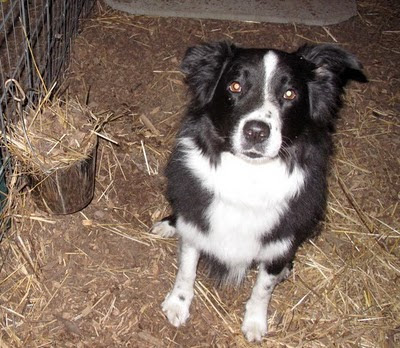
Yes, the two-quart bucket is completely filled with straw and mulch. Mostly straw, which came from inside the plastic doghouse about six feet away.
No, I have no idea how he did it.
I do not know why he did it.
Is it an editorial comment on the indignity of being left in a kennel, as if he was a dog for chrissakes? Protest over being confined alone?
Maybe. But I got this kind of Richard Dreyfuss sculpting Devil's Tower out of mashed potatoes vibe from it. It kind of felt like a compulsive act of art.
It was a deliberate and symbolic act. But what kind?
An unknown dog or dogs had an upset tummy* in my office this morning, and the weather is turning mild, so I put all the others outdoors while I was away. Sophia (it was her, as it happens) in the indoor/outdoor kennel by the barn, and Pip, Rosie, and Barry White with the run of most of the foster kennel and play area.
Moe was by himself in a run in the foster kennel. Just before I left I hung a bucket of fresh water from the fence.
When I returned, it looked like this:

Yes, the two-quart bucket is completely filled with straw and mulch. Mostly straw, which came from inside the plastic doghouse about six feet away.
No, I have no idea how he did it.
I do not know why he did it.
Is it an editorial comment on the indignity of being left in a kennel, as if he was a dog for chrissakes? Protest over being confined alone?
Maybe. But I got this kind of Richard Dreyfuss sculpting Devil's Tower out of mashed potatoes vibe from it. It kind of felt like a compulsive act of art.
It was a deliberate and symbolic act. But what kind?
Wednesday, December 23, 2009
I Lied

In this post, I laxed wyrical about young Cole's quick discovery that human children were super-kewl, even though he had never seen one in his life.
Today I wanted to find some puppy photos of Cole's brother Charlie.
While reviewing my files from January, I discovered that I had lied.
On one of my last days in Billings, Operation New Beginnings got some special visitors.
The woman who filed the cruelty complaint against Linda Kapsa with Yellowstone County, and then took it in her teeth and would not let go until the authorities acted, brought her two young children.
She wanted the kids to see why Mommy had been so preoccupied. What all the fuss had been about. Why we do what is right even when it is not what is easy.
The kids could not come inside the sheriff's perimeter fence. So I broke another rule (I hadn't realized it was a rule) and randomly selected a puppy from the seven in the bitch barn to bring outside. (Or did I pick up the first one to come to me?)
The photos don't lie -- it was young Cole, not any of his siblings, romping with the children on that warm day in January.
I am not posting the cutest of the pictures, because they necessarily expose the children's faces. Not gonna do that.
Did those few minutes playing in the winter sun open up a channel in Cole's brain while his synapses were still being pruned?
Friday, November 27, 2009
Kick Me
The turkeys have been bullying Sophia.
She's the largest dog here.She's the only one who has ever seriously injured another animal. (Forgot about all those murdered groundhogs for a minute there ...) Her people routinely take down bad guys, both for fun and for real. Yet the birds see a giant "Kick Me" sign on her ass.
Last week they got her cornered on the front porch; we looked out to see her cowering against the door, hackled from occiput to tail-tip, growling and snapping. The birds were not impressed. We had to let Rosie out to serve them, as she does in this clip.
Yet tiny Rosie, and even tinier Cole, easily drive or gather the turkeys, put them up in their coop, and generally keep order in the flock. The turkeys don't even think about giving any crap to any of the English shepherds. Notice the space they give Pip and Rosie in the clip.
At the moment they are cooped most of the time -- not for stalking the German shepherd, but for their serial acts of vandalism and hooliganism up in the village.
The neighbors didn't tell me about the "visits" -- or the turkey crap on their Weber grills, broken porch tchotchkes, stolen pet food -- until they'd been at it a week and developed a habit. When my neighbor came to tell me about the attempted theft of his Christmas lights, Rosie, Cole and I had to drive them home from over half a kilometer away.
This a long way to chase a dozen turkeys.
Now I only let them out for about an hour before bedtime, when I can keep an eye on them.
She's the largest dog here.
Last week they got her cornered on the front porch; we looked out to see her cowering against the door, hackled from occiput to tail-tip, growling and snapping. The birds were not impressed. We had to let Rosie out to serve them, as she does in this clip.
Yet tiny Rosie, and even tinier Cole, easily drive or gather the turkeys, put them up in their coop, and generally keep order in the flock. The turkeys don't even think about giving any crap to any of the English shepherds. Notice the space they give Pip and Rosie in the clip.
At the moment they are cooped most of the time -- not for stalking the German shepherd, but for their serial acts of vandalism and hooliganism up in the village.
The neighbors didn't tell me about the "visits" -- or the turkey crap on their Weber grills, broken porch tchotchkes, stolen pet food -- until they'd been at it a week and developed a habit. When my neighbor came to tell me about the attempted theft of his Christmas lights, Rosie, Cole and I had to drive them home from over half a kilometer away.
This a long way to chase a dozen turkeys.
Now I only let them out for about an hour before bedtime, when I can keep an eye on them.
Thursday, October 22, 2009
Consent and Compulsion
Please do not click on the photo link of Barry White in the second paragraph unless you are sure you want to see it. If you are easily upset by images of cruelty and animal suffering, do not look. I did not reproduce this photograph in the body of this post for a reason.
Instead, consider the portrait of Barry White as he is today.

Barry White had the honor of starring at the sentencing hearing of his former owner.
He was fortunate that he did not have to attend in person, but the sheriff's photo of him on the day he was seized as evidence glowed larger than life over the proceedings. His face screwed into a rictus of terror, eyes wide, tongue lolling and blue -- he has clocked out of a reality revealed by his emaciated flanks and pelvis (obvious even under his matted strawlike coat) and the necklace and cape of shit-and-mud pendants that must have doubled his weight.
Not long after that sentencing hearing, eight months after that photograph was taken, he and eighteen others were released from their special indenture by the judge, and I was allowed to evaluate him.
Most of our evaluations of the ONB dogs were pleasant, interesting interviews. Barry White's was not. I was traumatized by his completely genuine and inconsolable terror -- but not nearly as much as he was traumatized by having a leash hooked to his collar.
I promised his handler that day that, if it came to it, I would personally foster Barry White. She'd only recently taken him on -- he'd had several handlers in succession at ONB, and none had made much, if any, progress with him. With each failed attempt to leash and handle him, his spinning alligator reflex was reinforced and strengthened. This was not an act or contrived panic; the possibility that he would harm himself in his hysteria was real.
Parties with connections to Barry White's former owner were still planting and fertilizing rumors among the volunteers that Douglas and I were the Doggie Death Squad, "culling" (yes, that word was used) those dogs who "failed" their behavior evaluations. Handlers feared for the lives of the most regressed dogs; after eight months of repeatedly showing ourselves as good as our word, toxic slander still seeped into the hindbrains of otherwise sensible people.
I gave her some ideas for working on the leash hysteria, and steeled myself to welcome into my home a dog who could not be walked. She didn't have much time, and I didn't have a lot of confidence in the power of the few things I could suggest to work quickly.
I gave her some ideas for working on the leash hysteria, and steeled myself to welcome into my home a dog who could not be walked. She didn't have much time, and I didn't have a lot of confidence in the power of the few things I could suggest to work quickly.
Still, he was not an entirely discouraging case. He allowed his handler and me to sit with him in his stall and cut some of the few remaining mats from his fur. He did not seek the touch, but he didn't offer to bite us, or froth in terror, either.
And then there's his eyes. Barry White looks straight at me, and his eyes do not ask -- they require. Require acknowledgement, demand an answer, insist that I recognize him and work to give him what he needs.
A week later I watched him, leashed, following his handler willingly around the kennel of the Moore Lane hospital, where he'd come to be neutered. I still don't know how she flipped him so fast.
And three weeks after that, I opened his crate on the Barking Bus and led him out for a constitutional in my hayfield, then into the newly constructed kennel run that is his next waystation on the road to a life as a normal dog.
Every day we have our quiet time, during which we work on his willingness to approach a person and to be touched without flattening himself to the ground in surrender. And every day we have our walk, usually with my own dogs and young Cole, sometimes just the two of us. On many days, he can also follow me for some of my chores.
Until a few days ago, I held a 16' nylon long line on our walks. There was always a belly of slack dragging behind us as he followed at my heel sporting a huge dog smile, but I kept my grip, mindful of the possibility that something could panic him and make him bolt.
And there are points where he puts the brakes on. Barry White is afraid of doorways, gates, and constrictions. He still can't cope with a human being coming at him frontally at close range. At first, he tried to flee when I would pick up a tool or bucket -- anything larger than a paperback book was fearsome if it was in the hand of a human being.
When Barry White backs up or sets his brakes, I use gentle, steady, authoritative pressure on the leash to bring him through the scary space with as little fuss as possible. Since Barry White isn't interested in love and cuddles, praise, coaxing, a game of fetch, or a nummy bribe, I compel him to move through his fear.
We've never yet reprised the spinning croc. And there have been times when I've put a fair amount of pressure on him. He has the inherent ability to keep his wits, which is most of what he needs to advance towards normalcy.
Last week I took the plunge and dropped the end of the line when we are out in the pastures. And there's Barry White, sticking so close to my heels that I can't get a photograph of him unless I tie him to something and back away. I still don't have a decent picture of his beaming "go for a walk" smile.
Even though we've been doing beautifully with the drop-line on our walks and for some of the more active routine chores, it's good policy to tether the dog when one can't keep an eye on him. So Sunday, while Professor Chaos and I raked shingles out of the barnyard, I hooked his nylon line to a fence post nearby.
All was well until I walked away towards the house. I hadn't gone twenty steps before I felt a soft, familiar tap on my calf. Barry White's nose.
Barry White has determined that his Mission From God is to follow me around the farm. The leash interfered with the performance of that Mission. That Would Not Do. So he neatly, deliberately, without drama or fuss, without fear or panic, severed the leash and joined me. It looked as if he'd taken a pair of sharp scissors to it. He knew exactly what he was doing.
In other words, at any time in the past month, as I "compelled" Barry White to move through his fear, he could have chosen to opt out. He knows perfectly well how to make the leash go away; hundreds of times, he has chosen not to do so.
Barry White doesn't totally trust me; humans have been too unreliable and sometimes dangerous for him to let go of those parts of himself he has reserved. He doesn't like having his collar taken hold of, doesn't want me to reach for him. He doesn't want to be petted, though he'll allow it if "forced." He has a ways to go.
But one thing that Barry White does trust me to do is to walk him through fear and into the possibility of happiness. He can't always help himself by himself, but he consents to let me "compel" him to do so.
And now, I consent to remember what he has told me: that he makes his own choice about trusting me every moment of every day.
Subscribe to:
Posts (Atom)