Showing posts with label breed conservation. Show all posts

Tuesday, September 27, 2011

Choosing and Raising a Small Farm Dog: Short Form


By request from many of the wonderful participants at my farm dog presentations at the Mother Earth News Fair on Saturday, I have uploaded my powerpoint slides to the web. You can find the presentation here.

I added notes to the presentation, since the slides are mostly just mnemonic cues for me while I'm gabbling and a chance to put in some pretty pictures . The notes don't show up when you view the powerpoint online, but should if you download it. The urls for further resources are there on the slides.

After the Roseannadannas are all launched (I'm at three today, it will be two by Thursday) and I'm done feeling sorry for myself and moping around, I'll have more to say on this, concentrating more specifically on English shepherds, with in-depth information about health concerns, intelligence-gathering before purchase, and how to find an ES whose specific temperament is right for your farm and home.

Tuesday, July 26, 2011

Welcome, Roseannadannas


Twenty-one hours of stage I labor, four hours of delivery.

Three girls, four boys. Sable boy is a genuine runt who won't take no for an answer, but I'm still considering him touch and go. Two brothers who did not take a breath -- Rosie and I tried.

Mother went from a confused princess to a highly competent coyote dam in a matter of minutes.

I have been dismissed for the moment. Coyotes don't have the same staffing requirements as do princesses.

If your impulse this morning is to the pick up the phone to convey congratulations, don't.

Monday, June 6, 2011

This Weekend

So shoot me, I am not a food stylist. Have you bought your raffle tickets for a customized basket of Brandywine Farm humanely pasture-raised and home-grown yummies? The prize will have much more stuff than shown here -- this was all I could fit in the basket. Go to the chipin link above or to the right.


We're getting kind of excited about our first-ever English shepherd Gathering at Brandywine Farm. We are expecting somewhere north of fifty people, and a slightly larger number of dogs, with some special guests who have surprised even the hosts. Could be many more, as more RSVPs are coming in as the date approaches. We have participants coming from all corners of the country.

Here's some of what's going to happen. Full schedule and deets are here.

On Saturday, in addition to our barbeque (pasture-raised Brandywine broilers) and the potluck (ES folks can get competitive with their potluck contributions, so come armed and hungry) and all the general socializing and dog-walking and strawberry-picking, and movie night-ing, we will have a canine freestyle class taught by trainer Mary Waugh Swindell, who is coming all the way from Texas for the Gathering with her two ES, toddler, husband, Doberman(s), and there was the threat of a lizard or pair of lizards, I believe. Which have nothing to do with the potluck. I hope.

Mary is a long-time top competitor in freestyle and agility, with her magnificent Dobermans. I first met her about thirteen or fourteen years ago, when she lived in Pittsburgh. I went with my friend Barb to meet her rescue ES, Gwen, because we were interested in this little-known breed. At that point I started to plot to steal Devon, her Doberman. Devon is of sainted memory now, but it's possible that his son may just up and disappear this weekend.

Mary's current freestyle up-and-comer is her NESR puppy, Shiner Bock. You may remember Shiner under a previous identity.

Here's the skinny on the Freestyle clinic, which will start at 3 pm on Saturday:

Freestyle is a terrific way to have fun with your dog and build new skills that will help you in obedience, rally, agility, Therapy dog visits--or simply to dance better in your living room! This sport is appropriate for dogs of all ages and abilities, as long as they are ready to have fun and have a handler ready to have a good time. Depending on the skill level of the dogs and handlers attending we will work on the following skills:

Walking backwards
Dog Weaving through your legs while you walk
Teaching your dog to jump through your arms
Teaching your dog to back through your legs
Teaching dogs to sidestep (both in heel position and in front)
Spin, Twist, and jumping through hoops!

No prerequisites needed to attend; but bring treats or toys to guide and reward your dogs. If your dog is trained to go to a mat or target, bring that along. Have a hula hoop? Bring it on!

This is a great way to help build body awareness, and develop more communication between handlers and dogs.

Some of our freestyle students go to to work on group demos for public events, or to add skills for therapy visits and PR events, but most do it just to have a good time, and to teach some new skills.

You can see us doing Freestyle on Animal Planet's Breed All About it with our Doberman Devon, and you can watch a clip of an awesome routine by Carolyn Scott here.

We'll be having a great time, and Shiner will be showing you how to make this look easy!

We'll have a few slots available for local students who aren't here for the ES Gathering. You must contact me at houlahanATzoominternetDOTnet. to secure a place. We just ask for a donation -- what you can afford -- via raffle tickets.

Just before the Freestyle clinic, at 2, we will have a brief canine search and rescue demonstration by the dogs of Allegheny Mountain Rescue Group, many of whom are English shepherds.

On Sunday, we will host a Canine Good Citizen test, starting at 11 am. The cost for this will be nominal. Many thanks to Tammi Potts for agreeing to be our CGC tester for the day. This test will be open to the public, but you must contact me at houlahan AT zoominternet DOT net beforehand to secure a slot.

Throughout the weekend, we'll be raising money to cover the cost of the Gathering and to raise funds for both National English Shepherd Rescue and the English Shepherd Club's Health and Genetics Committee by raffling several items, including a customized Brandywine Farm Basket o' Noms which can be customized to your desires and shipped if necessary -- you do not need to be present to win.

The basket will reflect your preferences, and can include fresh pastured eggs, pastured humanely-raised chicken and/or guinea fowl (frozen), colony-raised rabbit (frozen), home-made raw-milk goat cheese (feta and/or chevre), home-made stock from pastured chickens, grape jam, home-grown and made marinara and salsa, dried currant tomatoes, home-made raw goat yogurt -- am I forgetting anything?

Again, use the chipin to the left if you would like to buy raffle tickets and will not be at the Gathering. I'm filling up a jar with pre-purchased tickets already. Make sure I have a way to contact you if I don't already have at least your email address.

Also being raffled will be a special Texas-sized gift basket donated by Mary and her students, in honor of her two NESR dogs. I can't wait to see what's in this one! I suspect it will have some fire to it. The same tickets apply to both baskets.

I'll keep the chipin open for raffle tickets until 7 am Sunday the 12th, and you can buy tickets at the Gathering right up to the drawing at 3 on Sunday. We will be tossing in a few other raffle items as well.

Photographer Martha Cristy-Couch has donated two complete sets of blank greeting cards in her extraordinary "River Reflections" series. The cards will be for sale in the community center all weekend, with information on posters and additional cards available.


Finally, for all English shepherd owners and former English shepherd owners -- we will be working on "Project Fill In the Blanks" for the English Shepherd Club Registry Database. We will be collecting photographs, measurements, and information (including pedigree info) about your current and former English shepherds for inclusion in their entries into the genetic database of the breed. Your dog does not have to be ESC registered to be recorded!

Health and longevity information on both living dogs and dogs who have left us is especially important for the conservation of the breed.

You can download a PDF form here and fill it out before the Gathering if you like. Bring photocopies (don't risk your originals if you can make a copy, but I can copy papers here if necessary) of registration, pedigree, and health screening certificates and results. We can take photos and measurements of the dogs who attend.

Throughout the weekend we will have a Rally obedience course set up for your "doodling" pleasure, and agility equipment for learning and practice, courtesy of Family Dog Obedience in Butler and Pittsburgh.

Tuesday, May 17, 2011

Brandywine Farm English Shepherd Gathering is Coming

Will we see you there?

RSVP by email, at the event's Facebook page, or in a comment on the event page -- full names, please, so we know which Jane or Joe has responded, and how many people and dogs you are bringing. We need to know how many people are coming so we can thaw enough chickens! We need to know how many dogs so we can brag about it.

I'll have a schedule and maps up later this week, as well as a guide on local attractions, services, and eats. Hotel and campground information is already on the event page.

I've started a chipin to cover the costs of renting the park and community center, agility equipment, charcoal, supplies, beverages, etc. Anything collected above expenses will be split between National English Shepherd Rescue and the English Shepherd Club Health and Genetics committee.


The door prize will be a Brandywine Farm Basket o' Noms. The prize winner will determine the specific contents depending of individual preference and whether the items will be shipped, and how far. It may include a selection of eggs, cheese, home-canned goods, frozen chicken, rabbit, guinea fowl. We can even devise a basket for a vegan, if you like marinara and jam and salad dressing. You do not need to be present to win. You don't even have to come to the gathering.

You can buy door prize tickets at the event, too, but this way it's out of the way and you can just relax and enjoy the gathering -- and we've got the lettuce to pay for the hall and the supplies up-front.

Sunday, March 6, 2011

Just the basics: How to read a pedigree

I was trying to refer a puppy-seeker to some basic online information that explains how to read a pedigree chart, and was shocked to find that, while there are many sites out there that have complicated and pretty complete information on how to interpret the titles and abbreviations in a dog pedigree, there are none that do a clear job of the simplest principles. They all assume a knowledge base that most people who are not involved with animal breeding or genealogical research do not have.

One essential thing that many puppy-buyers don't understand is that a pedigree is not the same as registration papers. Every higher animal on the planet has a pedigree, whether or not it was ever written down or recorded -- it is just a chart that tells us who an animals' ancestors are. Registration papers may or may not come with a pedigree, and just show that an individual animal is recorded with a specific registry and (usually) that it is considered "purebred." Registration papers are often used as proof of ownership.

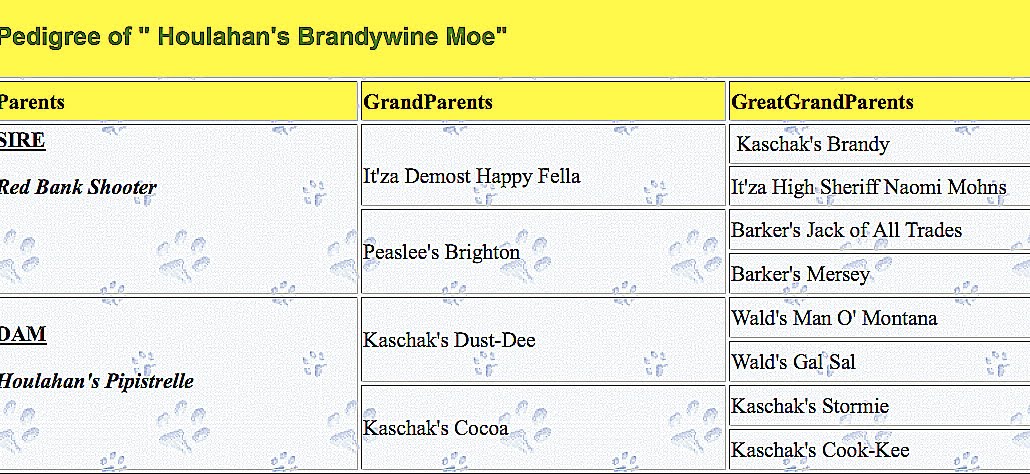
Let's start with a very simple pedigree chart:


Click to embiggen. Control-click (most browsers) to pop up a larger version in a new tab.

This is a copy of the three-generation pedigree for one of my own dogs, Moe. It is formatted by a free online dog breeders' website, but this does not matter. The pedigree is just information about the dog's ancestry, and a handwritten one on lined notebook paper would be laid out just the same and could have the same information on it. I entered the names into the form myself. The basic information that every pedigree must have (or it's not a pedigree) is the names of the animal's ancestors in a form that shows the relationships. (That counts for human animals, too.) Livestock animals might have a number rather than a name.

The pedigree reads from left to right. The name of the animal whose pedigree it is (let's call him Bubba) is either to the far left, or, as in this case, above the chart of ancestors. That saves horizontal space on the printed page. If this is a registered animal, this will usually be his or her registered name.

There will be two names in the far left column or the next column to the right if Bubba's name and info takes up the far left . The sire's (father's) name will be above, and the dam's (mother's) name will be below. The convention is always the male parent directly above the female parent. Moe's father is Shooter and his mother is Pipistrelle.

Then in the next column, you will see four names. The two above center line are the paternal grandparents -- Moe's father's father and mother. The two below center line are the maternal grandparents -- Moe's mother's father and mother.

Moe's paternal grandparents are "It'za Demost Happy Fella" and Brighton. His maternal grandparents are Dust-Dee and Cocoa.

This brings up a point that often confuses people looking at pedigrees. In many breeds the dog's registered name bears no resemblance to the name that people who know the dog will refer to him by. Often there is a kind of embedded "code" that is decipherable to insiders, including the breeder's kennel name and sly references to his ancestry. Strange spelling and punctuation is common. "It'za Demost Happy Fella" was called Chaz. I only know this because I've been told -- you can't derive it or guess it from the registered name. His owner followed the show-dog convention of using a very convoluted string of words to "name" her dog. Her kennel name was "It'za." As you can see, the owners of Moe's other ancestors followed the English shepherd owners' convention of fairly simple* registered names that are the same as, contain, or are similar to the dog's "call" name. Red Bank Shooter is called Shooter, and his owner's kennel and farm name is Red Bank. Houlahan's Pipistrelle is called Pip, and her owner is me, Heather Houlahan. My kennel and farm name is Brandywine. I didn't breed Pip, so she doesn't carry my kennel name.

In the third column, you will see eight names -- Moe's great-grandparents, all laid out so that you can see which grandparent each pair produced.

I've used a three-generation pedigree here so that it is easy to read and uncluttered.

The standard number of generations for a dog pedigree that is provided when you buy a puppy is generally five -- up to the great-great-great grandparents. That also happens to be the most extensive pedigree that can generally fit on a single sheet of paper (usually legal-sized) in readable type if you put Bubba's name above the "crane's foot"** of ancestors. Breeders who are researching their dogs' genetics will use spreadsheets or online databases to go back many more generations than can be fit on a sheet of paper. Some registries or services will sell up to an eight-generation pedigree printed on really big paper.

Now, let's get onto intermediate pedigree-reading. You can bail here if you found out what you need to know about reading a basic pedigree.

Here's a screen shot of the "top half" of Moe's five-generation pedigree as it is displayed by the English Shepherd Club Registry's database. When we talk about the "top half" of a pedigree, we mean the animal's sire's pedigree. Right now we are looking at Moe's father and his ancestors -- his mother and her ancestors are the "bottom half" of the pedigree. So we are really looking at Shooter's four-generation pedigree.

This is the "bottom half" -- Pip's four-generation pedigree.


Together they make Moe's five-generation pedigree. There are a lot of bells and whistles on this pedigree chart. You can see registration numbers, birthdates, colors, health information, owners' and breeders' names. I could configure it differently and get photos, where available, of three generations of ancestors. You won't get that level of detail on most pedigree charts from other registries, or most handwritten or home-produced pedigrees from breeders. You'll see that as you go further back in the generations, there is less information provided for each dog. This is necessary in order to fit all the names on a page.

Having a lot of information right on the pedigree chart is very useful when you don't personally know the animals. What a person or registry chooses to put on a pedigree tells you something about their priorities. This ESCR pedigree includes hip-health information, because hip dysplasia is a genetic health problem in our breed. If an owner didn't check his dog's hips or won't publish the results, that raises suspicions. If the hip information was good or bad and the owner published it, that gives important information about that dog that can help someone make buying and breeding decisions down the road. The rest of the information is mostly to help people identify the dog precisely (registration numbers) or find out more (owner and breeder information).

An AKC pedigree will include any show championships that the dogs have won. Show-ring wins are important to the AKC. The English Shepherd Club does not think that show-ring results tell us anything about the quality of the dog, so those will not ever appear on an ESCR pedigree. If a breeder is generating her own pedigree charts by hand or computer, she may include more information than a list of names; what she chooses to include may tell you about her priorities.

In order to read you will have to click to embiggen. Control-click to open in a new tab (on most browsers). But you might want to print them out on two pages and follow along.

A five-generation pedigree includes slots for sixty-two ancestors -- two in generation one, four in generation two, eight in generation three, sixteen in generation four, thirty-two in generation five.

However, it would be highly unusual for a purebred or purpose-bred dog's five generation pedigree to have sixty-two unique names in it. There will be repeats.

If a dog's name is repeated on both top and bottom of the pedigree, then Bubba is inbred on that dog.

If you look only at Moe's three-generation pedigree, at top, you would conclude that Moe is not inbred at all. All of his grandparents and great-grandparents are unique individuals, with no names repeated. His parents and grandparents were not cousins.

But if you look closely at Moe's five-generation pedigree, you will see that Kaschak's Brandy is both his paternal great-grandfather and his maternal great-great grandfather. Moe is inbred on Brandy in generations three and four. This is not very inbred by purebred dog standards.

He is also inbred on Butcher's Sam Odie, who occurs twice (top and bottom) in generation five. Again, this is pretty far back. It statistically makes Sam Odie the equivalent of a great-great grandfather, or 1/16th of Moe's genome -- 6.25%. By contrast, Moe is (statistically) 18.75% Kaschak's Brandy. Knowing something about Brandy -- his health, appearance, and behavior -- is much more likely to tell us about Moe than will knowing the same things about Sam Odie.

If a dog occurs multiple times only on the "top" (father's pedigree) or only on the "bottom" (mother's pedigree) then Bubba is not inbred on that dog -- the parent whose pedigree includes that repeat may be, but Bubba is not.

Moe's paternal great-grandmother Naomi is very inbred on Mohn's Boodie -- he is both of her grandfathers -- in other words, her parents were half-siblings. But Naomi's son Chaz (the guy with the long unpronounceable name) is not inbred on Boodie (as far as we can see from this pedigree) because his father, Kaschak's Brandy, does not have Boodie as an ancestor. Moe is not inbred on Boodie (as far as we can see from this pedigree) because Boodie does not appear in his mother's pedigree.

I hope that has been helpful information about how to read a basic pedigree chart. I've used a dog's pedigree here because that is the species I know best. An animal's detailed pedigree can be like a Russian novel for someone who is an expert in the specific breed. It takes many years of living with and learning widely about a breed of dog, horse, cow, etc. for a printed pedigree to easily give up its information that way. But a beginner can at least look at a five generation pedigree and get a sense for whether the animal was very inbred (as was Naomi) and question why. You can try to find the owners of the animal's parents and grandparents and find out more about them, such as their health and what kind of temperaments they have or had.

A pedigree can be a full of mistakes or frank lies. This is true of an official-looking printed pedigree certificate with gold-filigree borders as much as it is of a hand-scrawled pedigree on a brown paper bag. A breeder may not know that his bitch was bred by a different dog than the one he listed in the pedigree -- maybe the sneaky neighbor dog got in, or the stud dog's owner was careless in the kennel or dishonest. A breeder may lie about paternity or even maternity. Puppymillers use registration papers fraudulently, so a registry pedigree on a puppymill purchase is likely to be complete fiction. Most dog registry organizations can't or don't check the DNA for most litters, and there are even ways to get around those for the devotedly dishonest. An old mistake or lie is impossible to check. And both individuals and registries can introduce clerical errors; I have one pedigree that was produced and sold by the United Kennel Club in which a dog is listed as his own father (same registration number and all). Most pedigrees are probably mostly accurate, but it is important to note that they are just information that is reported and recorded by fallible human beings. If you can't trust the honesty or the competence of the people who provided the information, then you can't trust the pedigree to give you information about your animal.
_______________________

*Sometimes too simple. When the dog's full registered name is simply "Max," there is a high probability that there are going to be more of them. The common practice of using the owner's surname and the dog's simple name is better, but there turns out to be a bunch of Smiths, Wilsons, Thomases, Johnsons, etc. Sometimes this creates a great deal of confusion.

** The English word "pedigree" derives from Old French "pied de gru" or "crane's foot." This refers to the way the chart branches, literally looking like the foot or footprint of a bird. Pretty cool!

Saturday, December 11, 2010

News from English Shepherd Land

English Shepherd Club

The 2011 English Shepherd calendar is available from the English Shepherd Club for $14 (ESC members) or $17 (non-members). Order here. Volume discounts available.

This gorgeous calendar features ES from around the world, including many of our beloved rescue ES. It is a major fundraiser for the ESC, a 501(c)3 non-profit incorporated for the conservation of the English shepherd dog as a heritage agricultural resource.

While you're there, now is the time to renew your membership for 2011, or apply for membership if you are not already one. (Join now and get the member price on your calendars.)

NESR

The National English Shepherd Rescue 2010 cookbook is also on sale. Shepherds in the Kitchen: 483 Recipes to the Rescue is available for $20 here.


Yep, almost five hundred recipes for $20 -- about four cents a recipe. Hell, it costs me that much to print one out. And it's the only way you are going to get my chili recipe, or my famous marinara.

While you are on the order page, check out the other items that benefit NESR's work rescuing and rehoming English shepherds in need -- jewelry, decals, and the great martingale collars with side-release clips (hard-to-find item!) made by the vendor who supplied them for the ONB dogs. And visit the NESR Cafe Press shop.

Mark Your New ESC 2011 Calendar

Please come!

June 11-12, 2011 will be the first Brandywine Farm English Shepherd Gathering in Harmony, PA (16037).

What's a Gathering?

Two days of education, fun, food, networking, socializing, and celebration of (and with) the dogs we love.

I've been to Gatherings in Ohio, North Carolina, Ontario, Montana and California. Each one was different, each had activities tailored to the venue. The larger gatherings attracted ES and their humans from all over North America.

At Brandywine Farm, we are fortunate to be able to rent the township park and community center that abuts our hayfield -- giving us the entire farm, plus the community center's historic schoolhouse (with kitchen and bathrooms), picnic pavilion, baseball field, playground, and parking.

Activities planned include CGC testing, a SAR demonstration, agility, a silent auction to benefit NESR, lectures on breed history and conservation, obedience fun drills, and, if we have the fencing and stock squared away by then, a stockwork clinic. (I've already ordered new ducks for the occasion; we're working on the sheep.)

There will be two days of potluck picnicking, and a barbeque of Brandywine Farm pastured Freedom Ranger chicken. As those who are wise enough to order the NESR cookbook will soon discern, English shepherd people take their cooking seriously. I generally waddle away from Gathering potlucks with a smile on my face.

You can come for one or both days.

There are a variety of camping and dog-friendly motel accommodations nearby.

You do not need to own an English shepherd to come. The ES community is a friendly crowd, and we welcome friends of the breed, the curious, and all who have an interest in conserving heritage breeds. No one will check your dog's pedigree at the door, and all well-behaved dogs are welcomed.

If you have a Facebook account, you can RSVP or keep up on developments at the Brandywine Farm Gathering's FB page. I'll be adding a page to this blog with schedule and particulars as they develop.

Monday, March 1, 2010

Dispatches from the Before Time


I recently jumped at an opportunity to acquire a well-worn, slightly water damaged, mildly smelly time capsule that has, however, miraculously retained all of its plates for 163 years.

The Dog, by William Youatt.

Mine is the 1847 American edition, edited and with additions by E.J. Lewis, M.D.

You don't have to save your pennies for an antiquarian keepsake to read it; it's available as a modern reprint, and online for free.

Mr. Youatt was a British veterinarian of wide renown who published on many species, but had a particular interest in, and love for, dogs.

He wrote this opus more than a decade before the first British dog show.

The overview of British dog breeds includes no reference to any "standards" or litany of "important" show winners and sires of show winners.

Yet there they were -- sheepdogs, cur dogs, lapdogs, esquimaux dogs, Newfoundlands and beagles, poodles and The Alpine Spaniel or Bernardine Dog.

Somehow human beings managed to develop and maintain distinct breeds without the authoritative oversight of a kennel club. No overlord to petition for, grant, or withhold permission!

Now one of the things that is explained to me from time to time is that all objections anyone has to anything on animal welfare grounds are a plot hatched last Tuesday by PeTA.

So I periodically learn, for example, that Ingrid Newkirk invented both the word puppymill and its imaginary business model some time in the 1990's. Nevermind that I can remember first encountering the term and the reality in a dog fancier magazine some years before I first encountered pubes.

One of the most adamant recurring lessons goes like this:

If I can't cut off my dog's ears and tail to suit my whimsy, then I don't really own him. They'll be coming to take him away any minute.

It is mandated in the Breed Standard because that is what is correct for the breed.

Having its roots in the Historic Vital Function Of The Breed and in The Inerrant Authority Of The Dead Breed Founders.

Only a whiny little dog-ignorant sentimental Bambi-loving vegan twinkie raises an objection to this practice, which is not cruel or painful at all.

Real Dogmen know that The Standard represents not only Knowledge Moste Anciente and Wyse, but the unanimous consensus of all the Founding Breedfathers and the Leading Men of The Day.

Men like Youatt, natch:

Cropping of the Ears. -- I had some doubt, whether I ought not to omit the mention of this cruel practice. Mr. Blaine very properly says, that "it is one that does not honour the inventor, for nature gives nothing in vain ... That must, therefore, be a false taste, that has taught us to prefer a curtailed organ to a perfect one, without gaining any convenience by the operation." He adds, and it is my only excuse for saying one word about the matter, that "custom being now fixed, directions are proper for its performance."

The owner of the dog commences with maiming him while a puppy. He finds fault with the ears that nature has given him, and they are rounded or cut into various shapes, according to his whim or caprice. It is a cruel operation. A great deal of pain is inflicted by it, and it is often a long time before the edge of the wound will heal: a fortnight or three weeks at least will elapse ere the animal is free from pain.

...

Mr. Blaine very naturally observes that, "it is not a little surprising that this cruel custom is so frequently, or almost invariably, practiced on pug dogs, whose ears, if left alone to nature, are particularly handsome and hang very gracefully. It is hardly to be conceived how the pug's head -- which is not naturally beautiful except in the eyes of a perverted taste -- is improved by suffering his ears to remain."
Ever see an ear-cropped pug?

Me neither. Add that to the list of things for which I am deeply thankful.

Guess that particular arm of custom was not entirely fixed. I don't know whether pinna amputation never made it into the sacred texts, or was later removed.

Lucky pugs. Left without a functioning respiratory system by mandate of their "standard" and those who serve it, they have at least been permitted to retain their ears.

Dobermans, schnauzers, pit bulldogs, boxers, Boston terriers, Danes, miniature pinschers -- not so lucky.

A practice that would likely have faded away on its own accord in all but a few cases (fighting pit bulldogs, some LGDs) was codified, regularized, and made either mandatory or effectively so because kennel clubs and the dog fanciers' breed clubs were looking out for the "purity" and cosmetic uniformity of the gene pools they captured from the original landraces.

163 years after Youatt, is it too much to ask that fanciers of show dogs who do no work acknowledge the butt obvious truth that the leading dog vets of the mid-19th century could spot and name gratuitous cruelty grounded in idle vanity very well, thank you?

Or does Peter Singer have a secret time machine?

Tuesday, June 30, 2009

Poult Love


Turkeys have no personalities.
Turkeys will drown in a rainstorm.
Turkeys are born looking for a comfortable place to die.

Turkeys are stupid.

Like everyone else, I've been exposed to casual, "everyone knows" anti-turkey propaganda my entire life.

Not just from "everyone says" and popular culture, either.

No less a pastoral luminary than Gene Logsdon devoted a memorable chapter to turkeys in The Contrary Farmer.

I reproduce his advice to would-be turkey raisers in its entirety, from memory:

"Don't."

Understand this about me.

I like intelligent animals. Even those that -- as our friend The Donald said of goats -- are too intelligent for their place on the food chain.*

I like sturdy animals.

I like animals that meet me at least halfway in my efforts to keep them alive.

I like animals that meet my eye.

I don't have much use for stupid, delicate, suicidal, autistic animals.**

And I bought turkeys anyway.

And I am in love.

The fifteen Narragansett and Bourbon red poults came from the hatchery two weeks ago.

I knew I wanted heritage breeds, and to work on conserving these genetic resources through both breeding and market development. I was also planning to get a few commercial broad-breasted birds, which would be invited to Thanksgiving and Christmas this year. My heritage poults won't be big enough in time. We do a big bird at Thanksgiving, and the old breeds grow slowly.

But it seems there is a run on turkeys this year, and all the hatcheries are out. I was lucky to get my Narries and Bourbons.

First thing I noticed when I opened the box at the post office is that they were coming right at me -- pecking and full of piss. Aggressive? Seemed so.

Turns out, notsomuch.

Here's the truth about normal, non-industrial turkeys. They are active, engaged, lively, and curious about everything. They are not particularly delicate, as hatchling poultry goes. Our turkey-mentor friend Carolyn assures me that "These are the ones with Life Force." And there are lots of things they love.

Things turkey poults love

Heat lamp
Hard-boiled egg
Dog tongue on mah butt
Shiny stuff
Weeds, especially lamb's quarters and amaranth
Perch on top of brooder
Red stuff
Ride on hand
Perch on finger like parakeet
Fly
Amherst College Class of 1987 gold signet ring (see shiny stuff)
Sit on lap
Be petted and fussed over
Shoulder ride
MAMA!!!

And turns out, I am the Mama.

I have never been the Mama before. The chickens are tame and meet my eye, but mainly do their own thing. The guineas are simply wild. The ducks are convinced that we will most likely eat them in the morning; domestic in their habits, but not tame. But when I opened the box of poults, they imprinted on me, and humans in general. They run to me for attention. They call for me when they are distressed, and periodically when they are lonely or bored. The meaning of their three-note contact call is unmistakable.

I'm old enough to remember when autistic human children were created by bad mothers. All the experts proclaimed this, and Reader's Digest made it a universally known fact. And old enough to remember when someone grokked that the reason the mothers of autistic children seemed disconnected from their kids was that the children did not have the normal human behavior that elicits bonding. (Probably being told by "experts" that they were the ones who f'd up their screaming, stimming, touch-intolerant, non-verbal, zero-eye-contact kids did not help matters further.)

Well thus it is with the poultry.

The ducks, while cute for the first few days, and somewhat amusing in their absurdity now, are autistic poultry. I have no love for my ducks. They do not meet my eye. Any that don't earn their keep will be sent to freezer camp. Talk about a refrigerator mother.

The turkeys have successfully played the baby card. By treating me as their Mama, they've made me their Mama.

Don't get me started about eventually eating the grandkids.

* He may as well have been describing the vast majority of pet dogs, no?


**Keeping in mind that many exotics who are labeled one, two, or all three of the above are simply animals who have a life niche that includes specific, non-negotiable needs. Meet those needs and the animals are clever, vigorous, and imbued with the will to live. Fail to meet them through ignorance and sloth, and you've killed your captive.

Iguanas, for example. Croak all the time because of errors in temperature, lighting, and diet made by their incurious owners. Give them the right warmth, full-spectrum light, and a varied vegetable diet with adequate calcium in the right balance with phosphorus, and they grow into impressive terror-lizards that will send your dog running for cover.
With this one, I'll concede the "clever."

And I don't expect a captive wild animal to meet my eye.

Domestic livestock are another matter.

Sunday, June 21, 2009

This is What I Breed For


Portrait of the collie as a young pup.


When people ask me, why breed when there are dogs for free on Craig's list?

When someone wants to know what the point is of working so hard to conserve working drives and temperament.

When someone questions my sanity for jumping on an airplane and flying across the country, then driving over the Cascades in the fog and into the high desert, so that Pip could meet the exact stud dog I wanted.

This is why.


Pictured above: Young Audie, when his name was Andy. Janeen's dog, just biding time at my house where he happened to be born, waiting for me to get around to taking him home.

Sunday, June 14, 2009

Fellow Travellers who provide the vehicles


HT to Patrick for pointing us to another cell of the functional-dog Maquis.

Do I have an appropriate job here for Inuit dogs?

I do not.

Do I have a special personal connection to the culture, history, and society that is interwoven with functional Inuit dogs?

I do not.

Do I want to own Inuit dogs?

I do not.

Do I rejoice that there are people whose passion for conserving, using, understanding and appreciating real functional Inuit dogs is at least as fanatical as my own for my English shepherd dogs?

I do, I do, I do.

We are so much more the same creature than any "dog fancier" realizes. I have more common cause with the editor of The Fan Hitch than I will ever have with the beaming owner of a UKC "champion" English shepherd, or than the editor will ever have with someone whose show Malamute poses for Christmas pictures in a harness that gets stuffed back into the box with the colored lights.

As the recent articles by John Burchard and Vladimir Beregovoy demonstrate, The Fan Hitch gets it too.

I look forward to mining this resource for insights for some time to come. Their archives are online.

Check out this brief article on managing hierarchy within the pack, for example.

Thursday, June 4, 2009

Dog Breeding: Yer Doin' It Rite

Scanning the wasteland for the fabled Good Breeder

All right, I rail against puppy mills pretty regularly here. My regular readers are the choir; I really count on the Googles delivering some Easter Christians to hear the message, if only so briefly, else it would be wasted keystrokes.

And I do go on about vanity breeding for the show ring, closed gene pools, and the "dog fancy" in all its would-be-laughable-but-for-the-pain-it-causes naval-gazing excess.

Then there's the calling to task of "rescue" organizations, "humane societies," and advocacy groups that clearly have something else in mind besides the actual welfare of actual animals.

Don't get me started on trainers who can't train, and "behaviorists" who wouldn't know a "behavior" if it bit 'em in the ass. (Not a metaphor when speaking of dogs.)

OMG, I hate everybody.

Help me out of the funk.

Well, not quite true.

At last week's NADOI annual meeting, I found myself in the curious position of advocating for two different young dogs' testicles. Two very different dogs, very different breeds. Nicely put-together animals with temperaments to die for, from breeds where temperaments are rarely what one would wish to see.

Those dogs were not accidents. They were the products of breeding decisions that did not sacrifice soundness or temperament to other values.

I'd like to feature dog breeders who are doing it right. Give the interwebz some examples of the different ways individuals are holding up high standards in a breeding program.

Tell me about breeders you know -- friends, colleagues, your dog's breeder -- who are conscientiously producing sound, healthy dogs with temperaments appropriate to their breed and function. Who uphold high standards of animal welfare, including for animals not their own. Who show their concern for the families and communities where their pups will live. Who have big-picture attitudes towards their breeds' gene pools. Who stand by their dogs.

Any breed, except my breed, English shepherds. Or any crossbreed -- I'd be especially interested in thoughtful "out of the box" crossbreeders. Working dogs, hunting dogs, purely companion dogs.

I'd like to be able to interview the breeder, other breeders who know him or her, and puppy buyers.

And it can't be someone I already know.

Nominations are open! Use the comments section to provide the information that gets me started. Make sure I can contact you privately with followup questions.

Monday, January 26, 2009

All that is gold does not glitter


Retrieverman is mad.

Retrieverman thinks that anyone else who loves the golden retriever breed should be mad, too.

You betcha.

My first dog was a proper golden retriever. Sassy, lithe and athletic, and would have chewed off her own foot before she bit anyone. Shannon was born in 1974; pre-Liberty. Ante-deluge.

I've been saying it for years.

You got a Rottweiler that is biting people, you got a training problem.

You got a golden retriever that is biting people, you got a genetic problem.

And folks, we have got ourselves one doozy of a genetic problem.

Retrieverman postulates that breeding for "calm" goldens has caused them to become biters. I am unconvinced. Calm dogs of other breeds are not psycho biters. And the dumb blond show dogs he dislikes are not, to my eye, "calm." Lumbering, yes. Squinty-eyed, sure. But being too fat and hairy and possibly hypothyroid to enjoy life is not the same as "calm."

Here's a theory I heard from a veterinarian about ten years ago. She bred golden retrievers herself. No, I do not remember her name. Dammit.

She told me that in the highly competitive golden retriever show ring, certain things were rewarded consistently:

Big.
Blonde.
Hairy.
Up on its toes.

Every dog in every ring was the first three, to the point where they were effectively identical. What she meant by the last was, judges were selecting dogs that were "on" -- stiff and alert, head and tail up, projecting what passes for "charisma" in the pageant world.

What that meant in terms of the dogs that were beating the competition was that -- they were dogs that wanted to beat the competition. Into a bloody screaming ragdoll. They were dogs who were highly aroused and on edge in the presence of people and other dogs.

Select rigorously for "winners" who are pissed off just looking at a stranger or another dog, make more just like 'em, continue for ten or fifteen generations, what you gonna get?

Last time I checked, the golden retriever standard for temperament did not read: Stiff, tense, and snarky towards humans and dogs; resource-guarding, dominance aggression, and psychotic attacks on neighborhood children are highly desirable characteristics.

But a quick review of my files for the last five years or so reveals something really extraordinary.

Well over half of the purebred golden retrievers I've worked with in recent years, privately or in class, come to me with a serious aggression problem.

I've handled a couple of pups, one of which was alarmingly lethargic, and one nice adolescent who needed manners. A young male who seemed to have both cognitive and affective deficits, but was certainly nonviolent. Oh, and there was the "golden retriever" puppy that I did a single consult for, much of which consisted of trying to convince the owner that the puppymiller had, indeed, sold her a husky. (Pointy erect ears - - check. Red-and-white plush fur -- check. Mask -- check. Curly tail -- check. This is not a hard call, ma'am.)

The only breed with a higher proportion of genuinely aggressive individuals in my training practice (I exclude breeds with an n<3) style="font-style: italic;">in my entire career, have been biters. The one that didn't bite had OCD. Cocker mixes -- also biters.

I see a smaller proportion of German shepherds, Rottweilers, Jack Russell terriers, and Dobermans that are aggressive. Much smaller.

I have never worked with an aggressive "pit bull." And I'm known as a pit-friendly trainer, so I see a fair number of them. Mostly for destructive chewing and general manners.

Back to goldens. Scariest dog I ever trained, most dangerous, longest rap sheet: golden retriever.

I've only told three clients flat out to put the dog down, that it is too dangerous to share surface space on this planet with the rest of us. This dog was the first.

Let me preface this by saying, if I encountered the same situation today, I would call CYS and report the parents. And this is the case that prompted me to use a sternly-worded contract for all aggression cases, and charge a lot more, and require the money up-front.

Anyway, this golden had a bite rap sheet into the double digits when the owners called me. He specialized in nailing neighborhood kids who came over to play with the owners' children. Owners had never been sued, and I still don't grok that. The owners' own children feared and disliked the dog. (There's your sign.)

Dog tried to kill me at the first session. Oh, did I mention he also had seizure disorder? But he had to be well-bred, objected the owner, "His breeder was a minister's wife!"

Every session, the female owner would announce, in the face of overwhelming contradictory evidence, that the dog was "100% better than last time." Then I'd repeat my lecture to the owner about not giving the dog free access to leg o' toddler, since none of my management requirements were in place, then the dog would spend an hour thinking about how much he'd like to kill me if he could get the damned collar and leash off.

My final CTJ conversation with the client, which was also when I fired her, was over the phone. It went something like this:

Me: Your dog has not improved one bit with training. You don't seem to be willing to do any homework or change a single thing about the way you manage him. He's a very dangerous animal, and you have two young children over whom you also have no control. You need to put this dog down.

Client: Don't you know of a farm in the countr ...

Me: No. You are not hearing me. This is a very dangerous animal. He is escalating his attacks. In my opinion he is not neurologically normal. I know that your vet has told you exactly the same thing I am telling you. This dog is not safe to have around people, period.

Client: You don't think he'd bite my kids, do you? (This sentence verbatim. Exactly what she said.)

Me: (What I should have said) You delusional self-absorbed hateful bitch! It's fine for this psycho dog that you refuse to control to chomp down on other people's kids as long as yours are unperforated?! What the hell is wrong with you? Did the same bad nanny drop you and the dog on your heads?

Me: (What I actually said, more or less) Yes. Yes he is going to bite your kids. And he will bite them much more badly than he's bitten all the other kids, and your husband, and his other victims. Your kids are going to be bitten, and they already know it.

What happened was this.

The owners never spoke to me again, and never spoke to the vet (who had told them exactly the same thing after exhausting the medical angles) again.

They moved away. But, as it turned out, not very far.

About a year later, I was meeting with a new client who had a rather challenging Samoyed puppy, one that was getting pushy and dominant at quite a young age.

As I outlined the responsibilities that come with having such a mentally powerful dog, I mentioned the moral and legal liability in a neighborhood such as hers, which was crawling with free-range children.

And the client started telling me about the family that had moved into the neighborhood that year, and their dog had bolted out the front door and bitten a kid who was playing in the street, unprovoked.

This time, the parents of the victim reported the bite, and called the police, got a lawyer, and generally raised a stink.

And while the dog's owners were objecting that the dog was perfectly fine, and had never done anything like this before, and was a golden retriever for chrissakes...

I interupted her story. Named the dog. Yes -- that was the dog's name -- how did you know? Named the former client -- yes, that's them.

"Which of their kids did he bite?"

The boy. Didn't bite him. Mauled him. Then they killed the dog. Never made the papers. After all, everyone knows that golden retrievers are great family dogs.

(FWIW, the owner of the Sammy was a great client, did a wonderful job with her pup, and he's long since grown into a dignified, lovely companion.)

Now this is a great story of owner enabling and denial. But the fact is, owner neglect did not make this dog dangerous; it just supplied him with a bottomless bucket of tender juicy white meat while he indulged his abominable genetics with aberrant experience.

And this is not, by any means, the only one.

Here's a modest proposal to fix this before it becomes -- as I suspect the American cocker already is -- unfixable:

• Any golden retriever that lifts a hostile lip at a human being loses its gonads. Every. Single. Time.
• Any golden retriever that starts fights with other dogs loses its gonads. Every. Single. Time.
• No golden retriever gets to use its gonads before age four (bitches) or six (dogs).

No exceptions. Don't care if the cur won Westminster. Don't care if it's a field trial champion, either. No swimming in the gene pool for mean goldens. Problem solved.

Friday, January 9, 2009

We had to destroy the village to save it

I can haz ... oxygen?


The British documentary Pedigree Dogs Exposed was aired shortly before the birth of Raised By Wolves.

You can view the whole thing here.

The producer's stance? Purpose-bred dogs are worthy of preservation. The breeding practices enforced by Kennel Clubs, grounded as they are in disproven 19th-century eugenics theories, are destroying the genetic health of pure breeds, and causing unimaginable suffering in the products of "selection" for show-ring exaggeration. If we are to enjoy the company of purpose-bred dogs in the future, the Kennel Clubs are going to have to be dragged kicking and screaming into the reality-based world.

(Raised By Wolves' stand on the AKC, UKC, KC, etc.? Let 'em dig their own graves. I'll give them the shovel. Hell, I'll rent them the backhoe if it will go faster. Purpose-bred dogs and their owners will do much better without some central government telling them what is "correct," dictating who may mate with whom, and handing out rewards for brainless conformity to groupthink. The faster these bloated bureaucracies implode, the easier it will be for people who actually like dogs to get on with the project of conserving, perpetuating, and enjoying the particular kinds of dogs they like.)

Now (HT to Patrick the Terrierman), the zombie army over at PeTA is trying to lamprey itself onto the message of Pedigree Dogs Exposed.

And the producer of of the documentary, Jemima Harrison, is having none of it.
“PETA is a bunch of crackpots who do not care about anything but publicity and making money. They have not bothered to contact us - and, indeed, if they did we would make it very clear we do not want their support. It devalues and marginalises a film that raises a serious issue that needs to be addressed, and quickly.”
You go girl.

Here's where you expect the lecture about the difference between "Animal Rights" and "Animal Welfare."

Here's where I'm supposed to remind you that the death-worshippers at PeTA kill just about every animal they get their hooks into, that they practice theft by deception in order to get more animals to kill, and that they are committed to the extinction of all domestic animals.

They will destroy the village and pronounce it saved.

Okay, consider it done.

More important is the message that we must not let lunatics distract us from reality. We must reject the fallacy that the enemy of my enemy is my friend.

PeTA protests outside of Kentucky Fried Chicken? This does not mean that the broiler industry is A-OK on animal welfare, environmental quality, and human health.

PeTA screams that fur is murder? Does that make leghold traps humane? Does it mean that mink farming is not a cruel enterprise that caters to the vain and callous?

PeTA pisses off MAD with an anti-milk, pro-beer campaign? This does not mean that those California Cows are "happy."

PeTA claims they hate puppymills? Well so do I.

It's become all-too-easy for the calculating frontmen for agribusiness, the fur industry, the puppymill industry, and all manner of commercial animal abusers to convince dog owners -- especially dog hobbyists -- that "users" of animals must present a "united front."

If you don't support farrowing crates and shooting wolves from airplanes, goes the propaganda, they will come and take your dogs.

And dog hobbyists -- some still call themselves "fanciers" and identify as "part of The Fancy" -- who are thoroughly trained to obey a faceless entity over which they have no control -- the dog hobbyists fall for this bullshit.

By criticizing any atrocity -- veal production, canned hunts, Japanese "scientific" whaling, egg factories -- the animal lover is "playing into the hands of PeTA."

So, command the industrial animal abusers, shut up!

And that's where a lot of the screaming from "The Fancy" about Pedigree Dogs Exposed comes from.

We've heard it before. When this article was published, for example.

And this book.

To be sure, much of it is pure defense, from the people who are personally engaging in ongoing animal abuse by breeding what they know to be unsound animals in order to win ribbons. You can't expect someone who doesn't care that the dog he deliberately created cannot, by design, breathe, walk, see, hear, or pee normally to suddenly see the light.

But more telling is the squawking from dog hobbyists who consider themselves "reformers" and "mavericks," who actually train their dogs, who brag about "titles on both ends," who take part in dog sports (as opposed to the hilarious "Sport of Dogs.") The people who tch tch and turn away sadly when they pass by the German shepherd pageant ring on the way to their rally entry. It's a real shame what they've done to those dogs ...

The squawking is scripted by the political arm of the animal abuse industry and read by hysterics. It goes
Don't bring attention to our dirty laundry. Going public about the genetic abuse of animals we purport to love plays into the hands of PeTA. If we just keep deceiving the public, it will all be okay. We can fix this all without systemic reform or any scrutiny from the outside. Purebred dogs are ours. Nevermind that we sell the extras to ordinary people as pets, and that we've spent the last sixty years selling the unfounded idea that our sickly culls are better pets than "mongrels." The Code of Silence is our only hope.
Sorry guys. Your wagons can't bend into that circle. You've spent too much time agreeing with one another about what makes a good dog, and no time at all in the reality-based universe. Science passed you by a hundred years ago. Popular culture is catching up. Sometimes that takes the form of a new stupidity -- all hail the Labradoodle -- but the trend is always to strip you of your unearned authority on matters "dog."

Wednesday, December 3, 2008

Whitney on Pip's Ancestors

The army jeep of farm dogs: cheap, compact, low-maintenance, versatile, no-frills. It will not be improved by morphing it into a Lincoln Navigator.

Ah, Leon F. Whitney, prolific bloviator on all things dog (and, disturbingly, other stuff) for much of the 20th century. Love 'im or hate 'im. Mostly I hate 'im. He had a habit of indulging his half-considered prejudices and presenting them to his readers as the epitome of scientifical fact. This is gratifying when his prejudices reinforce one's own, infuriating when they are, you know, just plain wrong.

However, Whitney is one of the few general writers on dogs who acknowledged the corporeal reality of Pip's ancestors in the early-to-mid 20th century. He also had a high opinion of their virtues.

Pity he never bothered to discover that they were a breed -- or breeds -- with pedigrees, a couple-three registries, and thoughtful selection. The English shepherd is virtually unchanged from before Whitney's day, and has a registration history that goes back to the 1930's. The Australian shepherd is closely related, and the gene pools did not definitively diverge until mid-century.

Granted, most ES were not registered in Whitney's day; there are still good family lines of unregistered ES today, maintained by farmers who cannot see the logic in exchanging money for a paper that tells them what they already know.

Here's my latest discovery, from How to Select, Train, and Breed Your Dog, first published in 1950:

American Shepherd

Back in the colonial days, the settlers brought with them many fine dogs, most of them of the collie or shepherd type. Some refuse to call these dogs a breed, yet they have been, as a type, the American dog. As shepherd dogs they are not quite the equal of the marvelous border collie because the latter is the product of the most stringent selection for sheep herding without too much consideration of temperament. The border collies live away from human habitation much of the time and have not been bred for general farm use.

But the American dog has been a constant human companion as well as the farm shepherd and guard dog. Many have been used as hunters. In an illuminating article in Field and Stream, B.B. Titus describes how he used to train these general purpose dogs to hunt raccoons at night and squirrels in the day as well as to herd cows. Many of the dogs were real shepherds.

If you travel anywhere in the U.S.A. you will find, when you get away from the cities, so many more shepherds than any other breed. You'll wonder why they aren't registered in the A.K.C. Can you imagine what would have happened if as many of these dogs were observed by Americans traveling in, let us say, Argentina? Why they would have "given it a breed" long ago, formed a great club, and imported them by the thousand.

We've got the story, the breed -- a marvelous breed it is -- and we have the uses for it. In ability, it stood at the top of American war dogs. It is one of the few breeds bred for general intelligence. No exaggeration is needed.

This is the dog that can be trusted to guard children day or night. He will bark when the horse has colic or one of the cows calves. He can herd the cows home, let his master know if one is missing, and with some power hard to explain, even force a ew whose lamb has died to adopt an orphan. He is often the farm boy's hunting companion, and when "Old Shep" passes on, the family often holds a funeral. You'll find many a wooden slab in a field near a farmhouse with "Old Shep" scrawled on it, and you'll know his family was all choked up at the loss.

Yet, while a so-called sheep-herding dog named the Komondor from Hungary is registered in the A.K.C. the American shepherd hasn't even an official breed name.

Thank doG for small favors. In the same text, Whitney decries the ruination of the cocker spaniel by "a clique of breeders who, with the sanction of the A.K.C., arranged it so that only cockers with huge, woolly clipped coats had a Chinaman's chance of winning. That did it. Down went the breed in popularity because so few persons wanted such a dog."

"What was the real American cocker like? ... The proper cocker didn't know its teeth were made to bite ... The dog hungered for human companionship, was never shy, and did not piddle when surprised or happy."

But, you know, it was a sad thing that fanciers had not "recognized" the "American shepherd" and sought to similarly improve it by 1950.

58 years later, and still dodging fancier bullets.

The Aussie -- that western branch of the farm shepherd/farm collie family tree -- was the subject of a hostile takeover by the AKC in 1993. It was soon joined by other kidnapped gene pools -- the border collie, JRT, Beauceron, Cavalier King Charles spaniel, Havanese, Leonberger -- am I forgetting anyone? Only fifteen years later, the massive, fluffy, merle show dogs are utterly unable to work livestock -- and their fanciers sniff dismissively at the increasingly hard-to-find wiry, keen little cattle-workers, who are, you know, probably crossbreds.

Monday, October 20, 2008

One more Not of The Body

Mary Peaslee of Shepherd's Way sent me a link to this:

Working Dog Diary

Great stuff, fine writing. I'm going to enjoy devouring it all.

Small is beautiful. Diversity is strength. Dogs can lead us back to ourselves, if we will get out of the way and follow.

We are everywhere.

Monday, October 13, 2008

No Show

The most thoughtful of the people who are not embarrassed to call themselves "fanciers" of dogs -- and even "in The Fancy" or "part of The Fancy" -- meet critiques of the disastrous institution called a "dog show" with a sort of half-hearted, but still stubborn, defense:

Well, yes, so many of those people are terrible, win at all cost, and the judging is all political, and so many unsound dogs with bad temperaments get championships, and working ability is not respected there ... but this is where we breed fanciers get together. This is where we see other dogs of our breeds, and pick out mates, and sell puppies, and 'educate the public' about our breed. And it's where I get to see my friends 'in the breed' -- it's my social life. And the dogs get socialized, the chaos is good for the puppies to learn. And it's the breed club through AKC dog shows that educates us breeders about genetic defects and health problems and how to breed better dogs. Plus, how else would a puppy buyer find out about the good breeders out there instead of just go to a pet shop?


We drove over 900 miles this weekend, and came home with no championship points, no ribbons, no "legs," no silver loving cup.

Near as I can tell, nobody here is disappointed. Rosie is disgruntled, but she is always disgruntled -- everything vexes her.

Pip and Rosie got long-overdue new collars for the occasion -- burgundy for Pip, leopard-pattern for Rosie -- but they were rarely snapped to leashes, which were never used to string them around in a circle or restrain them for "inspection."

I did give Rosie a bath on Thursday night. This had nothing to do with enhancing her pretty white ruff to catch the eye of judge, and everything to do with whatever reeking black foulness it was that she rolled in Thursday afternoon. Pip's pre-trip grooming was limited to our usual evening burr-picking session.

Not one of the fifty-plus English shepherd owners who gathered at a horse farm in western North Carolina had occasion to whisper to another about the fix that "put up" the obviously inferior dog of a third one.

No one screamed "loose dog."

No vendor sold stacks of t-shirts reading "The winning dog was professionally handled ... and so was the judge." (Real shirt. Saw them selling like Eskimo pies in Hell at a show in 2003.)

Nobody jumped in the car early and headed home after losing in the "first round."

No one paid a fee to cover the overhead on Madison Avenue offices or a new tux for the judge.

There was no gatekeeper verifying that each dog's paperwork was in order.

Nobody got disqualified.

If anyone was being paid to be there, I didn't hear of it.

What did happen was this ...

A large group of owners, and wannabe owners, of a rare kind of dog came together on a glorious fall Saturday.

A large group of dogs of a rare kind wandered about, most of them off-leash most of the time, socialized, played, threw a few snits, went swimming, fetched sticks and frisbees, barked, flirted, checked in with their owners, and sometimes shadowed them with the commitment of one of Pullman's daemons.


Humans looked at dogs and inquired about who was the Momma and the Poppa, and did that stolid fellow still possess a full pair of cojones, and what about them hip scores?

A representative of the ALBC spoke to us about our shared project of heritage breed conservation.

Puppies were passed from lap to lap for cuddling and spoiling.


Pedigrees were passed from hand to hand for scrutiny and discussion.

We had a raffle, and bought books and things, to benefit breed rescue. Rescue and the breed club are not at odds, with one party screaming "neuter them all" and the other sniping about unbalanced humaniacs. The boards overlap. Breeders are active in rescue. I am one of them.

Online friends got to meet in person, and old acquaintances were renewed. Club members from Texas, Vermont, Idaho and Montana had come.

Breeders got a good look at pups they had sold, all growed up.

We included part-bred dogs and their owners as a matter of course. (Imagine the welcome extended to a "shepherd mix" at, say, a GSDCA specialty show.)


We watched agility competitors demonstrate their craft; the regular dogs also played with the jumps and tunnels.


We commented on how great it was for our guys to to relax and socialize with other dogs and humans who "get them."


We remembered those who had left our community this year, canine and human, and shared our sense of loss.

We ate wonderful potluck food.

We took pictures.

We talked dogs.

We gathered up our folding chairs and serving bowls and drove home, each and every one of us with the grand prize: The same great dog we had brought with us.

Tuesday, September 23, 2008

A Critique from Within?

I got a low-salt spam from Amazon.com today. They think I might be interested in this (not yet published) book:

SOS Dog

Maybe they are right. The primary author, Johan Gallant, has written a book on schnauzers and one on African dogs. The former, published twelve years ago, appears to be the regular run-of-the-mill breed book sort of thing. The latter has no reviews on Amazon.

Anyone know about the author? Is this one likely to be worth pre-ordering?