Friday, March 25, 2011

Photo Phriday: Wether or Not


I want him, Rosie's bringing me a goat.

Tuesday, March 15, 2011

Nine Questions I Would Ask ...

... if I was going to donate money to support search and rescue dogs, maybe because I felt awful about a big disaster.

1) Did I already pay for this?

Well, yes, yes you did -- if you are a US taxpayer.

The FEMA/DHS urban search and rescue task forces (USAR TFs) that are sent by the federal government to major disasters in the US and for relief worldwide are tax supported.

The task force members have their deployment expenses paid. Those who are paid firefighters and public safety personnel are paid for their time on deployment.

No donated funds are needed to deploy these task forces and their search dogs.

This is not true of local search and rescue teams called to local or regional incidents -- most of which are a single lost person, with no collapsed structures involved. The individual team members who respond pay all their own deployment expenses, down to the gas money to get to the search.

2) Does the charity that is asking for money field search dogs?

If the charity is this one, it does not.

National Disaster Search Dog Foundation acquires dogs, puts them through several months of training, and then assigns them to (typically) firefighters who have been selected by their employers to handle a dog.

The NDSDF does not field the teams. When they send out a fundraising appeal citing "our" search teams and this is reprinted in the press and on blogs and social media sites, be aware that the dog and handler are almost always employed by a big-city fire department, and are always members of a federal USAR task force that is responsible for their ongoing training, credentialing, and deployment.

Yet the print and online media, including media where the journalistic motto is supposed to be "Question Everything," and where grandiose claims from such "charities" as the HSUS and PeTA have been regularly skewered, have unquestioningly reprinted the NDSDF's press releases, generally including a "donate now" link.

When a press release invokes a narrative about animals + disaster + we need money, it is apparently unacceptably bitchy to apply normal doses of skepticism and scrutiny to the release or the entity behind it.

That's how HSUS raised and hoarded millions in the wake of Hurricane Katrina, while local animal shelters nationwide go begging.

The canine search teams are a small component of each USAR task force, but they receive the bulk of the media coverage.

There are two FEMA Task Forces sent by USAID to Japan. The Fairfax County, Virginia task force -- generally the "go-to" TF for international missions -- has six dog-handler teams deployed to Japan, none of them formed or trained with involvement by the NDSDF. But a google search on various terms such as "search dogs Japan" "disaster dogs Japan," etc. will invariably pop up the NDSDF logo and acres of regurgitated press release about "our dogs" and "our teams." And a donation button.

FEMA, and the individual task forces, devote more resources to operational matters than they do to public relations and fundraising blitzes. And it shows. The press agents of NDSDF crowd out coverage of the majority of task force canine teams. Those six dogs and handlers from the Fairfax County task force may as well not exist. The hundreds of other federal USAR teams standing at ready who met the standards without involvement from NDSDF are complete nonentities. And the many hundreds of seasoned SAR teams who not only respond to "normal" searches, but maintain readiness for disaster response outside of the federal system aren't even a dream.

3) Does the charity that is asking for money train the search teams?

This one is a bit trickier.

NDSDF says that they provide the firefighters -- most of them with no previous dog handling or training experience -- with professionally "trained" dogs. The implication is that the dog is a plug 'n' play component of the disaster search team, delivered to the handler pre-assembled and ready to go. Certainly superior to a handler training her own dog from scratch.

A review of the dog biography narratives on its own website reveals that it typically takes more than a year, often many years, sometimes, apparently, never, for a firefighter + NDSDF dog to pass a FEMA basic test.

Just like a civilian handler, or anyone, who joins a task force with his or her own dog, or joins a task force and acquires his or her own dog to train.

Meanwhile, NDSDF says that it is providing ongoing training to the teams.

But every FEMA task force is supposed to have its own training program and its own training officer -- for every canine handler, not just those who acquired their dogs from NDSDF.

There are 238 operational FEMA canine teams nationwide, most of whom train and qualify without receiving any money or support from NDSDF.

4) Is the provision of partly-trained adult dogs to firefighters the only, or best, way to provide quality disaster dog teams?

To answer the first part (only?), emphatically no.

Most disaster (urban) SAR handlers are still civilians who choose, raise and train their own dogs. Initially, FEMA only accepted operational handlers who already had search and rescue deployments under their belts. That way, when a team was deployed on a disaster, with its additional stresses and dangers, it would not be the first time that the handler and dog had done real-world work together. The working partnership was already "proofed."

Unfortunately, and for a variety of mostly bad reasons, FEMA moved away from exploiting the skills of experienced dog handlers and started to allow individuals with no canine experience to fill slots on its task forces. In some task forces, experienced wilderness handlers need not apply.

As for the second part (best?), I can give you my opinion as a SAR handler with nineteen years of experience.

There are two elements here: Do firefighters without dog experience make the best handlers, and do adult dogs who have been through several months of kenneling and training make the best search dogs?

I have seen no evidence suggesting that they do.

My personal experience with firefighter-first handler candidates has been that the small minority of them who are suitable need a lot of education about dog behavior and interspecies teamwork, and constant on-scene oversight, in order to work effectively with a dog. That's not oversight from the fire chief, that's oversight from an intimately-involved canine training officer with many years of canine SAR experience and good teaching chops. Conversely, too much oversight -- handholding -- just serves to nurse along handler wannabes who are not capable or not interested in developing the higher-level skills that make a truly adaptable and resourceful handler. Not just a guy who can, maybe, pass a test.

Working with a search dog is not like learning a new machine that also happens to be a PR goldmine. It is a humbling, life-altering experience that requires profound openness and health of ego to achieve.

My experience with young adult dogs recruited for SAR training has been that the only ones that typically succeed are working-bred animals -- field Labs and goldens, working GSDs and Malinois, well-bred border collies. And they generally succeed when paired with already experienced SAR handlers who went through a lot of trouble to choose their own dogs.

Interestingly, even for working-bred dogs, there appears to be no fast-track to operational status achieved by starting with a young adult as opposed to a young puppy. Takes the team just about as long or a little longer, on average, to get to operational status if the dog is two when they start as it does if the handler starts with an eight-week-old puppy.

This is assuming similar ability and motivation on the part of the handler, similar operational standards, similar availability of credentialing procedures. (In this post-NIMs world, availability of credentialing and backlogs for evaluation and classes are a real issue for all kinds of emergency providers. When one's dog isn't getting any younger, it's beyond frustrating.)

Time to certification is important because, assuming total "trainee" time elapsed is the same, you get more bang for your buck starting a puppy and getting him operational by age two than you do starting a two-year-old and getting him operational at age four. Right?

Depending on breed, most SAR dogs retire at between 8-12 years of age, if there are no special medical concerns. Border collies and English shepherds often go longer. Rottweilers and bloodhounds, typically significantly shorter. Working-bred dogs of all breeds usually have a longer career than those who are indifferently-bred or show-bred, in addition to qualifying at much greater frequency.

The difference in return-on-investment in the dog's training for a six-year career vs. a ten-year career is significant -- for handler, for the unit, for the lost person.

In the case of dogs who have not been bred for work and well-raised, the training time is increased, and the chances of the dog ever becoming operational (again, assuming the same talent and motivation in the handler) are much lower.

My biggest objection to starting with adult dogs is that one loses the concentrated learning period of young puppyhood, in which the pup may be essentially imprinted with a commitment to scent games, as well as learn to be fearless in the face of all kinds of challenges. The best person to provide that kind of upbringing is the pup's handler. Good breeders exploit the learning window from birth to eight weeks, too. Many a star SAR dog's training effectively begins in the womb.

5) Is the firefighter + "pretrained" canine candidate team the way forward for disaster search and rescue?

I sure hope not. The NDSDF would like it to be, and are setting out to make it so using charitable contributions from nice people who want to support search and rescue.

If that were to happen, it would be both the result and cause of an ongoing redefinition of the job of search dog and search dog handler that, in my opinion, does not well-serve the public.

High standards are not the same thing as cookie-cutter methods.

In fact, I maintain that the two are incompatible.

An aside. NDSDF has a strong bias towards Labrador retrievers; that's not just shown in their numbers, that's something they state outright. They think that Labs are, as a breed, better candidates for disaster SAR than other breeds. That they fit the NDSDF's cookie-cutter training methodology.

Their own results do not bear this out.

72% of the dogs "graduated" and assigned to handlers by NDSDF (from the bios on their page of current teams) are Labradors or Labrador mixes.

I don't know what the intake v. graduation rate is, because they don't publish it. (Remember, "graduation" is not operational status. It is NDSDF's term for being assigned a handler and leaving the kennel.)

The rest of the dogs are of very few breeds: border collies and border collie mixes, golden retrievers, German shepherds, and one Aussie and one Catahoula.

50% of total Labradors + Labrador mixes have qualified under a FEMA standard.*

63% of border collies + border collie mixes

67% of German shepherds

83% of goldens.

Is NDSDF so institutionally breed blind that they ignore their own results? Are they graduating and assigning to wannabe handlers Labradors that have little or no hope of qualifying because of this bias?

It would be nice to have hard figures on the dogs they take in for training -- which ones wash out during training, and for what reasons, which ones fail after being assigned a handler, which ones ultimately qualify under FEMA and in how much time. For now, there are just a lot of questions about why the NDSF's favorite breed is not, apparently, their own most successful breed.

6) Is the firefighter + "pretrained" canine candidate team a more efficient or cost-effective way of providing disaster SAR teams?

NDSDF took in well over 3.3 million dollars in 2009, per their 990.

They don't state how many trainee teams "graduated" from their program in that time, or how many of their previous graduates qualified as operational with their FEMA task forces, so it's impossible to say what the per-team cost of becoming operational is.

They don't say how many of the dogs they take in as candidates wash out before being placed.

They don't say how many handlers wash out and have their dogs repossessed and reassigned after "graduating." There are some references to these events in some of the dog biographies.

With a great deal of tedium, one can get something like a figure for how many total dogs provided by the NDSDF have qualified with their FEMA task forces. This meant going through every individual dog profile linked on this page, and reading not only the dog's vital stats, but also the secondary page of narrative. In some cases the narratives and the vital stats disagreed on some point, and I had to try to make a judgment about which account was correct. Profiles don't consistently give dates that the dog was acquired or "graduated," but most have a birthdate, which is likely estimated in some cases.

They list 82 dogs, born between the years of 1996 and 2009. These are only dogs that are currently assigned to handlers. I did not include deceased and retired dogs listed on other pages, because NDSDF doesn't provide enough information about them to compare them to the ones on the main page. (I'm skeptical that a Labrador born in 1996 is still operational, but she's on the page, so gets counted.)

Of these, as near as I can determine, 41 have passed some kind of FEMA test, either just the basic, or the basic and then the advanced test. Exactly half. I did not include dogs that have passed a "state test," including the Tijuana state test, because I have no way of knowing whether those tests are, in fact, comparable to one administered by FEMA. I don't know whether some of the dogs who at one point passed a FEMA test have had their certification lapse, either because they didn't re-test at the appropriate time or because the failed a re-test; regardless, a dog who passes the test qualifies as operational for three years, unless injury or some other contingency intervenes.

Let's just look at the dogs born from 2005-2009. Some dogs have neither birthdates nor any operational data -- they may be older or younger, but they don't have FEMA certs according to NDSDF, which is fairly motivated to be up-to-date on such announcements. But of the 31 dogs placed with handlers and still out there (so not counting any that have been definitively washed out, retired, or died since placement) who were apparently born between 2005 and 2009, eleven -- just over a third -- have (according to NDSDF's website) passed a FEMA basic test. None have passed an advanced test. That's 3-4 teams per year passing a FEMA test once they are out with a task force. Can that be right?

Million dollar search teams?

Here's another interesting thing.

NDSDF makes a big deal about "rescued dogs becoming rescuers." They say they scour the pounds for candidates. Save those crazy dogs that are so unsuitable as pets, maybe on doggie death row as unadoptable, but are just born to pound the rubble.

Makes good copy, doesn't it? I have an adopted dog in training for SAR myself, and I can tell you straight, Cole's narrative can draw tears of joy from a cinder block. It is an m-fing great story.

It is not, however, the most efficient, cost-effective way to consistently bring dogs to operational success. And NDSDF's own numbers demonstrate this.

Of those animals (born 1996-2009) whose source could be determined from their biographies, 20 were breeder donations or purchases (puppies), 8 were donated by owners, 13 came from guide or service dog organizations, 14 came from rescue groups, and 19 came from shelters.

The breeder-sourced puppies were all (from what I could tell) good working-bred dogs, as were quite a number of the owner-donated young dogs. This is as it should be.

Here's the rundown on the outcomes for these dogs since 1996, broken down by source (as well as could be determined from the dogs' biographies -- what NDSDF has chosen to publish)

75% of the dogs donated by breeders and paired with handlers passed a FEMA standard, and a third (25% of the total) of those passed the advanced test. That's the best group. If they could deliver those results consistently, my hat would be off to them.

64% of dogs from rescue groups passed a FEMA standard.

62% of owner-donated dogs passed a FEMA standard. This group is mixed between dogs donated by working handlers or from working breeding, and "failed pets."

34% of guide/service dog "career change" dogs passed a FEMA standard.

26% of dogs from shelters passed a FEMA standard. A near mirror-image of the breeder-sourced dogs.

Remember, these are just the numbers for the dogs on their website who are still out with handlers. It does not include washouts from training, or dogs that have been washed out definitively since being sent home with a handler. We don't know about those dogs. And they don't publish enough data about retired/deceased dogs to compare them to current dogs.

From the available information, it appears that there is a significant advantage to taking a well-bred puppy selected by a knowledgeable working dog breeder, raising it in a savvy home (per the guide/service dog model), and training at a young age. Gee, who could have guessed?!

But what "We bought this puppy from a great breeder to ensure the best chances of success" doesn't do is raise a ton of money. The story isn't as good. It's unsentimental. Donors don't line up sobbing to hand over the simoleons.

The cost of a good working-bred Labrador, golden retriever, German shepherd or border collie pup ranges from $500-$1500. Some breeders will happily donate a promising pup to a good cause. Such pups are ready to start their training at eight weeks. They can be ready for operational testing by the time they are two.

So, is the project to rescue dogs from shelters? To maximize the number and competence of operational disaster search teams and minimize the time-to-certification to ensure the longest possible operational life? Or to raise the maximum in tax-deductible donations with a sounds-good narrative?

7) Is this charity a lean, efficient user of donated money?

Let's look at the largest search and rescue canine organization in the US for comparison -- the California Rescue Dog Association.

I choose CARDA because their operational standards are rigorous and well-regarded, and they are on the same sort of scale of personnel as NDSDF. Comparing NDSDF to a typical local SAR team with between two and ten operational canine teams at any given time, or to a single USAR TF, is comparing apples to watermelons. Also, NDSDF is located in California, as are most of "their" teams, and does a lot of fund raising in California.

CARDA has no paid staff. None. No full time PR people banging the drums for media coverage, no fund raising employees, no executives, no office manager, no paid or contracted trainers. It is, like almost every SAR unit in the United States, an all-volunteer organization.

CARDA is both a training and an operational organization. Volunteers train weekly in CARDA groups, have assigned mentors during their training period, and they respond to call-outs through CARDA. CARDA volunteers meet California state standards for operational competence.

CARDA handlers choose, train, and own their own dogs.

CARDA handlers complete required time as pre-apprentices and apprentices before they can challenge the operational tests. Operational handlers put in significant time as mentors.

Right now, this all-volunteer entity has at its disposal 123 trained, certified, credentialed, qualified, can-go-on-a-search-this-instant search and rescue dogs. That does not count dogs that may be certified but have been pulled from operational status due to injury or some other contingency. It does not count trainees. It's really 123 dogs that can work now.

The CARDA operational dogs are from 21 pure breeds, and also include eight mixed-breed dogs. Diversity is strength.

In 2008, according to their form 990EZ filed in 2009, CARDA spent $25,218. Total revenues were $29,579. That's just over $240 non-profit dollars spent per operational dog. That's two-four-zero -- not $2,400, not $24,000.

It gets worse. Better. Depends on how you look at it.

$18,688 of CARDA's income was member dues! Yep, the bulk of the operating expenses of the largest SAR dog organization in the country came out of the personal pockets of the very same people who are devoting enormous swaths of their own time and herculean efforts to volunteer.

Only $6,457 of CARDA's incoming money in 2008 was in the form of contributions or grants.

$52 of charitable money per operational dog. Dogs whose volunteer owners are shouldering the full cost of dog food, veterinary care, equipment, gas, vehicle maintenance, outside training, time lost from work ...

Grants and donations don't even begin to cover the cost of issuing that operational handler a radio. Which is the only thing the handler gets from the organization, and just about the only assets that CARDA owns.

Now, frankly, this sucks in the other direction. I was so gobsmacked that I called up a CARDA member I know and grilled her about it. Yep, CARDA bites at fundraising and public relations. Terrible at it. Too modest to toot its own horn. Refuses to even record the event when a CARDA dog finds a missing person, because of an overdeveloped "team" ethic. ("It would be prideful to admit that one of our own just saved someone's life ...") I would characterize CARDA as overly lean.

I upbraided my friend on behalf of her unit in what I hope was taken in the helpful, if exasperated, way in which it was offered. You guys should be bringing in more money, supporting your handlers, and reminding the public of the amazing service you provide.

The fact remains that the largest and most-respected SAR dog training, credentialing, and deployment organization in the US does its work on a financially threadbare shoestring, and does it damned well.

From 2000-2005 (the latest that full-year statistics are published) CARDA teams responded to an average of 318 searches per year. Those would have ranged from a single dog and handler deployed to check a suspected crime scene for human remains, to massive lost person searches involving hundreds of searchers and scores of dog teams.

They are running over 7,000 volunteer man-hours per year, just on search responses -- not counting an order of magnitude more hours spent on training, testing, and organizational chores.

8) Is this charity managed and run in a transparent and professional manner that is responsible to donors and does not enrich its principals?

You can download NDSDF's 990's here.

I have some questions.

For example, the same individual who receives $800 per month per dog for boarding and training (so she is technically not on the payroll, but a "contractor") is also serving an eight-year term on the board of directors.

Her assistant is her daughter.

That raises my eyebrows a bit.

According to page 7 of the 2009 990, no board member is compensated.

Ms. Davern's kennel received $148,629 for "handler training" in 2009.

There is also a line item for "trainers fees" (24c on page 10) of $210,333. I must assume that this is the $800 per month per dog collected by Ms. Davern's kennel for boarding and training, cited on their "Donate Now" page.

Apparently they don't consider $359,000 in no-bid contract work to be "compensation" to a board member. I guess that may be technically true. I'm sure this is all perfectly legal.

There are six total trainers on-staff for the "yield" of operational teams cited above. Their website does not indicate whether these people are all full-timers, nor what they are paid.

I expect it is probably significantly less than the $320,000 total paid to the top five salaried employees -- the Executive Director, the "Development" Director (which I understand to be "chief fundraiser") , a Business Administration Manager, the Manager of their project to build a multi-million dollar training center, and someone called a "Relation Manager."

As I understand it, these salaries are not out of line in the world of very large, high-overhead nonprofits. (The kind to which I choose not to donate, for this very reason.)

But remember, for CARDA -- and every other volunteer SAR unit in the country that actually deploys humans and dogs -- the figure is zero donor dollars spent on staff salaries.

And, among other questions, does it really cost three quarters of a million dollars to build a rubble pile?

9) Are these the guys who are going to save my bacon in a disaster?

The most important factor in lifesaving after a natural or man-made event causes building collapse is the speed at which help arrives.

FEMA task forces typically take days to mobilize, travel, and deploy.

If you are in the Walmart when the tornado hits and are buried alive under rubble and low, low prices, it will be your local first responders who stand a chance of finding you in time and getting you out. Wouldn't it be nice to know that they've had the resources they need to train to a high level of competence? Wouldn't it be gravy if the individual handlers were not straining their personal finances to be ready to save you?

The Task Forces, though trained for rescue, are typically active during the recovery phase of the search. Bluntly, they arrive in time to find the bodies. If there was a single live-find in rubble in the US by a FEMA-deployed dog team, I have not been able to track it down. The first live finds I can verify were several recently in Haiti. American teams had at least one live find in Mexico City; that was in 1985, years before the development of FEMA task forces with federalized disaster dogs. The dog teams deployed were volunteer wilderness handlers who had cross-trained for disaster.

Otherwise, twenty years without a single lifesaving find for the entire federal USAR system. (If I'm wrong about this, please, point me to the news articles.)

Pip and I deployed during the recovery phase of Hurricane Katrina. This was a state-to-state EMAC request for disaster-qualified SAR dogs who could work both live search and remains recovery. Not a very numerous resource. (This was the one and only time I have had any of my expenses covered in SAR.) Recovery work in a disaster is important work, but it is not the same thing as the high-pucker search that must be done in the first hours after an incident.


One reason we deployed was to hone our skills for the possibility of a future local disaster, one in which we would be the first responders, there in time to save a life. From that point of view, our time in the Gulf was time well-spent, though -- knock splintered wood -- we have not had call to exploit it as yet.

Well-trained and operationally-experienced wilderness search dog teams that are cross-trained for disaster first response and are close to the site of the disaster are the canine resource that is most capable of making a life-or-death difference.

When there isn't a "newsworthy" building collapse or massive disaster, these same all-volunteer teams are out pounding the ground looking for the missing hunter, the wandering dementia patient, the lost child. Saving those lives from "little" personal disasters.

Almost all are members of units that are 501(c)3 charitable non-profits, and are paid nothing for their time and effort.

None of them took in close to $3 million dollars in donations last year.

The next life they save could be yours. Your kid's. Or a total stranger's.

I don't know any who would turn down some help.


------------------------------

* As elsewhere, I am only counting passing the FEMA test as a metric for the NDSDF-supplied dogs. This is because I've no way of knowing whether various "state standards" are comparable, on paper or as executed. NDSDF's stated purpose is to populate the USAR TF's with NDSDF-supplied operational USAR dogs, so I think this is the fair metric by which to gauge their success.

Sunday, March 6, 2011

Just the basics: How to read a pedigree

I was trying to refer a puppy-seeker to some basic online information that explains how to read a pedigree chart, and was shocked to find that, while there are many sites out there that have complicated and pretty complete information on how to interpret the titles and abbreviations in a dog pedigree, there are none that do a clear job of the simplest principles. They all assume a knowledge base that most people who are not involved with animal breeding or genealogical research do not have.

One essential thing that many puppy-buyers don't understand is that a pedigree is not the same as registration papers. Every higher animal on the planet has a pedigree, whether or not it was ever written down or recorded -- it is just a chart that tells us who an animals' ancestors are. Registration papers may or may not come with a pedigree, and just show that an individual animal is recorded with a specific registry and (usually) that it is considered "purebred." Registration papers are often used as proof of ownership.

Let's start with a very simple pedigree chart:


Click to embiggen. Control-click (most browsers) to pop up a larger version in a new tab.

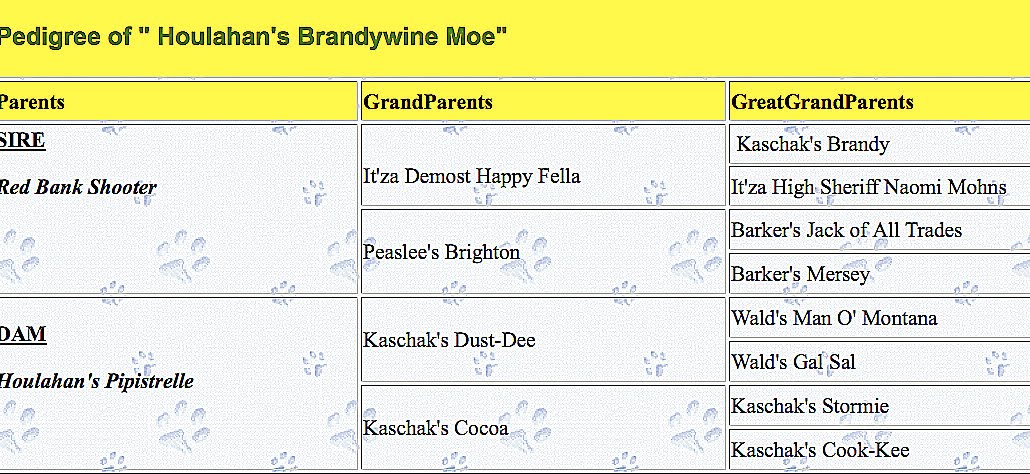
This is a copy of the three-generation pedigree for one of my own dogs, Moe. It is formatted by a free online dog breeders' website, but this does not matter. The pedigree is just information about the dog's ancestry, and a handwritten one on lined notebook paper would be laid out just the same and could have the same information on it. I entered the names into the form myself. The basic information that every pedigree must have (or it's not a pedigree) is the names of the animal's ancestors in a form that shows the relationships. (That counts for human animals, too.) Livestock animals might have a number rather than a name.

The pedigree reads from left to right. The name of the animal whose pedigree it is (let's call him Bubba) is either to the far left, or, as in this case, above the chart of ancestors. That saves horizontal space on the printed page. If this is a registered animal, this will usually be his or her registered name.

There will be two names in the far left column or the next column to the right if Bubba's name and info takes up the far left . The sire's (father's) name will be above, and the dam's (mother's) name will be below. The convention is always the male parent directly above the female parent. Moe's father is Shooter and his mother is Pipistrelle.

Then in the next column, you will see four names. The two above center line are the paternal grandparents -- Moe's father's father and mother. The two below center line are the maternal grandparents -- Moe's mother's father and mother.

Moe's paternal grandparents are "It'za Demost Happy Fella" and Brighton. His maternal grandparents are Dust-Dee and Cocoa.

This brings up a point that often confuses people looking at pedigrees. In many breeds the dog's registered name bears no resemblance to the name that people who know the dog will refer to him by. Often there is a kind of embedded "code" that is decipherable to insiders, including the breeder's kennel name and sly references to his ancestry. Strange spelling and punctuation is common. "It'za Demost Happy Fella" was called Chaz. I only know this because I've been told -- you can't derive it or guess it from the registered name. His owner followed the show-dog convention of using a very convoluted string of words to "name" her dog. Her kennel name was "It'za." As you can see, the owners of Moe's other ancestors followed the English shepherd owners' convention of fairly simple* registered names that are the same as, contain, or are similar to the dog's "call" name. Red Bank Shooter is called Shooter, and his owner's kennel and farm name is Red Bank. Houlahan's Pipistrelle is called Pip, and her owner is me, Heather Houlahan. My kennel and farm name is Brandywine. I didn't breed Pip, so she doesn't carry my kennel name.

In the third column, you will see eight names -- Moe's great-grandparents, all laid out so that you can see which grandparent each pair produced.

I've used a three-generation pedigree here so that it is easy to read and uncluttered.

The standard number of generations for a dog pedigree that is provided when you buy a puppy is generally five -- up to the great-great-great grandparents. That also happens to be the most extensive pedigree that can generally fit on a single sheet of paper (usually legal-sized) in readable type if you put Bubba's name above the "crane's foot"** of ancestors. Breeders who are researching their dogs' genetics will use spreadsheets or online databases to go back many more generations than can be fit on a sheet of paper. Some registries or services will sell up to an eight-generation pedigree printed on really big paper.

Now, let's get onto intermediate pedigree-reading. You can bail here if you found out what you need to know about reading a basic pedigree.

Here's a screen shot of the "top half" of Moe's five-generation pedigree as it is displayed by the English Shepherd Club Registry's database. When we talk about the "top half" of a pedigree, we mean the animal's sire's pedigree. Right now we are looking at Moe's father and his ancestors -- his mother and her ancestors are the "bottom half" of the pedigree. So we are really looking at Shooter's four-generation pedigree.

This is the "bottom half" -- Pip's four-generation pedigree.


Together they make Moe's five-generation pedigree. There are a lot of bells and whistles on this pedigree chart. You can see registration numbers, birthdates, colors, health information, owners' and breeders' names. I could configure it differently and get photos, where available, of three generations of ancestors. You won't get that level of detail on most pedigree charts from other registries, or most handwritten or home-produced pedigrees from breeders. You'll see that as you go further back in the generations, there is less information provided for each dog. This is necessary in order to fit all the names on a page.

Having a lot of information right on the pedigree chart is very useful when you don't personally know the animals. What a person or registry chooses to put on a pedigree tells you something about their priorities. This ESCR pedigree includes hip-health information, because hip dysplasia is a genetic health problem in our breed. If an owner didn't check his dog's hips or won't publish the results, that raises suspicions. If the hip information was good or bad and the owner published it, that gives important information about that dog that can help someone make buying and breeding decisions down the road. The rest of the information is mostly to help people identify the dog precisely (registration numbers) or find out more (owner and breeder information).

An AKC pedigree will include any show championships that the dogs have won. Show-ring wins are important to the AKC. The English Shepherd Club does not think that show-ring results tell us anything about the quality of the dog, so those will not ever appear on an ESCR pedigree. If a breeder is generating her own pedigree charts by hand or computer, she may include more information than a list of names; what she chooses to include may tell you about her priorities.

In order to read you will have to click to embiggen. Control-click to open in a new tab (on most browsers). But you might want to print them out on two pages and follow along.

A five-generation pedigree includes slots for sixty-two ancestors -- two in generation one, four in generation two, eight in generation three, sixteen in generation four, thirty-two in generation five.

However, it would be highly unusual for a purebred or purpose-bred dog's five generation pedigree to have sixty-two unique names in it. There will be repeats.

If a dog's name is repeated on both top and bottom of the pedigree, then Bubba is inbred on that dog.

If you look only at Moe's three-generation pedigree, at top, you would conclude that Moe is not inbred at all. All of his grandparents and great-grandparents are unique individuals, with no names repeated. His parents and grandparents were not cousins.

But if you look closely at Moe's five-generation pedigree, you will see that Kaschak's Brandy is both his paternal great-grandfather and his maternal great-great grandfather. Moe is inbred on Brandy in generations three and four. This is not very inbred by purebred dog standards.

He is also inbred on Butcher's Sam Odie, who occurs twice (top and bottom) in generation five. Again, this is pretty far back. It statistically makes Sam Odie the equivalent of a great-great grandfather, or 1/16th of Moe's genome -- 6.25%. By contrast, Moe is (statistically) 18.75% Kaschak's Brandy. Knowing something about Brandy -- his health, appearance, and behavior -- is much more likely to tell us about Moe than will knowing the same things about Sam Odie.

If a dog occurs multiple times only on the "top" (father's pedigree) or only on the "bottom" (mother's pedigree) then Bubba is not inbred on that dog -- the parent whose pedigree includes that repeat may be, but Bubba is not.

Moe's paternal great-grandmother Naomi is very inbred on Mohn's Boodie -- he is both of her grandfathers -- in other words, her parents were half-siblings. But Naomi's son Chaz (the guy with the long unpronounceable name) is not inbred on Boodie (as far as we can see from this pedigree) because his father, Kaschak's Brandy, does not have Boodie as an ancestor. Moe is not inbred on Boodie (as far as we can see from this pedigree) because Boodie does not appear in his mother's pedigree.

I hope that has been helpful information about how to read a basic pedigree chart. I've used a dog's pedigree here because that is the species I know best. An animal's detailed pedigree can be like a Russian novel for someone who is an expert in the specific breed. It takes many years of living with and learning widely about a breed of dog, horse, cow, etc. for a printed pedigree to easily give up its information that way. But a beginner can at least look at a five generation pedigree and get a sense for whether the animal was very inbred (as was Naomi) and question why. You can try to find the owners of the animal's parents and grandparents and find out more about them, such as their health and what kind of temperaments they have or had.

A pedigree can be a full of mistakes or frank lies. This is true of an official-looking printed pedigree certificate with gold-filigree borders as much as it is of a hand-scrawled pedigree on a brown paper bag. A breeder may not know that his bitch was bred by a different dog than the one he listed in the pedigree -- maybe the sneaky neighbor dog got in, or the stud dog's owner was careless in the kennel or dishonest. A breeder may lie about paternity or even maternity. Puppymillers use registration papers fraudulently, so a registry pedigree on a puppymill purchase is likely to be complete fiction. Most dog registry organizations can't or don't check the DNA for most litters, and there are even ways to get around those for the devotedly dishonest. An old mistake or lie is impossible to check. And both individuals and registries can introduce clerical errors; I have one pedigree that was produced and sold by the United Kennel Club in which a dog is listed as his own father (same registration number and all). Most pedigrees are probably mostly accurate, but it is important to note that they are just information that is reported and recorded by fallible human beings. If you can't trust the honesty or the competence of the people who provided the information, then you can't trust the pedigree to give you information about your animal.
_______________________

*Sometimes too simple. When the dog's full registered name is simply "Max," there is a high probability that there are going to be more of them. The common practice of using the owner's surname and the dog's simple name is better, but there turns out to be a bunch of Smiths, Wilsons, Thomases, Johnsons, etc. Sometimes this creates a great deal of confusion.

** The English word "pedigree" derives from Old French "pied de gru" or "crane's foot." This refers to the way the chart branches, literally looking like the foot or footprint of a bird. Pretty cool!

Friday, March 4, 2011

Photo Phriday: Runway

Posted by Picasa

Takes about thirty yards for one of these to get airborne.

Thursday, March 3, 2011

Rural Gods II: The Sex-Change Fairy


The Sex-Change Fairy and her peeps Y-Gor and The Mighty ZedWu

Y-Gor and his sister The Mighty ZedWu determine the biological sex, and sometimes socially-constructed gender, of livestock, governing mammals and poultry, respectively.

If the farmer is raising Thanksgiving turkeys for a customer pool who mostly want giant celebratory tom birds to wow the inlaws, ZedWu will arrange for 80% of the "straight-run" poults she bought to be dainty little hens. Y-Gor will will do the same for the beef producer hoping for steer calves from his cows.

But if the farmer is working to build a dairy herd of goats or cattle, or a productive laying flock of chickens, these gender daemons will bless her with a neverending bounty of male offspring.


The farmer who has pinned his herd improvement hopes on a fine and expensive purebred ram or bull or buck may find that he's gone and bought a gay stud. Y-Gor is nothing if not playful.

ZedWu and Y-Gor always aim for balance. If they have blessed your henhouse with an entire hatch of leghorn roosters, you can be sure that your next litter of production pigs will all be gilts. They are nothing if not fair.

If their efforts fail to to impose this balance, the Sex-Change Fairy will step in. Her powers are mostly limited to rabbits (as well as pet rodents) and all poultry.

Save the four does from a litter of meat rabbits, make hassenpfeffer of the bucks, and one month later you are sure to find three of the "does" fighting amongst themselves, trying to bite one another in the ... testicles? Where the hell did those come from? The fourth bunny will be underaged-pregnant by one or all of her new brothers.

Noticing that your hens are looking bedraggled and put-upon, you eat or sell most of your date-raping roosters, drakes, and toms.

Look into the poultry yard a week later. When did that hen turkey start strutti ... is that a beard? Goddammit. Did that pullet just crow? What the ...


When the Sex-Change Fairy does not work her enchantment on the gonads (and combs, hackle-feathers, beards, spurs and attitudes) of your flock, she enlists the help of her corporeal minions, mobilizing the raccoons, owls, and Jack Russell terriers of the world to slaughter only female poultry, preferably those that are sitting on nests.

Being the second in a series of revelations concerning the powerful deities who govern rural life. Iconography by the inimitable Kelly Bahmer-Brouse.

Thursday, February 24, 2011

Rural Gods I: The Budget Gremlin


This majikal being lurks in rural mailboxes and snuggles in the staples that hold together savings passbooks.


It seeks balance when it detects the arrival of a check, or threshhold exceeded in the bank-balance, that signals a hubristic human intent to undertake an improvement project, such as, say, installing the bloody perimeter fence or buying a new tractor.


The BG then works its majikal way with water and motors. Wash out the driveway, punch holes in the barn roof, erode the seals on the car that needed to last just two more years, burst the pipes. Or a Budget Gremlin water-motor twofer specialty, kill the well pump.


Soon the offending check or excessive bank balance has evaporated, and normalcy is restored without any offensive infrastructure changes. The Budget Gremlin returns to lurking. He is always with you.


Being the first in a series of revelations concerning the powerful deities who govern rural life. Iconography by the inimitable Kelly Bahmer-Brouse.

Sunday, February 13, 2011

Take Two, They’re Small

It was a great compliment to a newly-minted dog handler to be asked by my training mentor to evaluate a litter of puppies to identify the search and rescue prospects.*

The big litter of superficially near-identical black German shepherds was from her own breeding, offspring of two SAR dogs. The buyers were a family from Pennsylvania who already owned two of her dogs, both operational SAR dogs. It was time for them to start bringing along a new pup to eventually succeed their oldest bitch.

After messing with the pups for the better part of a day -- observing the litter interact amongst themselves, taking them out one at a time for some formal puppy tests and informal play and mild stress, watching them move -- I arrived at the same answer that their breeder had. “Either of these two bitch puppies is an excellent prospect. And I can find no reason to prefer one over the other. I think they might be actual identical twins.”

A few days later Martha and Dan, SAR dogs JT and Schatten, and Martha’s two teenage boys arrived in an SUV the size of a city block, to visit for a few days, train, and choose their new puppy.

I liked them. We had a lot of fun navigating the baffling New Hampshire topography behind Annabella’s cabin. It was refreshing to cross-pollinate with handlers from another unit who were not using the interaction as an opportunity to gain local political advantage or attempt a mean-spirited alpha roll on the New Kid.

Martha agreed about the two bitch puppies. She spent three days with them, and could find nothing to favor one pup over the other. So she took them both.

Annabella tried to talk her out of this course of action, but in the end relented. Martha and Dan insisted that each one would train a pup.

Less than a year later, Perfesser Chaos took a new job. We packed up Lilly, two cats, all our crap, and the lives we had started in New England and relocated, Clampett-like, to Pittsburgh. We weren’t close enough to Martha to join her SAR unit, but it was nice having a friend and guide in the general area. Their spacious home, set back in the woods near the Laurel Ridge, was our rural refuge, as Annabella’s Unabomber cabin had once been.

Things were not going as one would hope with the puppies, Lauren and Danielle.†

They were still physically indistinguishable (to me) -- color-coded collars were a necessity. But one puppy (I cannot remember which one, seventeen years later) had taken on the role of leader, the other of follower. It was fortunate that the dichotomy was as strong as it was; that’s probably what spared that family the fun of littermate bitches deciding to kill one another at unpredictable intervals.** The fact of the relationship -- the absolute need that dogs have to define their roles relative to their packmates -- cause the identical puppies’ personalities to diverge much more dramatically than they would have under other circumstances.
I cannot remember a single dog who was raised with her mother to adulthood who could be successfully trained for a Guide Dog. Where two litter mates are raised together in the same home we have had the same results. Puppies raised in homes where there are dogs not related to them have never been affected this way by the association with other dogs ... In the case of two litter mates raised together, one becomes a successful candidate for Guide Dog work and one fails, even if their aptitude tests were equal.
Clarence Pfaffenberger
The New Knowledge of Dog Behavior
Howell Book House, 1964 (p. 125)
Lauren and Danielle presented a classic picture of this kind of squandered potential, except that neither were heading for the success promised by their early puppy profiles. They were co-dependent, whining and pacing incessantly whenever separated from one another, even if one of the other dogs was there. Their obedience and general response to human leadership was sketchy at best. I would not consider them housetrained. They barely paid attention to what their humans wanted. They lacked the aura of intelligence and awareness that JT exuded. And neither puppy was all that committed to working. The noses functioned, but the fire did not blaze.

Indeed, at a year of age, they were still “the puppies.” At two, three years of age, “the puppies.” No real progress towards operational status that I could see, and general arrested development compared to their own older dogs, and other SAR dogs of the same cohort.

One divorce and many life changes later, Martha and Dan split up “the puppies.” Each ex-spouse went away with one good older SAR dog and one unfocused, slightly neurotic, unfulfilled young pet. Neither ever fielded a second SAR partner.

Well what does all that matter to me? you say, I just want dogs as pets.

Two puppies will keep one another company, so I can go to work and not feel guilty. It’s a lot of fun watching them play with one another. And they never have to go through the full trauma of leaving their first family. They’ll be friends all their lives, so we don’t have to identify other dogs with whom they can socialize. Throw in a fenced yard -- no need for time-consuming leash walks.

Oh the temptations.

If I wasn't so aware of the number of hits this post is likely to receive from people looking for validation for a decision to buy two puppies, I'd give you the phone number of the clients who called me two weeks into their two-puppy adventure. They were "smart." They didn't buy littermates (partly because they had a thought of breeding the two German shepherd pups in the future.) They got a big robust bitch puppy and a smaller, more retiring dog puppy who was a week or so younger, from a different breeder. The two pups commenced ignoring every human directive, enticement, and entreaty, while the bigger pup began mercilessly bullying the smaller one.

When they called me, this couple who had successfully raised three children had not slept in a fortnight. I felt as if I'd come to help the parents of quadruplets who were both suffering from post-partum depression.

I was able to help quite a bit with puppy management, training, general stress levels. This was a couple who really wanted to do right by their dogs, had high expectations of them, and had found themselves completely unprepared for the onslaught.

I’m down to one Indiana Plague Puppy; Donna went home this morning. They are about 13 weeks old now, several weeks older than the optimum age for going to their permanent homes. Puppy care just got harder.

Four puppies was herding a troupe of striped-assed baboons. Two puppies are half as many as four -- half as much poop, half as much cuddling, half as much training, half as many little ferrets diving for the door or scattering like cockroaches when I needed to contain them.

Two puppies is not, however, twice as many as one. I haven’t yet suffered through a sleepless night of foresaken wailing. I could gate the two of them in the puppy-resistant kitchen for long periods and they entertained one another. I called the puppies, and if one was inclined to come to me, the other almost invariably followed. If I corrected a pup for mouthing me while she was in a ripping frame of mind, she just turned to her sister and piled on -- redirection always available..

In short, raising two puppies rather than one makes it easy and apparently consequence-free to neglect them both. It is the canine developmental equivalent of parking the toddler in front of Gilligan’s Island with a bag of gummi worms and a loaded diaper.

He’s not just less likely to get into Stanford in the long-term; he’s significantly more likely to treat you to phone calls from the school principal and later, the police chief. Or, better yet, to be living in the basement eating your Hot Pockets when he's 35.

I departed from the easy path in several ways. I separated the pups for some period of time every day, taking them each out for leash walks that were, from the standpoint of exercising puppies, entirely gratuitous. They ate from separate bowls, spent time in separate crates, had separate lap-times. But mostly, they were “the puppies.” Neither had launched out of her natal pack and into a new life in a human family.

There are things they ideally should have started learning at seven weeks -- the age at which they found themselves in the dog pound, riddled with cooties, and still a week from coming into foster care where we could begin to address their vetting and start matching them with potential adopters.

It’s neither wise nor productive to unleash two uncivilized puppies -- much less four of them -- into a non-puppy-proofed area of the house. While you are rescuing a shoe from one varmint, another one is behind the TV eating power cord. Whisk one outside when she circles and sniffs, and her brother is makes a deposit to greet you at the door on the way back in. So they lived in the kitchen and did not learn to leave my stuff alone and ask to go out.

One puppy sat sweetly for a treat or attention, another jumped on her head and started gnawing as the human reached down. Each learned that sitting sweetly for what she wants is asking for an ambush -- much better to keep leaping on my legs like a wild heathen.

Shout NO as a pup engages in suicidal or criminal misconduct, and his sister who was innocently playing with a new toy is hit with discipline shrapnel. Uh oh, maybe I shouldn’t play with my toy. Or, maybe this “No” thing is overhyped, and I can ignore it.

One puppy runs from the giant rattling monster garbage bin that is chasing her down the driveway, and her sister concludes that it must be terribly dangerous, and follows in retreat. The fact that the grown-up dogs and the human aren’t a bit worried about this thing doesn’t get through the collective puppy panic.

As a result, the last two girlpuppies were, as of 6 a.m., pig-ignorant barbarians compared to any single pup we have raised. The latest we have ever had littermates together was eleven weeks. At thirteen weeks, the girls were on the verge of overripe; when they had the rips, they were about as tame and approachable as these:


Which, frankly, they closely resembled in more ways than I care to contemplate.


The developmental window for primary socialization and learning has not closed. They will be just fine. And they are still miles ahead of our group-raised ONB puppies, some of whom were with their littermates to the age of eight or nine months.

One or two more weeks of litter-living, though, and these pups would be courting real developmental challenges.

Starting today I am sucking it up and raising one puppy properly, as if she was my own, until she goes to her permanent home. The adult dogs -- trained, civilized,‡ full members of a human family with all the privileges and duties attendant thereof -- act as uniform assets in the pup’s upbringing. They teach her things that can be best, or only, learned from another dog, and they reinforce the policies and procedures of the human household. But the real work will be down to me and PC. Little Susie is Canis lupus familiaris, not plain ol’ C. lupus. She needs to look to human beings for her physical needs, play, direction, leadership, an explanation of her world. As her foster humans, it's our duty to prepare her to keep doing that all her life.

And Miss Susie is already doing this; there is a dramatic change in her compared to last night. I liked her before; now I really enjoy her puppy company.

Here's some free unsolicited advice:

Never buy or adopt two puppies the same age to raise together. Especially littermates. Especially same-sex littermates.

Do. Not.

Here's some more:

If you are a breeder, or place puppies for adoption, never sell or adopt two same-age puppies to one home.

Never. Ever.††

You don't see that "never" here very often. Here's how important I think this is: It is more unwise to buy two well-bred puppies from a breeder who raises them skillfully and lovingly, and bring those puppies up together in the same household, than it is to buy a puppy from the deli case at Petland.

A breeder worth her salt knows this. She won't sell you a set. She most certainly won't offer, suggest, market, discount or hard-sell pups in pairs. Wanna test the balance between a breeder's behavioral savvy and her walletitis? Ask her to sell you two at once. If she says O-tay, walk away clean.

_______________________

* In retrospect, this may have been one of Annabella’s characteristically opaque Zen master lessons about what she thought I had actually done right with my first SAR dog, a truth that I later discerned about myself: I’m a fair to-middling-trainer. What I am good at is selecting puppy prospects who can withstand ham-fisted management, beginner’s mistakes, bad training methodologies, rotten timing, and the whole litany of handler incoherence -- pups who are nearly idiot-proof.

† Martha had a husband named Dan, a son named Dan -- why not just go with it again? Yell out “Dan!” and see how many beings answered.

** Two bitches in the same household who have each decided that the other needs to Go Away Permanently are among the least-favorite projects that face any dog trainer. When those two bitches are littermates whose owners earnestly believe they should loooove one another because they are sisters -- chewing up and swallowing a box of lightbulbs with a Betadine chaser ranks higher on the list of things to do today.

‡ And Sophia. Sigh. She is as God made her.

†† Of course not. Pack hounds. Buy whole litters of 'em and keep 'em in the kennel. It's all good. Carry on. I'm talking about pets, and working dogs that are not pack-hunting hounds.

Also, does not apply to cats. Kitten pairs work well, especially for owners who need them to be contented indoor latchkey kitties.