Showing posts with label genetic selection. Show all posts

Tuesday, September 27, 2011

Choosing and Raising a Small Farm Dog: Short Form


By request from many of the wonderful participants at my farm dog presentations at the Mother Earth News Fair on Saturday, I have uploaded my powerpoint slides to the web. You can find the presentation here.

I added notes to the presentation, since the slides are mostly just mnemonic cues for me while I'm gabbling and a chance to put in some pretty pictures . The notes don't show up when you view the powerpoint online, but should if you download it. The urls for further resources are there on the slides.

After the Roseannadannas are all launched (I'm at three today, it will be two by Thursday) and I'm done feeling sorry for myself and moping around, I'll have more to say on this, concentrating more specifically on English shepherds, with in-depth information about health concerns, intelligence-gathering before purchase, and how to find an ES whose specific temperament is right for your farm and home.

Sunday, March 6, 2011

Just the basics: How to read a pedigree

I was trying to refer a puppy-seeker to some basic online information that explains how to read a pedigree chart, and was shocked to find that, while there are many sites out there that have complicated and pretty complete information on how to interpret the titles and abbreviations in a dog pedigree, there are none that do a clear job of the simplest principles. They all assume a knowledge base that most people who are not involved with animal breeding or genealogical research do not have.

One essential thing that many puppy-buyers don't understand is that a pedigree is not the same as registration papers. Every higher animal on the planet has a pedigree, whether or not it was ever written down or recorded -- it is just a chart that tells us who an animals' ancestors are. Registration papers may or may not come with a pedigree, and just show that an individual animal is recorded with a specific registry and (usually) that it is considered "purebred." Registration papers are often used as proof of ownership.

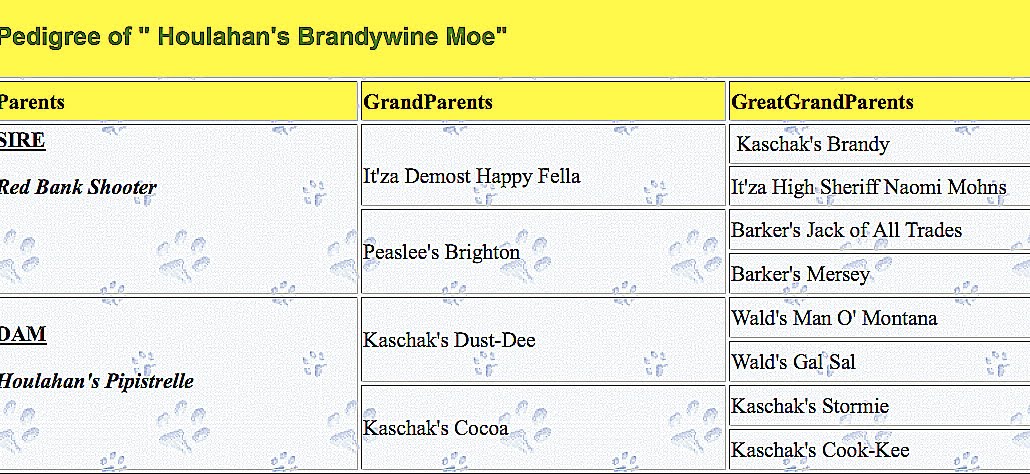
Let's start with a very simple pedigree chart:


Click to embiggen. Control-click (most browsers) to pop up a larger version in a new tab.

This is a copy of the three-generation pedigree for one of my own dogs, Moe. It is formatted by a free online dog breeders' website, but this does not matter. The pedigree is just information about the dog's ancestry, and a handwritten one on lined notebook paper would be laid out just the same and could have the same information on it. I entered the names into the form myself. The basic information that every pedigree must have (or it's not a pedigree) is the names of the animal's ancestors in a form that shows the relationships. (That counts for human animals, too.) Livestock animals might have a number rather than a name.

The pedigree reads from left to right. The name of the animal whose pedigree it is (let's call him Bubba) is either to the far left, or, as in this case, above the chart of ancestors. That saves horizontal space on the printed page. If this is a registered animal, this will usually be his or her registered name.

There will be two names in the far left column or the next column to the right if Bubba's name and info takes up the far left . The sire's (father's) name will be above, and the dam's (mother's) name will be below. The convention is always the male parent directly above the female parent. Moe's father is Shooter and his mother is Pipistrelle.

Then in the next column, you will see four names. The two above center line are the paternal grandparents -- Moe's father's father and mother. The two below center line are the maternal grandparents -- Moe's mother's father and mother.

Moe's paternal grandparents are "It'za Demost Happy Fella" and Brighton. His maternal grandparents are Dust-Dee and Cocoa.

This brings up a point that often confuses people looking at pedigrees. In many breeds the dog's registered name bears no resemblance to the name that people who know the dog will refer to him by. Often there is a kind of embedded "code" that is decipherable to insiders, including the breeder's kennel name and sly references to his ancestry. Strange spelling and punctuation is common. "It'za Demost Happy Fella" was called Chaz. I only know this because I've been told -- you can't derive it or guess it from the registered name. His owner followed the show-dog convention of using a very convoluted string of words to "name" her dog. Her kennel name was "It'za." As you can see, the owners of Moe's other ancestors followed the English shepherd owners' convention of fairly simple* registered names that are the same as, contain, or are similar to the dog's "call" name. Red Bank Shooter is called Shooter, and his owner's kennel and farm name is Red Bank. Houlahan's Pipistrelle is called Pip, and her owner is me, Heather Houlahan. My kennel and farm name is Brandywine. I didn't breed Pip, so she doesn't carry my kennel name.

In the third column, you will see eight names -- Moe's great-grandparents, all laid out so that you can see which grandparent each pair produced.

I've used a three-generation pedigree here so that it is easy to read and uncluttered.

The standard number of generations for a dog pedigree that is provided when you buy a puppy is generally five -- up to the great-great-great grandparents. That also happens to be the most extensive pedigree that can generally fit on a single sheet of paper (usually legal-sized) in readable type if you put Bubba's name above the "crane's foot"** of ancestors. Breeders who are researching their dogs' genetics will use spreadsheets or online databases to go back many more generations than can be fit on a sheet of paper. Some registries or services will sell up to an eight-generation pedigree printed on really big paper.

Now, let's get onto intermediate pedigree-reading. You can bail here if you found out what you need to know about reading a basic pedigree.

Here's a screen shot of the "top half" of Moe's five-generation pedigree as it is displayed by the English Shepherd Club Registry's database. When we talk about the "top half" of a pedigree, we mean the animal's sire's pedigree. Right now we are looking at Moe's father and his ancestors -- his mother and her ancestors are the "bottom half" of the pedigree. So we are really looking at Shooter's four-generation pedigree.

This is the "bottom half" -- Pip's four-generation pedigree.


Together they make Moe's five-generation pedigree. There are a lot of bells and whistles on this pedigree chart. You can see registration numbers, birthdates, colors, health information, owners' and breeders' names. I could configure it differently and get photos, where available, of three generations of ancestors. You won't get that level of detail on most pedigree charts from other registries, or most handwritten or home-produced pedigrees from breeders. You'll see that as you go further back in the generations, there is less information provided for each dog. This is necessary in order to fit all the names on a page.

Having a lot of information right on the pedigree chart is very useful when you don't personally know the animals. What a person or registry chooses to put on a pedigree tells you something about their priorities. This ESCR pedigree includes hip-health information, because hip dysplasia is a genetic health problem in our breed. If an owner didn't check his dog's hips or won't publish the results, that raises suspicions. If the hip information was good or bad and the owner published it, that gives important information about that dog that can help someone make buying and breeding decisions down the road. The rest of the information is mostly to help people identify the dog precisely (registration numbers) or find out more (owner and breeder information).

An AKC pedigree will include any show championships that the dogs have won. Show-ring wins are important to the AKC. The English Shepherd Club does not think that show-ring results tell us anything about the quality of the dog, so those will not ever appear on an ESCR pedigree. If a breeder is generating her own pedigree charts by hand or computer, she may include more information than a list of names; what she chooses to include may tell you about her priorities.

In order to read you will have to click to embiggen. Control-click to open in a new tab (on most browsers). But you might want to print them out on two pages and follow along.

A five-generation pedigree includes slots for sixty-two ancestors -- two in generation one, four in generation two, eight in generation three, sixteen in generation four, thirty-two in generation five.

However, it would be highly unusual for a purebred or purpose-bred dog's five generation pedigree to have sixty-two unique names in it. There will be repeats.

If a dog's name is repeated on both top and bottom of the pedigree, then Bubba is inbred on that dog.

If you look only at Moe's three-generation pedigree, at top, you would conclude that Moe is not inbred at all. All of his grandparents and great-grandparents are unique individuals, with no names repeated. His parents and grandparents were not cousins.

But if you look closely at Moe's five-generation pedigree, you will see that Kaschak's Brandy is both his paternal great-grandfather and his maternal great-great grandfather. Moe is inbred on Brandy in generations three and four. This is not very inbred by purebred dog standards.

He is also inbred on Butcher's Sam Odie, who occurs twice (top and bottom) in generation five. Again, this is pretty far back. It statistically makes Sam Odie the equivalent of a great-great grandfather, or 1/16th of Moe's genome -- 6.25%. By contrast, Moe is (statistically) 18.75% Kaschak's Brandy. Knowing something about Brandy -- his health, appearance, and behavior -- is much more likely to tell us about Moe than will knowing the same things about Sam Odie.

If a dog occurs multiple times only on the "top" (father's pedigree) or only on the "bottom" (mother's pedigree) then Bubba is not inbred on that dog -- the parent whose pedigree includes that repeat may be, but Bubba is not.

Moe's paternal great-grandmother Naomi is very inbred on Mohn's Boodie -- he is both of her grandfathers -- in other words, her parents were half-siblings. But Naomi's son Chaz (the guy with the long unpronounceable name) is not inbred on Boodie (as far as we can see from this pedigree) because his father, Kaschak's Brandy, does not have Boodie as an ancestor. Moe is not inbred on Boodie (as far as we can see from this pedigree) because Boodie does not appear in his mother's pedigree.

I hope that has been helpful information about how to read a basic pedigree chart. I've used a dog's pedigree here because that is the species I know best. An animal's detailed pedigree can be like a Russian novel for someone who is an expert in the specific breed. It takes many years of living with and learning widely about a breed of dog, horse, cow, etc. for a printed pedigree to easily give up its information that way. But a beginner can at least look at a five generation pedigree and get a sense for whether the animal was very inbred (as was Naomi) and question why. You can try to find the owners of the animal's parents and grandparents and find out more about them, such as their health and what kind of temperaments they have or had.

A pedigree can be a full of mistakes or frank lies. This is true of an official-looking printed pedigree certificate with gold-filigree borders as much as it is of a hand-scrawled pedigree on a brown paper bag. A breeder may not know that his bitch was bred by a different dog than the one he listed in the pedigree -- maybe the sneaky neighbor dog got in, or the stud dog's owner was careless in the kennel or dishonest. A breeder may lie about paternity or even maternity. Puppymillers use registration papers fraudulently, so a registry pedigree on a puppymill purchase is likely to be complete fiction. Most dog registry organizations can't or don't check the DNA for most litters, and there are even ways to get around those for the devotedly dishonest. An old mistake or lie is impossible to check. And both individuals and registries can introduce clerical errors; I have one pedigree that was produced and sold by the United Kennel Club in which a dog is listed as his own father (same registration number and all). Most pedigrees are probably mostly accurate, but it is important to note that they are just information that is reported and recorded by fallible human beings. If you can't trust the honesty or the competence of the people who provided the information, then you can't trust the pedigree to give you information about your animal.
_______________________

*Sometimes too simple. When the dog's full registered name is simply "Max," there is a high probability that there are going to be more of them. The common practice of using the owner's surname and the dog's simple name is better, but there turns out to be a bunch of Smiths, Wilsons, Thomases, Johnsons, etc. Sometimes this creates a great deal of confusion.

** The English word "pedigree" derives from Old French "pied de gru" or "crane's foot." This refers to the way the chart branches, literally looking like the foot or footprint of a bird. Pretty cool!

Friday, November 19, 2010

Twitterpated


What? Walt Disney got the biology of critters wrong? Say it ain't so!

Spring is not the season of twitterpated. At least it isn't around here.

As the plant world and the invertebrates* die or tuck themselves in for the year in the forest and farm, the local tetrapods are getting busy. Late fall is the time for making babies. When I say you can smell the sex on the air, I'm not being hyperbolic or metaphorical. I'm hoping the wind doesn't shift from the goat pasture towards the house.

Rosie is in season, which makes her pushier, snarkier, cuddlier, and generally underfoot. She harasses the eunuchs and has her way with them. Neither Moe nor Cole got the memo about their testes, so they are happy to oblige. It's hazardous to turn a corner suddenly around here -- always a little disconcerting to walk in on a couple of dogs in flagrante delicto.

I've had bitches who became uncharacteristically stupid or wacky when they came into season, and were unreliable in their work. Pip and Rosie just add energy and intensity to their already driven performances. Rose has done a bang-up job on her last two trails; her estrus is a good time to throw extra distractions and new challenges her way. Canine sublimation?

Next estrus is put up or shut up time; we'll be deciding soon whether she will be a mother.

The deer rut means that I see more of them, as caution takes a back seat to libido. Six paraded through the south pasture at dusk; I think it was five does and a buck, but there may have been two bucks. Their rubs are particularly shreddy this year.

Our new rabbit herd got off to a slow start. The first doe that my original buck bred, back in September, did not "take," though she seemed to have. It's likely that his swimmers' soup was overcooked by the summer heat. The second doe had a litter of six, around the same time that the buck sadly succumbed to (what turned out to be) a urinary blockage. I got a new unrelated young buck from a different breeder, and have just integrated him and a new doe in the colony. Within two minutes of being released, New Guy had scent marked ten places in the stall, bred one of the younger does, and gotten his ass kicked by the dominant doe. With five does in the colony, I expect an early winter population explosion.

Gollum the barn cat, fearsome slayer of mice, voles, rats and chipmunks, has taken to sleeping amongst the rabbits. No shit. He ignores the babies, which are hardly larger than a large rat, and I've spotted him nuzzling with more than one of the does. Gollum said buh-bye to his little friends at a tender age, so I don't think he's joined in any Samhain barncat orgies, but he did get into a fight recently, which for a cat is much the same thing. His face wounds healed up fine, and he kept claiming that I shoulda seen the other guy. His sister does not corroborate his account, however.


It's not just dogs who can† discriminate between "ours" and "other" without explicit instruction and control their predatory impulses accordingly.

Meanwhile, I have to remind myself that our baby chicks and turkey poults were also freaking adorable, and grew up to be delicious.

Speaking of bucks, and urine.


Jefferson the he-goat is visiting from Rachel and Stan's farm.

He's got a lovely calm temperament. Pity about his personal habits. I do everything I can not to touch him. There's burdock in his beard and on his rump, and he's just going to have to cope, because there is no way I'm combing him out. Also, I know just how far backwards he can reach; he could groom that burdock out if it was a priority for him.

His job here is to settle Patsy and Edina. Lovely term that. Knock them up.** We'll know in a couple of weeks whether he's succeeded.

He courts the ladies by applying Capraxxe body spray, waggling his tongue, blubbering, flaunting his flehmen, and -- well, now I know what inspired the odd-looking phalli on all those vases depicting Bacchanals.


The wethers swear that he's been hanging around the playground wearing a trenchcoat and talking about a lost puppy. I'm monitoring the situation.

Jefferson gave me some crap about the gate his third morning here. Cole, who is deathly afraid of the electric fence around the goat pasture and never willingly approaches it, came flying off the back porch, through the gate, and straight at the he-goat's nose. Cole doesn't think much of visiting he-goat, and he interpreted a little stroppiness as a genuine threat. And now I know what he does when he thinks I'm threatened.

Good to know.

Finally, a weirdly untimely ray of hope in our disappointing heritage turkey breeding season.

Three or four weeks ago I noticed that the Bourbon red hen who had not succeeded with a clutch this year was not coming in to roost or running with the flock. But I would sometimes spot her for a few minutes in the morning around the feed trough before she would dematerialize.

Far too late in the year to be setting a nest, but the signs were unmistakable.


I finally found her Tuesday morning, close to the barn and setting a dozen eggs. She'd already pushed out three eggs -- a good sign, actually, indicating that she was paying attention to their viability and keeping the live eggs protected -- and this nest and eggs were clean, unlike her previous nests.

It is now far too cold and snotty for her to set outside, and I lost two shrubbery-setting hens this year to a raccoon, so in she came, whether she wanted to or not. The answer was Not. A twelve-pound bird can be surprisingly strong when she Does Not Want, but in she came with her eggs to a private stall. I candled them Thursday, and found squirming embryos in seven of them. Fingers crossed. It's a ridiculous time to raise turkeys, but I cannot say no to her.


The broody hens work so hard. It breaks my heart when things don't go well for them. Such devotion demands fulfillment. The only thing harder than brooding a clutch is the hero's journey of hatching out of an egg. It's hatch or die, and if anyone takes pity and helps the little warrior, it's likely to kill or cripple him. We mammals know nothing of birth struggle.

Spring may be the time of vegetative abundance and enthusiasm, but as the death and dormancy of Winter looms, the animals flaunt their eternal optimism. Snow all you want, we'll make more.

******************

* Including the hornets, wasps and bees that make life exciting and possibly brief, and the $#@^$ stink bugs that make it annoying.

** For the dairy-animal uninformed: A goat (or cow) can produce milk for about a year after giving birth (kidding or calving), provided she is nursing offspring and/or milked regularly. To continue to get milk, the farmer must breed her every year. The onset or resumption of lactation is called freshening. She'll lactate just fine while pregnant. It's the usual practice to dry her off a couple of months before she's due again. So I'll stop milking the girls, and wean their 2010 kids, in February in preparation for April kidding.

None of this applies to the "Happy California Cows" of agribusiness fairy tales who calve and freshen, then receive hormone injections to keep them continuously lactating until their udders break down and they become hamburger. (The cows. Come to think, the udders, too, both metaphorically and probably literally.)

† Can. Can. Not necessarily will. And an absence of formal, or even conscious, training does not equate to a guidance vacuum or magical thinking.

Tuesday, September 28, 2010

Charter of Freewarren


A Note for Naysayers

Nobody, even the most avid animal-rights fanatics, needs to worry about depriving caged rabbits of their liberty. Those born in confinement don't know what liberty is; they are not deprived of anything.

Also, you will note I advise housing rabbits only in wire hutches. If you house them this way you and the rabbits will do just fine. But if you let a rabbit out, you are asking for trouble ... That goes for pet rabbits, too. The wire hutch is ideal. Keep them there, except perhaps to hold and pet them.

-- Bob Bennet, Storey's Guide to Raising Rabbits

We are now wabbit wanchers.

I'd been looking into this for some time. We raise the pastured meat chickens in the summer and fill the freezer, make a little money selling them. We hunt, and a friend is raising pigs, one of which we'll buy a whole or half-interest in. Hair sheep and perhaps a feeder steer are in the works.

In addition, I wanted to explore a fast avenue to fresh meat in the winter and year-round, something that wasn't dependent on freezer storage. And a varied diet is important for us and the dogs, yes? Americans eat way too much chicken and beef.

I am not sure whether we are okay with my devoted-to-pet-rabbit friends. I am respectful of their sensibilities. I hope we can all come to an understanding about animal welfare, and the touchy problem of pet v. livestock within a species.

I've had pet rabbits in the past. The archetypal bunny-in-a-backyard hutch as a child. A house rabbit as an adult. The latter demonstrated the range of a rabbit's social capacities, and the species' need for enrichment. I've also delivered several abandoned bunnies to house rabbit rescue folks, in the days before Pittsburgh shelters accepted them, and acquaintances who found pets dumped in the park would call the crazy animal lady to take this thing out of their bathtub.

I don't care whether it is livestock or pet, solitary living in a backyard hutch is not species appropriate.

What do all animals need? Fresh air, sunlight*, wholesome food and clean water, general hygiene, and the opportunity to move about freely.

What do rabbits need, specifically? The opportunity to dig and chew, social interaction with other rabbits, including the chance to play and groom, hidey-holes, enough space so that they don't feel driven to fight one another.

Bob Bennet can join Frank Perdue, Salmonella Jack DeCoster, this knuckle-dragging gap-toothed hick -- and the rest of the livestock abuse industry -- in kissing my shiny white ass. My rabbits are going to get what they need.

I guess I am rather broad in my definition of "need." Obviously, animals survive, grow, and reproduce without any of those things. Cattle put on weight in feedlots, hens lay while their feet have grown into the cage like a tree grows into a fence, and rabbits breed like bunnies while their hocks rub raw on wire floors. A bitch in a puppymill pumps out little lurve-objects for cuteness consumers while eating rancid food, drinking filthy water, living in solitary confinement in a cramped cage, never seeing the sun or breathing fresh air, covered in shit and shot through with parasites. Biologically speaking, hope springs eternal. A plant that is barely hanging on -- a tomato languishing in a nursery six-pack, unplanted, or a weed in a sidewalk crack -- puts everything it's got into producing a few sickly fruit and seeds. Things could get better for my descendants, so I better make sure I have some toot sweet.

99% of rabbit breeders keep their livestock / petstock in individual wire-bottomed cages. It's orderly, takes little room, easier to keep somewhat clean, and easier to control breeding. The good breeders -- the ones who care about animal welfare -- use larger cages, provide resting boards, give the does roommates when they can get along (bucks are either fighting or fucking in a cage situation), make sure the cages are high enough that the rabbits can stretch out vertically, meerkat-like, which is something rabbits really like to do.

I got my four foundation rabbits from a breeder who has a locally excellent reputation. Her cages were large, and all the animals are in good condition.

They are Californians, one of the two most common meat breeds. I asked for animals that had excellent production conformation, without regard to fancy points such as "correct" coloration. I got a buck and three does that are of good production quality and unrelated. (I also considered cross-breeding to increase hybrid vigor, and will probably do this when I start breeding this buck's daughters -- buy a New Zealand buck to breed to them.) I do like the Californians, though, because their dark points are just variable enough that I can tell individuals apart by markings, without checking ear tattoos. This will become important, as you'll see.

I'd read about colony-raising of rabbits, and am going to try it.

The Brandywine freewarren. The walls are either block or wire-covered wood. The floor is concrete covered with rubber stall mat and thickly bedded with sawdust topped with straw. There is a high window for daylight, which doesn't open, but I'll be replacing it with one that does. It took the rabbits about five days to really start digging; they now have a nice labyrinth around the bales. It took them perhaps three days to recognize fresh greens and fruit as food, and a week or so to become comfortable with the space and climb the bales a little. I haven't seen anyone binky yet, but that doesn't mean they aren't doing it when I'm not there.

Although rabbits come in quite a few breeds, and artificial selection for functional traits and fancy points has obviously worked many changes on them, I don't consider them a truly domestic animal. Demi-domesticated, like white mice, ferrets, budgerigars, and, in a rather different way, my knuckleheaded African guinea fowl. They've lived among humans for too short a time, and too peripherally for most of it. They can't be managed in flocks or herds the way chickens, goats, cattle, etc. can.

Romans used to keep colonies in leprosaria leporaria† -- stone-walled gardens or pits from which the rabbits could not tunnel -- but did not control breeding. The leporaria kept the rabbits convenient for the catching, and provided some protection from predators. They were something like a fenced Texas game-ranch set up for canned hunts, but without the repulsive conceit of "sport."**

Rabbits became "domesticated" some time in the Middle Ages. When Pope Gregory I designated laurices as fish for the purposes of Lent and other fast days, monks and others were motivated to propagate rabbits under closer husbandry.

A laurice is a fetal or newborn rabbit, eaten guts and all. A "delicacy."

Yeah, I know. Moving along ...

In early medieval England, rabbits were introduced from the Continent and managed in open colonies established by landlords who purchased charters of free-warren from the king. The charter gave the holder the right to manage and kill rabbits, hares, pheasants and partridge in specified game preserves -- warrens. Warreners were hired to protect the colonies, create artificial earths for the rabbits, and catch them (usually with ferrets and nets) for the table or sale. It took hundreds of years of protection under extensive husbandry for the Iberian rabbits to adapt well enough to the British climate and naturalize. At the same time, warreners in some places practiced some selection for fur color in their colonies, presumably by culling the common-colored animals and preserving the eye-catching sports.

I have not been able to come up with a word in English that describes animals (or plants) occupying and evolving in this limbo between managed wild game and domestic livestock. Commensal is not right. Yet it must have been a stage in the domestication of many species, though it would look different depending on the ethology of the species and the point in technological and cultural history at which it happened. No haughty monarch was presuming to grant or deny the right of freewarren when the chickens came home to roost and the sheep joined the human fold.

Neither will the modern efficiency experts who see sentient creatures as units of meatwidget production dictate the "right" way for my stock -- livestock -- to live.
____________

* Unless one is, say, a naked mole rat.
† I am not certain of this word. The OED does not verify it, but then, it's not English. My student's Latin dictionary doesn't have it, but then, it's not the O.L.D. The term later was applied to leper colonies. An erudite reader provides the correct word, see comments!
** The Romans reserved that fiction for the arena.

Friday, September 3, 2010

Photo Phriday: Don't Screw With The Broody


One of the ornery Daughters of Henery disappeared for a few weeks in late Spring.

Well good riddance, Owl Bait, I thought to myself. Her sister had just become taco filling after murdering three of our scant crop of turkey poults, and her personality had not been notably better.

Three weeks after she dematerialized, she reappeared out of the shrubberies with thirteen gorgeous chicks in tow.

She declined to take them back to the coop, and instead raised them as she had incubated them -- as wild chickens. Wild chickens that got fed corn and soybeans twice a day along with the meat birds and flock of guineas, up by the summer goat shed.

The meaties mobbed their feed troughs pretty completely, and were each quite a bit more substantial than the little half-Hamburg biddy.


But DoH's kids always got their own trough.


She may be ornery, noisy, and barely domesticated, but she raised all thirteen of her brood to full-feathered "fledging." No other hen has done so well, and with such little care. I didn't do as well with my first incubator experiment this year. She has earned tenure.

Posted by Picasa

Sunday, June 6, 2010

RIP Dale "Supersize" McNugget 4/14/09-6/6/10


Dale McNugget passed away peacefully and rather suddenly in the sunny barnyard, surrounded by her flockmates, this afternoon.

The proximal cause of death was pulmonary failure. This was secondary to what I would have called morbid obesity -- except, on necropsy, she really had very little body fat. She was just one enormous chicken.

Hybrid broiler birds are not designed by artificial selection to live long, healthy lives. Had Dale been a conventional cornish cross hen, she would have been unlikely to live four months, much less fourteen. Because she was a "freedom ranger," she was a little better equipped to live in the world. But she was still too heavy to flutter up to the roost with the other hens, spending her nights on the coop floor with the ducks and the two auxiliary Dales -- hens who escaped capture on processing day last July. She laid eggs under the nest boxes* after she became too large to fit inside one -- or rather, too large to get out once she had squeezed in. Later I installed a large covered cat litter box as a floor-level nest box for the former McNuggets.

I started limiting the plus-sized girls' access to feed a few months ago, gating them out of the coop during the day by installing a creep on the pop door that the smaller chickens could slip through, but kept the three big girls outside to forage on pasture rather than hog down layer feed. It didn't seem to make a lot of difference in their weights, but they did become more active.

Of course I'm ambivalent about the very existence of hybrid broiler chickens, let alone the lives they usually lead. That those will be short is a given; knowing this and feeling a bit guilty about it, we endeavor to eliminate nasty and brutish from the list of options. There are currently fifteen Cartmans living in a chicken tractor in the pasture; they'd have grown just fine in a stall in the barn, but a chicken should breath fresh air and eat bugs and grass. They'd also be fairly content confined to the tractor, but I open it up during the day so they can shuffle around a bit, and sack out in the tall grass along the old fenceline when they want to, and dustbathe. To the extent their genetics allows, they get to be chickens during their very short span on this earth.

There are 76 new McNuggets growing feathers in preparation for their own move out to pasture, where they'll live behind electronet at night, range free for much of the day, and have even more chicken-like and slightly longer lives.

But their genetics dictate, always, that those lives will be short. Not even an internet rabble with money in their teeth will convince me to hold back any meat birds from this years' flocks. I do not believe it is kind.

I think of the short lives of giant breed dogs, and how their hearts so often give out. The incredibly plastic canine genome can produce 200 pound dog bodies, but not the hearts to run them.

One of the two auxiliary Dales died a month or so ago; her heart was at least four times normal size.

I didn't weigh Dale after my mom found her still-warm body this afternoon. But a necropsy on a chicken is another way of saying "dressed out," with a little more haruspicy. She makes at least a dozen dog meals -- feeding five English shepherds and one hollow-legged German shepherd -- in other words, you could easily feed an English shepherd for a week on one chicken. She must have been at least sixteen pounds alive.

I took her skin, head, and intestines out to the Fox Stump at the far end of the south pasture, where we leave offerings to the vulpine neighbors in exchange for respect for our living flock. Think of it as a sky burial.

____________

* She had no fewer than eight eggs at various stages of growth queued up in her oviduct.

Wednesday, December 9, 2009

Pedigree Dogs Exposed: US


The BBC documentary Pedigree Dogs Exposed will air tomorrow -- Thursday, December 10 -- on BBC America. 8 pm Eastern, 7 pm Central.

Check now to see if your cable or satellite system carries BBC America. Set your recording implements! This is not one to miss.

I believe this may be the "international edition" mentioned by filmmaker Jemima Harrison. If so, we may see our friend Dr. John Burchard.

In Britain, the airing of this documentary elicited lawsuits, shrieks, and recriminations from the Dog Fancy and its bureaucratic superstructure.

But it also backed them into a very tight corner, and has forced reform that would have never occurred otherwise.

The US Fancy Establishment, primarily embodied in the American Kennel Club, is larger, more contaminated by the puppymill industry, and even more arrogant than the British Kennel Club.

Will they attempt reform? Or continue to circle the wagons in the face of registration revenues that have been shooting down the crapper for over a decade?

Saturday, September 19, 2009

Photo Phriday: What's Up With These Ears?

Sam had the bad luck to be bought as a young puppy and registered with the United Kennel Club as "Kapsa's Shep."  It appears that she sold a lot of his offspring, or at least, pups with his name listed as sire. He's got a great temperament and is a lovely individual.  He also has a wry jaw and absolutely atrocious teeth, and an extra set of floating ribs.  (Hint: not breeding stock in the sane world.)  He likes to carry a ball at all times, and I wonder if this isn't because it is more comfortable than closing his jaws.  At least one of his sons rescued through Operation New Beginnings seems to have inherited the jaw deformity.

He also has a split in one ear pinna.  Normally I would assume that such a feature was due to trauma, probably fighting.  But it appears we have a mystery


There are two males that we are sure are Sons of Sam.  Here is the left ear of one of them:

The other ear is the same.

The other son is fostering at my house, and has a single split in one pinna, just like Sam's.

And this bitch could well be a Sam daughter:


It was Fancy's perfectly symmetrical split pinnae that first caught my attention, on the day that Sam, Fancy, Bruno and Max (now Barry White) were all neutered.

I am convinced that it is a congenital deformity, though I've never heard of such a thing being a genetic defect in dogs.  The head vet tech working that day is just as convinced that "someone" cut the ears when these dogs were pups, in order to "mark" them.

Anyone have any ideas?

Sunday, June 21, 2009

This is What I Breed For


Portrait of the collie as a young pup.


When people ask me, why breed when there are dogs for free on Craig's list?

When someone wants to know what the point is of working so hard to conserve working drives and temperament.

When someone questions my sanity for jumping on an airplane and flying across the country, then driving over the Cascades in the fog and into the high desert, so that Pip could meet the exact stud dog I wanted.

This is why.


Pictured above: Young Audie, when his name was Andy. Janeen's dog, just biding time at my house where he happened to be born, waiting for me to get around to taking him home.

Thursday, June 4, 2009

Dog Breeding: Yer Doin' It Rite

Scanning the wasteland for the fabled Good Breeder

All right, I rail against puppy mills pretty regularly here. My regular readers are the choir; I really count on the Googles delivering some Easter Christians to hear the message, if only so briefly, else it would be wasted keystrokes.

And I do go on about vanity breeding for the show ring, closed gene pools, and the "dog fancy" in all its would-be-laughable-but-for-the-pain-it-causes naval-gazing excess.

Then there's the calling to task of "rescue" organizations, "humane societies," and advocacy groups that clearly have something else in mind besides the actual welfare of actual animals.

Don't get me started on trainers who can't train, and "behaviorists" who wouldn't know a "behavior" if it bit 'em in the ass. (Not a metaphor when speaking of dogs.)

OMG, I hate everybody.

Help me out of the funk.

Well, not quite true.

At last week's NADOI annual meeting, I found myself in the curious position of advocating for two different young dogs' testicles. Two very different dogs, very different breeds. Nicely put-together animals with temperaments to die for, from breeds where temperaments are rarely what one would wish to see.

Those dogs were not accidents. They were the products of breeding decisions that did not sacrifice soundness or temperament to other values.

I'd like to feature dog breeders who are doing it right. Give the interwebz some examples of the different ways individuals are holding up high standards in a breeding program.

Tell me about breeders you know -- friends, colleagues, your dog's breeder -- who are conscientiously producing sound, healthy dogs with temperaments appropriate to their breed and function. Who uphold high standards of animal welfare, including for animals not their own. Who show their concern for the families and communities where their pups will live. Who have big-picture attitudes towards their breeds' gene pools. Who stand by their dogs.

Any breed, except my breed, English shepherds. Or any crossbreed -- I'd be especially interested in thoughtful "out of the box" crossbreeders. Working dogs, hunting dogs, purely companion dogs.

I'd like to be able to interview the breeder, other breeders who know him or her, and puppy buyers.

And it can't be someone I already know.

Nominations are open! Use the comments section to provide the information that gets me started. Make sure I can contact you privately with followup questions.

Monday, May 18, 2009

Three Hybrids

Heterosis is the term for what we laymen usually call "hybrid vigor."

In brief, it's the generalized positive effect on growth, healthy, longevity, fertility, immunity and general thriftiness that one sees in an animal or plant whose parents were unrelated. It is the effect of the animal being heterozygous for most of the variable alleles in its genome; this is a general effect, and not the same as just "avoiding deleterious recessives" by the practice of inbreed and purge.

Despite the protestations of ornamental animal breeders seeking that perfect feather crest or flawless dime-sized spots, the biological reality of heterosis is not in question. Those who scoff at it -- I knew a mutt that died at age five of cancer! -- are in the company of those who disbelieve the biological reality of evolution via natural selection because those wicked scientists are always arguing with each other, so obviously they don't really agree except when they are feeding us Good Christians into the maw of the savage Darwin.

In fact, a robust manipulation of heterosis is the basis for almost all modern industrial agriculture.

Now, an ordinary animal breeder* can utilize the power of heterosis in both purebred populations and in crossbreeding. The least troublesome way (to registries and others who fret about purity) is to simply select breeding partners that are less related than the average within the "pure" registered population. Another way, sanctioned by many livestock registries, is to "grade up" mixed breed herds by utilizing purebred sires for a number of generations (3-7, depending on the breed/species), after which the youngest generation is considered "purebred." Yet another way is to simply crossbreed, selecting for production characteristics and ignoring fancy points.

When you are eating a steak, do you really care whether the steer it came from had a white face or was all black?

Virtually no dog registries have actual grading up programs**, and it is anathema to the kennel clubs that exist to perpetuate dog pageants. But the recent lemming-run popularity of "designer breeds" and the historic practice of crossing for performance (e.g. for lurchers or Alaska huskies for race teams) are both, in part, attempts to capitalize on heterosis.

On an industrial scale, the use of heterosis is much more sophisticated.

Highly inbred parent strains of animals are closely-guarded and coddled corporate assets. In poultry, male strains (all females born are culled) and female strains (converse) are crossed to produce the production animals. Production animals generally have truly impressive economies; they will not breed true, so the farmer must continue to pay the corporate overlords for grow-out stock. And because of the extreme selection practiced on the parent strains, the effects of heterosis are more targetted than that provided by Nature when two normal unrelated animals reproduce.

Here are three hybrid birds, on their four-week birthday:


They were all hatched within a day of one another, and are all commercially-bred from highly selected parent strains. They are all representative of their respective genetics, brooded together, and all well-fed.

The chick at left is a golden comet pullet. The golden comet is a hybrid cross specialized for egg-laying. It is one of the varieties known as a "sex-link," which has the great virtue of segregating by color along gender lines. It is easy to tell the cockerels from the pullets among newly-hatched chicks -- females hatch out a reddish tint, males like yellow marshmallow peeps. They are a cross of silver-factored white rock hens and New Hampshire red roosters, and are produced mostly for the private small flock owner.

If I wanted to breed my own golden comets, I could lay my hands on the purebred parent stock of the appropriate breeds and start makin' em. Comets have normal lifespans, normal immune response, normal growth rates, high egg production, early maturity, and hardiness.

The chick in the center is one of the 100+ colored range broilers, or "Freedom Rangers," that I'm raising for meat this year. I know virtually nothing about the parent strains, which would certainly qualify as commercial, without perhaps crossing the threshold into "industrial." These birds are engineered for medium-fast growth (slaughter weight in 9-12 weeks), good feed-conversion rations, and the ability to thrive when raised on pasture -- outdoors, unheated, uncooled, and with natural green things as a major part of their diet.

Some people keep a few of these hybrids past the normal slaughter age, adding them to their regular backyard flocks of laying hens and hobby birds. And they do fine. They live normal lifespans, and the hens are decent layers of very large eggs.

I did not weigh the chicks, but the range broiler is easily twice the body mass of the same age golden comet. Today we had one of the range broilers die in a freak neck-snapping accident, and we heard the commotion and found him right after he died. I dressed him out to eat. Whole -- with blood, feathers, head, feet and corn-stuffed innards -- he weighed 2 pounds, 4 ounces at 4 1/2 weeks. Dressed, 1 pound 6 ounces, which is exactly the weight of a supermarket "cornish game hen." A small meal for two people, but a meal. One of the comets wouldn't even be a mouthful.

The chick on the right is a Cornish x white rock industrial broiler. Every chicken you buy in a grocery store is one of these. I got four of them at the feed store in order to compare them to the range broilers. These are generally called Cornish crosses, or just Cornish x.

The front view photo doesn't really fairly portray the difference in size between the ranger and the Cornish x. The ranger is very slightly forward of the Cornish, which skews the perspective, and he's also standing up straight, so he looks bigger. But here's a top view of the same three chicks:


All four of the Cornish x chicks are named, but they all have the same name: Eric Cartman. Ken thinks they have passed the "big-boned" stage long since, and are now Chickie-the-Hut.

The naked parts are not because he's got some horrible feather-loss disease or parasites or is being picked. None of the above. His feathers are just fine -- it's just that he's growing so fast, they can't come in fast enough to cover him. You'd think he'd want a little chicken sweater, but in fact, he's often too warm in a stall that is cool for the other chicks. The Cartmans feel like squishy oversized hot potatoes when I pick them up. At the county fairs in late summer, one can often see the regular chickens, including large and very fluffy ones, looking perfectly comfortable, while the Cornish x entered in the 4H "meat pen" competition are nearly expiring from the heat.

He's at least 2/3 larger than the range broiler chick, has possibly three times as much flesh in his breast, and check out those feet. Notice that in the top view he is lying down. It was the very devil to get him to stand for the front view photo. Despite having feet and legs like Greek pillars, Cornish x have a hard time standing much, and do a lot of lying around.

A "Cornish game hen" is nothing other than this bird, slaughtered at this age.

This bird is designed to live 6-9 weeks. There is a decent probability that he could drop dead of congestive heart failure before reaching that milestone. Or he could "go off his feet" and be unable to lift his own weight, making it necessary to cull him. To slow down the growth a little, I follow the common practice of restricting feed from the Cartmans; at night, these four little piggies go into a dog crate, where they are kept away from the food for 12 hours. (It was the door of this crate that killed the range broiler today; I've fixed the issue.) If you don't restrict feed when raising Cornish x, you are much more likely to have a lot of birds go DRT before their time. The woman I bought my goats from had two Cornish chicks that she was restricting even more drastically, feeding only twice a day; they looked like real chickens to me. Their feathers nearly covered their whole bodies.

If someone keeps a Cornish x past about 11-12 weeks of age, the probability that it will go off its feet or go spurs up for no apparent reason in the next couple months approaches 100. If the bird doesn't actually die that soon, it will suffer quite a bit from the imbalance between its body mass and its skeleton and circulatory system. This is the messy fate of too many Easter chicks -- Cornish x are cheap to buy, and are cute, fat, and yellow as day-old peeps.

This chick is the offspring of a male from a closely-guarded, highly inbred proprietary sire strain, and a female from a different, closely-guarded, highly inbred proprietary dam strain. These strains are quite different from the Cornish and Plymouth Rock breed chickens that are available to regular farmers and hobbyists. The breeding stock do not gain weight the way the hybrid offspring do, but they still must be kept under a regimen of severe feed restriction if they are to be kept alive long enough to breed.

Farmers who produce chickens for roasting and broiling buy Cornish x chicks from enormous hatcheries. If a farmer raises a standard breed or a DIY hybrid instead of buying Cornish x, she'll be at a significant competitive disadvantage, as they will take much longer to grow to a smaller size eating more feed. There's no practical way to create one's own hybrids on a small scale. Their ubiquity is an unstoppable economic force; they are the Microsoft of feathers.

As grotesque as the Cartmans are, and as much as I loathe the industrial "proprietary" nature of their origins, I do see the point in a bird that goes from egg to freezer in only two months. The labor savings of such a bird are significant. And their feed-conversion ratio is nothing short of astounding, with industrially-raised birds turning 2.5 pounds of feed into a pound of flesh. I could certainly see raising a batch of them in the Fall, say, in some short nook of time before weather got bad and we just needed some more chicken in the freezer. But I'd feel guilty about them; not about slaughtering them, but about keeping them alive.

I'm fascinated with these three ways of exploiting heterosis. But the Cornish cross chickens show that it's not an unalloyed blessing for the animal. A "random" mutt -- meaning, a mutt whose parents practiced selection for themselves -- of any species is more likely to be vigorous, long-lived, fertile, disease-resistant, and cancer-free than is an inbred individual of the same species. But human selection for extremes, and human selection for traits that are burdensome or frankly cruel to the animal born with them is not limited to the deranged inbreed and purify practices of fancy breeders. In the hands of those who view animals as widgets, not beings, a fanatically controlled and organized hybridization program presents the same assaults on the welfare of the "genetic material."

*Plants are more complicated to view as a group, since the option of self-pollination in some species and the wide variability of different species in re heterosis makes generalizations almost invariably invalid. But suffice it to say that there is no benefit to you, the home gardener or consumer, or to the planet, from planting or eating a hybrid tomato -- just plenty of benefit to the industrial seed company. Corn, different story. Fruits, whole 'nother ball of wax.

** The ESCR's "Step-In" program is close, but it is explicitly limited in scope to animals considered "purebred" English shepherds, but from unregistered bloodlines. In a former age, the found of one of the commercial registries that served ES, the Animal Research Foundation, had a program to mix in various other breeds -- including Beauceron and curs --to engineer a dog for his own purposes. The descendants of these mixes are inextricable in the English shepherd gene pool.

Saturday, April 18, 2009

You Can't Eat Dale

I will pass through all thy flock to day, removing from thence all the speckled and spotted cattle, and all the brown cattle among the sheep, and the spotted and speckled among the goats: and of such shall be my hire.

Genesis 30:32

I know why we have animals that look like this:

Evil-ass tiger at Doc Shepard's place. Does not validate Belyaev's results. This cat scared the crap out of me.


And this:

Mandelbrot goat. No kidding.

A lot has been made of the Belyaev experiments, and how spotting and neotenic features are genetically and biochemically linked to tame behavior. Sure. Fascinating. One of my favorite things that I ever learned about. But there's another route to piebald. Because we monkey-folk, visual foragers in the deepest recesses of our brains, absolutely fixate on one of these things that's doin' it's own thing...

So, my broiler chicks came in the mail Friday morning.

I picked them up at the PO and moved them into the Green Giant potato box in the basement. (Shout out to my homie Ray, who scored me these boxes from his store. Best brooders ever.)


Most chickens raised for meat are industrial hybrid crosses of proprietary inbred parent strains, mutant half-naked obese Frankenchickies that grow to slaughter size in only six weeks, and spontaneously drop dead shortly after that point, if they have managed to stay alive and up on their bloated feet that long.

They look like this:


And mostly what they do, besides grow like mung beans and look for a comfortable place to die, is eat and shit and stink.

After seeing these pathetic creatures at the county fair (4H meat pen class) for years, and reading the descriptions of what it's like to raise them from posters on the Backyard Chickens forum, I really did not want to go there. I'd be embarrassed to have anyone see them on my farm. I'd be ashamed to look at them myself.

But, you know, we don't just like chickens -- we like chicken. Tastes like chicken, it does.

At the recommendation of several posters on Backyard Chickens, we got these.

The colored range broilers, aka "freedom rangers," are also F1 hybrids, and are arguably "industrial," in that the parent strains are not generally available for producers to breed their own. But instead of being selected and "designed" to gain weight at unnatural speeds while protected from the elements and constantly fed, they are selected to grow about half as fast, to forage for themselves on pasture and display normal chicken behavior, all while keeping about the same feed-conversion ratio as the industrial birds.

They are the same varieties used to grow premium label rouge poultry in France.

I expect them to be delicious.

Back to domestication, and spotty critters. These guys come in several color morphs -- most of them will be mostly red or yellow feathered, a few will have other colors and patterns. Like many hybrids, they may not resemble either parent. I don't know. I haven't actually seen pictures of the parent strains.

I settled the McNuggets into their brooder, and several hours later my mother went down to visit them.

Overheard her alternately cooing over the box of chicks and arguing on the phone with my brother:

Oh no, these are egg-laying chickens, not eating chickens.

Uh, Mom, these are our meat birds. What would I do with 100 laying hens?

Oh no! I already started naming them! You can't eat Dale!


Here's Dale sticking out of the crowd:


Most of the chicks are a fairly uniform yellow or orange. A few have some indistinct darker markings. One has a smudgy dark face, thus named Pigpen. Only Dale has very distinct chipmunk markings. He, or she, stands out in the mass of 100. It's easy to convince oneself that Dale has more personality than the other 99 chicks, more expression, more intelligence.

He gets picked up more often than the other chicks, so unless he has a more flighty-than-average temperament, he's more likely to be friendly and tame.

If one of the plain yellow chicks actually had some unique and charming behavior, how would we know? Is it the same chick every time, or just something that the yellow chicks occasionally do?

So originally, it worked the other way 'round. The mutant yellow chick in the brood of chipmunk-striped ones that grew into a distinctive white or red hen. The puppy with some white on his chest amid the wolf-sable littermates. The calf with the star on her forehead. All got favored treatment for the mere fact that they stuck out of the crowd. Got named Spot or Goldie.

And then got to live long enough to have babies. Because you can't eat Dale.

Other predators notice difference, flash, spots too. That's probably why an owl took my "lilac" (silver-grey) guinea cock and left the natural-colored "pearl" cock. The lilac bird fairly glowed in the moonlight.

Humans started preserving the flashy animals when we domesticated them, and weren't just aiming our spears at the funny-looking one. We had to be in a position to protect them from other predators, too, a struggle that continues to be more difficult with flashy domesticants.

A species' natural coloring is natural because it works. A domesticated species' unnatural coloring also works, because the guys providing the food and protection fixate on it.

Nevertheless, we will most likely eat Dale.