Friday, December 4, 2009

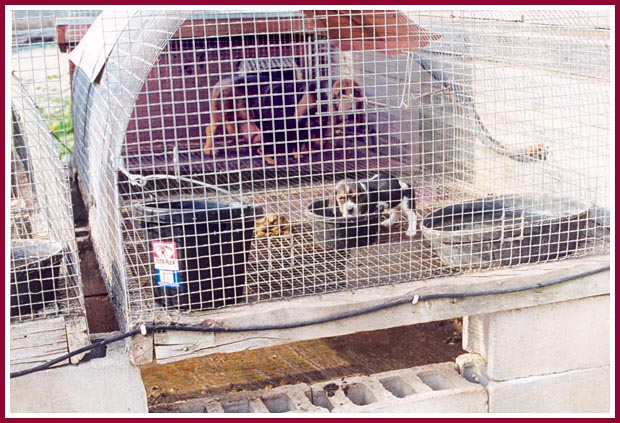
Photo Phriday: Mount Jasmine


There are some benefits to being under emerald ash borer quarantine.

Arborists, township road crews, and the utility company guys who turn street trees into hideous Suessian lollipops are not allowed to move wood chips very far. It can be challenging for a tree guy to find a legal place to dump a truckload of what I consider primo hardwood mulch.

The foster kennel is already mulched inside, but the outside run, which was originally turf, was starting to edge towards mucky.

So a while back, when I saw the big orange Asplundh truck parked outside a local mechanic's shop, I nipped in to see if the tree guy was there.

He wasn't, but the shop belongs to Professor Chaos' assistant fire chief (because, small town, if you haven't already got that). Neil said he'd mention it to the guy, and I put a note on his window with a map and phone number.

About a week later, this enormous truck just appeared. It could not have taken on even one more wafer-thin mint of a woodchip.

I opened up the side of the run of the foster kennel, and the guys dumped all the chips in.

Trouble is, I pulled an intercostal muscle last week, and what I certainly cannot do is rake. Or fork. Or be useful in any way.

My cunning plan is to lock up Jasmine and Cole for a few hours of puppy romping at a time, and get them to distribute the pile.

So far they seem willing and energetic, but are not making much headway.


Barry White isn't bothered by it, but doesn't see much point in the kidnicks' because it is there philosophy.

Wednesday night when I went out to bring Jasmine and Barry White inside for the night, she was curled up in a ball on top, fast asleep.

Thursday, December 3, 2009

Polishing the Turd that is Cranberry

Professor Chaos has the cover story in this week's Pittsburgh City Paper.

I don't care how purty a developer talks about "greenways."

When I see a man with a tripod and a theodolite at the edge of my hayfield, I find the key to the gun safe.

My last day on the Graham farm in Cranberry was a day or so after I returned from my Houlie Puppyseed trip to the upper Midwest. I dropped off one foster dog and delivered two puppies to their new owners. Then I came home.

It was also only a few weeks after the death of Mel, which has left a jagged hole in the universe that will never heal over.

I took Pip, Moe, Rosie and Sophia for a walk. Since Rosie was a wee tot, I drove to the coffin plant rather than walk them all up the street and across Rochester Road.

We set down our usual path into the woods, where a few weeks before I'd taken Rosie and all her siblings on a Puppy Outward Bound Adventure.


And then, quite abruptly, there was no woods. No path. Nothing.

A moonscape.

In the distance, a mountain of wood chips.

And a machine into which trees disappeared and wood chips shat forth.

Another jagged hole in the universe.

I pulled out my phone and called Professor Chaos. Between sobs I told him that we needed to start looking for land. Somewhere else. Right now.

Lassie of Borg

H/T to Smartdogs for the most addictive timesuck of all, Paleo-Future.

Just reinforces my perennial pique.

Where is my damned jetpack!?


Why is there no cheerful robot cooking my dinner?

How come no monorail?


And how did past futureologists envision 21st century "pets?"

LONDON (UPI) -- The programming of family pets to perform various tasks and various deeds, good or evil as required, may be fairly common practice by the year 2000, according to an American psychologist.

Dr. Boris Levinson of Touro College in New York, a specialist on relationships between people and animals, said that by the end of the century pets controlled by brain electrodes may become commonplace. Recent experiments make this a strong probability, he said.

"it does not lie in the realm of science fiction," Dr. Levinson told a symposium organized by the British Small Animals' Veterinary Association. "In a sense the electrodes will make the animals become living robots. They will be able to open doors, close windows, adjust beds and even call for help."

He said pets could even be used for warfare and for espionage and if the knowledge of genetic engineering involved fell into the hands of insurgent groups they could be employed in bombings and in plane hijackings. Criminals might use them in the commission of theft, robbery and even murder.

But he said most pets would play a highly beneficial role in society -- "a very important safety valve in a sick society" -- as specially trained companions to invalids, old people, childless couples and even astronauts.

Dr. Levinson's remarks brought quick reactions in this nation of animal lovers. A spokesman for the Royal Society for the Prevention of Cruelty to Animals and other animal lovers described "exploitation" of pets as reprehensible.

Dr. Levinson pointed out that dogs had been used as living bombs in the Russo-German fighting in World War II an he was stating the possibilities.

"We can already implant minute electrodes into animals' brains to make them placid, angry or to stop them attacking," he said. "It is only a matter of time before electrodes can be implanted into every part of the brain to make them do whatever we wish."


Putting aside Dr. Levinson's muddy conflations of remote-control with "training," animal with "pet," and brain implants with genetic engineering, this 35 year-old prognostication raises interesting questions.

Dogs and helper monkeys already perform all the services Dr. Levinson predicts, and much more.

They can do this because of training, not electrode implants.

The BNW of remote-controlled pets has not come to pass, and I don't see any sign of it on the horizon.

There is nothing new under the sun when it comes to the principles of training animals. There are new tools. Not the same thing. Everything you or I have ever done to train a dog or another animal to do any given thing has been done before, and was probably done before the invention of agriculture. We're continually rediscovering and rearranging old knowledge for our current needs. Those with an inferiority complex invent new jargon so as to seem original.

But brain implants that directly controlled motor functions would be entirely new.

If it was available, if it worked, would you do it?

Would you have your dog wired?

What needs, human or canine, could induce you to do so?

What if the electrodes simply delivered stimulation to the pain or pleasure centers of the dog's brain -- so that we are, however tenuously, back in the realm of "training?"

Would you deliver a remote punishment to the dog's brain?

What about a remote reward?

If you see a difference, what is it?


borg dog sez  you will be assimilated
see more dog and puppy pictures

Friday, November 27, 2009

Kick Me

The turkeys have been bullying Sophia.


She's the largest dog here. She's the only one who has ever seriously injured another animal. (Forgot about all those murdered groundhogs for a minute there ...) Her people routinely take down bad guys, both for fun and for real. Yet the birds see a giant "Kick Me" sign on her ass.

Last week they got her cornered on the front porch; we looked out to see her cowering against the door, hackled from occiput to tail-tip, growling and snapping. The birds were not impressed. We had to let Rosie out to serve them, as she does in this clip.

Yet tiny Rosie, and even tinier Cole, easily drive or gather the turkeys, put them up in their coop, and generally keep order in the flock. The turkeys don't even think about giving any crap to any of the English shepherds. Notice the space they give Pip and Rosie in the clip.

At the moment they are cooped most of the time -- not for stalking the German shepherd, but for their serial acts of vandalism and hooliganism up in the village.

The neighbors didn't tell me about the "visits" -- or the turkey crap on their Weber grills, broken porch tchotchkes, stolen pet food -- until they'd been at it a week and developed a habit. When my neighbor came to tell me about the attempted theft of his Christmas lights, Rosie, Cole and I had to drive them home from over half a kilometer away.

This a long way to chase a dozen turkeys.

Now I only let them out for about an hour before bedtime, when I can keep an eye on them.

Photo Phriday: Whew -- that was close

The turkeys are all still with us. Proof:


Dale thrives. She is so fat she cannot cluck (she grunts) and I periodically have to extract her when she gets stuck in a regular-sized nest box. As the slowest hen, she became a "favorite" of the adolescent former cross-dressing, gang-raping roosters. Roosters don't mind fat chicks.


What, you say something is wrong here?


"You know, there are certain days that remind me of why I ran for this office -- and then, there are moments like this, where I pardon a turkey and send it to Disneyland."
-- Barack Obama

Sunday, November 22, 2009

Blog Remix: Gaiting Away from Omelas


With a clamor of bells that set the swallows soaring, the Festival of Summer came to the city Omelas, bright-towered by the sea. The rigging of the boats in harbor sparkled with flags. In the streets between houses with red roofs and painted walls, between old moss-grown gardens and under avenues of trees, past great parks and public buildings, processions moved. Some were decorous: old people in long stiff robes of mauve and grey, grave master workmen, quiet, merry women carrying their babies and chatting as they walked. In other streets the music beat faster, a shimmering of gong and tambourine, and the people went dancing, the procession was a dance. Children dodged in and out, their high calls rising like the swallows' crossing flights over the music and the singing.

The room is about three paces long and two wide: a mere broom closet or disused tool room. In the room a child is sitting. It could be a boy or a girl. It looks about six, but actually is nearly ten. It is feeble-minded. Perhaps it was born defective, or perhaps it has become imbecile through fear, malnutrition, and neglect. It picks its nose and occasionally fumbles vaguely with its toes or genitals, as it sits hunched in the corner farthest from the bucket and the two mops. It is afraid of the mops. It finds them horrible. It shuts its eyes, but it knows the mops are still standing there; and the door is locked; and nobody will come. The door is always locked; and nobody ever comes, except that sometimes--the child has no understanding of time or interval--sometimes the door rattles terribly and opens, and a person, or several people, are there. One of them may come in and kick the child to make it stand up. The others never come close, but peer in at it with frightened, disgusted eyes. The food bowl and the water jug are hastily filled, the door is locked, the eyes disappear.


These people go out into the street, and walk down the street alone. They keep walking, and walk straight out of the city of Omelas, through the beautiful gates. They keep walking across the farmlands of Omelas. Each one goes alone, youth or girl, man or woman. Night falls; the traveler must pass down village streets, between the houses with yellow-lit windows, and on out into the darkness of the fields. Each alone, they go west or north, towards the mountains. They go on. They leave Omelas, they walk ahead into the darkness, and they do not come back. The place they go towards is a place even less imaginable to most of us than the city of happiness. I cannot describe it at all. It is possible that it does not exist. But they seem to know where they are going, the ones who walk away from Omelas.

Friday, November 13, 2009

Photo Phriday: Quaaaaak!


No ducks were harmed in the gang-creaming of this German shepherd.